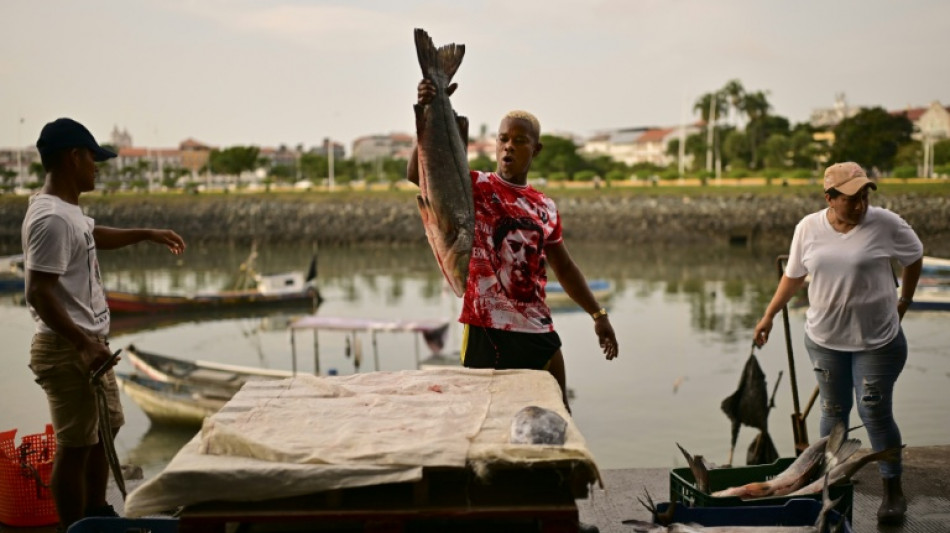
Empty nets in Latin America as fish flee El Nino / Photo: MARTIN BERNETTI - AFP
 'Devastating' waves leave California beach homes on brink of collapse

 Meta says its new AI models on par with OpenAI, Anthropic

 Talarico rejects mental health conspiracy theory after return from flu
 Brazil presidential candidate Flavio Bolsonaro to visit jailed father

 Brazil's patron saint reappears in polarized election campaign

 US Open champ Zverev to become tennis world number one

 Migrant crisis wounds unhealed in Ceuta as Spanish royals visit

 Brazilian judge allows Flavio Bolsonaro to visit jailed father

 France braces for fresh student demonstrations as Macron calls for 'respect'

 Zelensky doubtful on Russian acceptance of Trump's 'energy ceasefire'

 Federal agents search home of Trump critic Ilhan Omar: government

 Pakistan detains hundreds from ex-PM Khan's party as protests falter

 Australia's Smith off field after being struck on helmet

 UK retains early access to test latest US AI models

 Top NATO commander warns Russia any attack would be 'futile'

 Stolen Renoir paintings found behind wall in France: prosecutor

 UNHCR sounds alarm on funding crisis

 French supermarket chains say cyberattack forced refrigerator shutdown
 Minister's resignation rocks German coalition

 Hurricane Simon lashes Mexico's Pacific coast, threatens landfall

 France schools protest rumbles on as Macron urges 'respect'

 Americans Hall and Woodford win economics Nobel for stabilisation models

 MEXC Brings AI, TradFi and the Future of Trading to Life at TOKEN2049 Singapore

 Italian rice farmer beats heat with biodiversity haven

 Stocks mixed as oil prices slip after Trump hails 'energy ceasefire'

Fishermen along Latin America's Pacific coast are reeling in half-empty nets as ocean warming aggravated by El Nino causes tuna, anchovies and other top catches to migrate to cooler waters.
From Ecuador and Peru in South America, to Panama and Guatemala in Central America, some skippers have stopped going out altogether as fish stocks dwindle close to shore, in seas running at up to six degrees Celsius above normal.
"The water is warm," Juan Ollague, 56, told AFP in the southwestern Ecuadoran port of Santa Rosa where hundreds of idle fishing boats are crammed into a small port.
After a night on the water, Ollague returns with just six small tuna.
"We came away empty-handed," he lamented.
"Fishing used to be good, now it's terrible," fellow skipper Darwin Zambrano, 53, complained as he untangled a net that hasn't scooped up big tuna like albacore or bonito in weeks.
El Nino is the warming phase of a natural cycle in the tropical Pacific that causes hotter and drier conditions in some places, and cooler and wetter in others.
This year's "super" El Nino, which is expected to peak later this year, is already wreaking havoc in Central America, where drought is endangering animals and stunting crops.
The average sea surface temperature, excluding polar regions, reached 21.07C in August, tying with March 2024 as the hottest on record, according to the European Union's Copernicus climage change observatory.
The average sea temperatures off Ecuador's coast rose by 2.5-3C at the surface and up to 6C at a depth of 40 meters in the past ten weeks, said oceanographer Jonathan Cedeno, who led a mission from Guayaquil's Polytechnic University to measure the temperatures.
- 'Losing money' -
On Panama's Pacific coast, Rigoberto Gonzalez said he has to sail further and further from shore to earn a living.
This means spending more on food, ice to preserve the fish, and fuel for the small boat he uses to catch snapper, kingfish and barracuda.
"We go out with $100 worth of gas, and when we come back, we earn $150" from sales of the fish, which has to be divided among four workers, Gonzalez, 59, told AFP, on Veracruz beach.
In nearby Panama City, some fishermen have thrown in the towel and decided to remain in port.
"We can't keep losing money," Jesus Morales, leader of the artisanal fishermen's union of Panama, said.
Further north, in Iztapa, Guatemala, 50-year-old Eliseo Ovando said it now takes three days to catch what he used to pull from the water in a day, and complains that only commercial fisheries receive government assistance to ride out the shortages.
"The big fish eat the little ones," he said, referring to the struggles of small-scale operators like himself.
In Peru, the world's biggest catcher of anchovies, fishermen are turning to construction to feed their families as their tiny prey slips out of reach.
- Economic ripple effect -
In Panama City, the poor yields are visible at a wholesale fish market next to the dock that supplies the city's supermarkets.
"Less is arriving" off the boats, says Carlos Nieto, a 46-year-old vendor. And sometimes the catch is "damaged by the heat," he said.
Nieto now spends about $600 a month on ice, "practically a whole salary."
For now, vendors in Panama haven't passed on their higher costs and reduced income to consumers in the form of significantly higher prices.
But in Ecuador, the world's second-largest tuna producer after Thailand, the prices of mahi-mahi (also known as dorado) and swordfish have doubled due to the shortage, according to the industry.
In Santa Rosa, the sea's dwindling bounty has a knock-on effect, leading to the temporary closure of food stalls along the port.
Francisco Orlando, who earns a living filleting fish, is worried that he could soon be out of a job.
"We're hoping they (fishermen) catch fish," the 37-year-old explained as he sharpened his knives to separate the bones from the meat.
"If they do, we work. If they don't, we don't."
M.Fischer--AMWN