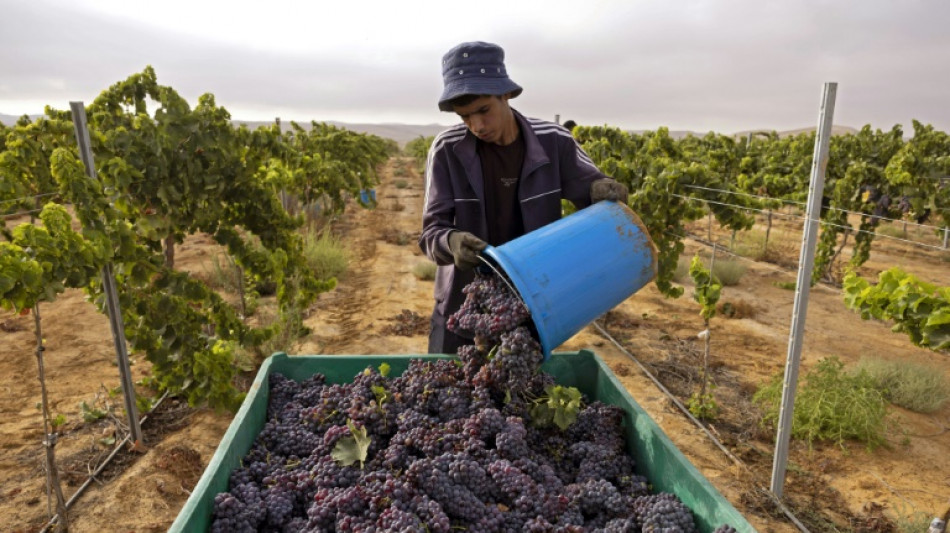
Negev desert winemakers show way ahead in Israel's hot climate / Photo: MENAHEM KAHANA - AFP
 'A day for French badminton' as Lanier triumph gives them golden double at world champs

 Kane voted German footballer of the year

 'New season, new trim': Man City star Haaland chops off flowing locks

 Lanier clinches badminton world title in France's golden double

 After Wildberries, Ukraine launches drone campaign on Russia's Ozon

 Padikkal, Gill half-centuries take India to 187-3 at tea

 Cummins hails 'sharp' Australia as they get back to winning ways
 Bangladesh eye more Australia Tests to hit next level

 Thousands expected at Sweden climate demo as election looms

 Starc heroics put Australia on brink of victory over Bangladesh

 Austrian mountain town finds niche in AI boom

 Messi scores but Miami slump continues with loss to Toronto

 Sydney marathon unveils medal with wrong stadium

 Macron hosts Saudi's MBS for visit ranging from esports to Mideast

 Australia in control with 146-run first innings lead over Bangladesh

 World No. 3 Pegula beats defending champ Swiatek to reach Cincy final

 Wyndham Clark surges clear at BMW Championship

 Maresca says Man City must fill Rodri void after Barca switch

 Canada retaliates as trade war with US escalates

 Fils dominates Cobolli to book Cincinnati final

 Spurs lacked fight in dismal defeat at Brentford says De Zerbi

 Inter thrash Monza to launch Serie A title defence

 Shambolic Spurs battered by Brentford

 Pogacar wins Vuelta a Espana opening stage

 Clinical New Zealand shock wasteful South Africa in first Test

In Israel's Negev desert, winemakers are sharing their knowledge of growing vines in the blistering heat with European producers also facing fierce temperatures this summer.
Walking between rows of ripe grapes growing from the scorched land, David Pinto enthuses about how his vineyard has come of age in the past three years.
"We're masters of the conditions, without depending on the whims of the weather," said Pinto, whose estate near the town of Yeruham carries his name.
With nearly year-round sunshine and little rain in the barren Negev, Pinto has adopted a micro-irrigation system to conserve resources and drip water slowly onto the vines.
Such techniques may soon need to be used across the Mediterranean region, with winemakers in France forced to start picking earlier than usual due to an exceptionally dry and hot summer.
"Winemakers from Bordeaux came to visit us following the heatwave in France," said Pinto, who advised his guests on ways to adapt to climate changes.
"Now we share the same challenges, with the extreme climate and the dryness that harms the grapes," he added, while workers plucked grapes in the early morning light.
Israel's greener north has long been the centre of its viniculture, but more pioneering winemakers are discovering its sun-baked south.
Pinto, whose wines sell for 89 shekels ($26), is one of more than 25 wineries now dotted across the desert landscape.
They include Ramat Negev, adjacent to the Egyptian border, and Nana, located near the vast crater-like formation of Makhtesh Ramon.
- Enduring extreme heat -
Ilan Abitbol, who advises various Israeli winemakers, is busy creating a variety of blends on a small plot of land.
"The temperature of the Negev gives a particular identity to the region's wines: more dry, stronger in alcohol," he said.
Pinto's Malbec, for example, brings a weighty 14.5 percent alcohol volume to the table.
"We're used to extreme temperatures, whereas in Europe, the climatic changes have an impact on the vines, because they're not used to these temperatures," said Abitbol.
For Yaakov Oriya, Pinto's winemaker, there are unique opportunities in a desert region, where wine has been produced for centuries since Byzantine times.
"When you're faced with a different land like this, you can create different wines," he said, including dessert and sparkling varieties.
"We're not the first to make wine in this region but making the desert bloom remains a wonderful objective," said Oriya.
On the Pinto estate, where sturdy olive and argan trees also grow, the family is expecting to produce 55,000 bottles this season.
Beyond their own commercial gains, Jimmy Pinto, David's father, said the wine industry can boost the wider economy in the sparsely-populated desert.
"Creating a winery here in Yeruham contributes to our efforts to develop the region," he said.
Jimmy Pinto likened the years-long work in the fields to an educational network he has developed for children in remote areas.
"It's a great challenge, but in the same way that we think that the children of this region can be better, we want to produce a wine that will be the best," he said.
"And in these two areas, it takes time before you see the fruits of your investment."
Th.Berger--AMWN