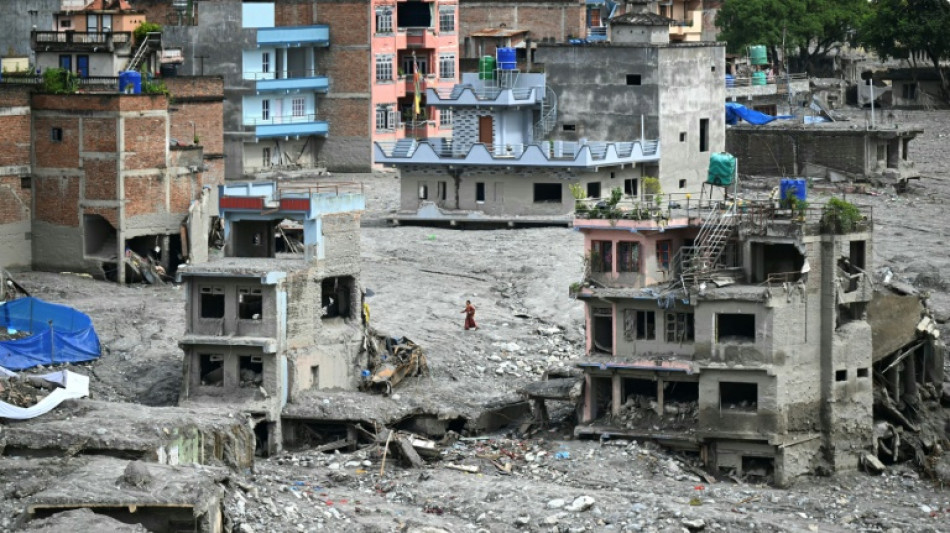
Nepal flood victims look to PM Shah to press climate case at UN / Photo: Prakash MATHEMA - AFP/File
 Malaysia's migrant return plan chills Myanmar Rohingya

 Pakistan confirms Afghan strikes after resident says Kandahar hit

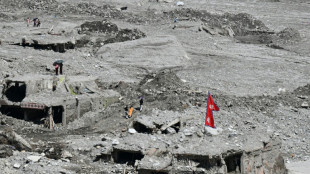 Thousands missing, aid needs mount one month after Nepal's deadly floods

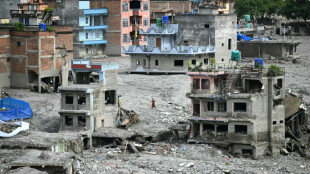 Nepal flood victims look to PM Shah to press climate case at UN

 Trump admin says there were 8 suicide attempts on US aircraft carrier

 Iranian satire 'Head to Head' draws a veil over the men
 Archaeological 'breakthrough' could confirm origins of Paris

 Morocco elects new parliament with lowest turnout in nearly two decades

 North Korean IT contractor found remote work in New Zealand: agency

 Anthropic touts AI-led biology discovery

 Giants QB Dart to have season-ending surgery

 Venezuelan shot by ICE needs urgent surgery, mother tells AFP

 Giants QB Dart to have season-ending surgery: reports

 Judge urged to lift Trump's White House ban on media outlets
 Stocks fall on soaring bond yields, higher oil prices

 US judge weighing Trump's White House ban on media outlets
 At UN, OpenAI's Altman calls 'for extreme care' in AI

 Hamilton gives thumbs up to Gulf GPs despite Iran conflict

 Leclerc admits going 'too far' in Hamilton shunt in Italy

 Row engulfs Dolly Parton's estate as manager accuses nephew of making threats
 Mandela Digital Extends Early Access Programme to 11 February 2027 Following Strong Response

 US seeks 11th Presidents Cup win in a row over global foes

 McDonald's to boost franchisees as inflation weighs on consumers

 Trump invites Putin to G20 summit in Miami

 Archaelogical 'breakthrough' could confirm origins of Paris

As Nepal's prime minister heads to the United Nations seeking climate justice, survivors of the catastrophic floods that tore through Himalayan valleys are counting on the young leader to give voice to their grief.
Balendra Shah, 36, will press for international support at the UN General Assembly this week after the disaster that killed more than 1,400 people and left over 6,000 missing in Nepal and China's Tibet region.
Scientists say climate change played a key role in the August 26 floods, fuelling Nepal's argument that vulnerable mountain nations are paying a heavy price for a crisis they did little to create.
For teenager Karma Lama, that argument is rooted in his devastating loss.
The 17-year-old lost his parents and five other relatives when torrents of water, mud and debris swept through mountain communities.
"We need homes, we need a livelihood... big countries of the world should know our plight," the 17-year-old told AFP from a temporary shelter.
"He has to speak for us, for the flood victims."
Lama was on his way to school when the flood struck.
With roads and bridges washed away, he walked for hours through forests to reach his village in the badly hit Rasuwa district, only to find it gone.
"What I really want is my parents back. But that is not possible.
Almost a month after the catastrophe, helicopters still ferry food and medicine to isolated settlements while rescue teams continue searching for bodies.
Across Nepal's flood-hit valleys, thousands face the same uncertain future.
- Rethinking projects -
In Nuwakot district, excavators claw through debris through houses buried beneath mounds of grey silt.
Shoes and schoolbooks remain scattered across the ruins, with air conditioners hanging outside windows.
Among those being forced to start over is Sobita Rijal, 35, who still has the keys to the three-storey home where she and her husband once ran a small shop.
Half the building now lies beneath debris, and the family now lives in a cramped rented room.
"I don't know what caused this, I don't know what climate change is," she said.
"But what I can say is that we need help... we are a small country."
The disaster has exposed the risks facing communities living below the world's highest peaks, where even a small increase in global temperatures can destabilise glaciers and river systems.
Nepal, a largely rural nation of 30 million people that contributes only a tiny share of greenhouse gas emissions, estimates reconstruction could cost $4.78 billion.
The country must not only rebuild towns and transport links, but also decide how to resettle thousands displaced by the flood.
It will also have to rethink infrastructure projects, including hydropower plants and trade corridors built in fragile mountain terrain.
- 'Pain is deep' -
Scientists from the World Weather Attribution group have said climate change was a key driver of the disaster, describing it as a "compound crisis" fuelled by long-term warming, glacier retreat, permafrost thaw and geological instability rather than a single extreme weather event.
The flooding has added urgency to Nepal's calls for climate finance and compensation from wealthy nations.
Countries agreed to create a "loss and damage" fund in 2025 to help vulnerable states cope with climate impacts, although payments have yet to begin.
The stakes extend far beyond Nepal.
Glaciers across the wider Hindu Kush-Himalayan region supply water to some 240 million people in the mountains and another 1.65 billion living downstream across South and Southeast Asia.
Manjeet Dhakal of Climate Analytics said the disaster gave Nepal "a very strong ground" to make the case for climate justice before the international community.
"We should... remind the global community of its responsibility to urgently reduce emissions to limit temperature rise and scale up support for climate action in vulnerable countries," he said.
"This sympathy has to be translated into real action."
Survivors such as 51-year-old Narayan Prasad Khatiwada hopes that the suffering of those who lost everything is not forgotten once the world's attention moves on.
"We are a small country. If we had all the resources we would not need support from anyone. The big countries must help," he said.
"I hope the prime minister delivers a good message. Our pain is deep, very deep."
A.Malone--AMWN