'The foxes are guarding the hen house': Russia's war highlights UN impotence
 Japan tightens rules for foreigners wanting permanent residency
 'Happiest moment': China's Mu first woman to win eSports Games gold
 EU talks deportations as five nations seek migrant centre in Africa
 Kenneth Branagh examines the scars of Iraq war in 'Atonement'
 Hundreds held, dozens wounded as French school protests escalate
 US government's new AI chatbot pulls back from debunking Trump
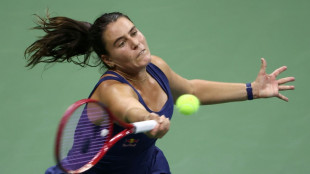 US tennis star Navarro reveals health battle, ends season
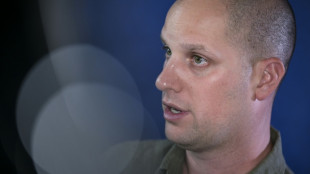 Panic, anger, tears: Evan Gershkovich's uneasy journey after Russian jail
 UK PM says 'strong indications' Iran involved in airbase incident
 Google restricts access to new AI model over safety concerns
 Watchdog clears former US Fed chief Powell in renovation probe
 Israel PM hails Indian pilot of rerouted flight for averting disaster
 Fury, Joshua kick off 'battle of Britain' in good spirits
 Ronaldo leaves Portugal training camp after coach says he is dropped
 Florence Pugh stars in 'East of Eden' adaption on Netflix
 Watchdog finds no criminal misconduct over US Fed renovations despite Trump probe
 In Manchester, City fans 'devastated' while rival fans call for relegation
 UK-France Channel migrant exchange deal scrapped: London
 Portugal boss denies 'incident' with Ronaldo

 Israel PM says one of the pilots of rerouted flight tried to crash plane
 Manchester City: Main points of damning judgement and possible sanctions

 Italy looking for 'identity' under Mancini says Scalvini
 The voices of Spain's housing camp protesters
 Romanian parliament rejects pro-EU PM candidate
 Court halts Tennessee's first execution of woman in 200 years
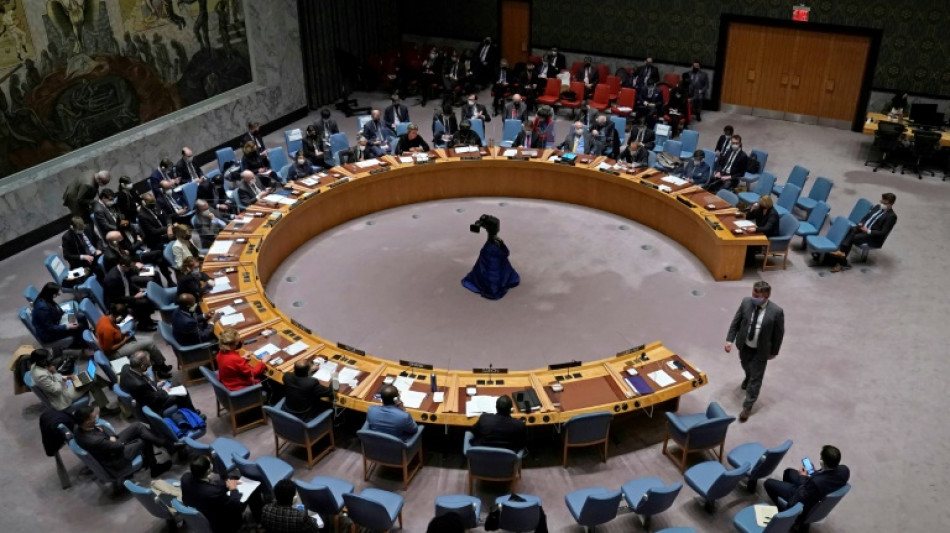
It was arguably the ultimate illustration of UN powerlessness: an emergency Security Council meeting designed to avoid war rendered redundant by Russia's invasion of Ukraine just minutes after the late-night session began.
As UN chief Antonio Guterres and member state after member state on the 15-country council urged Vladimir Putin to step back from the brink, the Russian leader was already sending his troops across the border.
The ambassadors of the United States, Britain, France and others reading pre-prepared speeches calling for Putin to pursue diplomacy seemed unaware of what journalists watching the proceedings already knew: Russia's president was on state television announcing that his military operation had begun.
As news filtered through to the chamber at the UN's headquarters in New York, the mood turned to one of anger, despair and hopelessness.
Adding an air of surrealism was the identity of the country chairing the meeting: Russia, in its role as temporary president of the council.
"I call on every one of you to do everything possible to stop the war," pleaded an emotional Ukrainian ambassador Sergiy Kyslytsya.
But as with the 2003 invasion of Iraq by the United States and Britain, the United Nations again proved incapable of preventing conflict.
With Putin intent on launching his invasion and Russia a permanent council member with the power to veto resolutions, what if anything could the body have done?
"The Security Council was never going to solve this crisis," Richard Gowan, a UN expert at the International Crisis Group think tank, told AFP.
"That is because of Russia's veto power, plus the simple fact that President Putin clearly doesn't give a damn about international opinion or diplomacy."
Since its creation in 1945, the UN has been unable to stop any conflict started by one of its five permanent members: Britain, China, France, Russia and the United States.
The same five powers that emerged victorious from World War II wield all the power today, relegating the organization to a role focused primarily on providing humanitarian aid in natural disasters and wars, in some cases succeeding in limiting the expansion of conflicts.
The format of the Security Council has not changed in 77 years, with other countries rotating through the body's 10 non-permanent member spots, which do not have veto power.
- Deadlocked reform -
Experts and governments have long argued for reform to take into account an international order that is now multipolar, with countries like India, Japan and Germany arguing that they should have a permanent, veto-wielding seat.
But reform efforts have been deadlocked for years, however, hampering the credibility of the council, which has all too often been riven by division and infighting, leading to inaction.
"Essentially the foxes are guarding the hen house. Thus, the Security Council is back to its Cold War paralysis," Pamela Chasek, chair of the political science department at Manhattan College in New York, told AFP.
Russia has not hesitated to wield its veto, doing so more than 15 times with regards to the Syria conflict.
Moscow will exercise its right again on Friday, to block a resolution proposed by Western powers that would "condemn in the strongest terms the Russian invasion of Ukraine," according to a senior UN official.
A similar text will then be sent to the General Assembly, which brings together all 193 members of the UN. Experts will closely watch the vote to see how isolated Russia is, but ultimately it is non-binding.
A similar scenario occurred in 2014 when Russia annexed Crimea. Eight years later, Russia is still in control of that region.
- 'Saddest day' -
At Wednesday night's session, as ambassadors learned of Russia's invasion via their mobile phones, many made second speeches, directing much of their anger at Moscow's envoy Vassily Nebenzia.
"There is no purgatory for war criminals. They go straight to hell, ambassador," Kyslytsya, the Ukrainian representative, told him.
US ambassador Linda Thomas-Greenfield was seen consoling Kyslytsya and afterwards, a dejected Guterres said Russia's military assault marked "the saddest day" of his tenure as UN chief.
For some UN watchers, the invasion is not only a personal failure for Guterres but also further evidence of the declining stature of the world body.
"The mediation efforts by the Secretary-General would have been taken seriously 20 years ago," Trita Parsi of the Quincy Institute think tank told AFP.
"Today, no one even notices his absence because no one has even an expectation that the UN or the Secretary-General will play such a role."
So what can we expect the Security Council to achieve in the Ukraine crisis?
"For now, the UNSC is a theater where the West and Russia can shout at each other," said Gowan.
"It won't do much to bring this war to a close."
prh-ft-mlm-pdh/sst
M.Thompson--AMWN