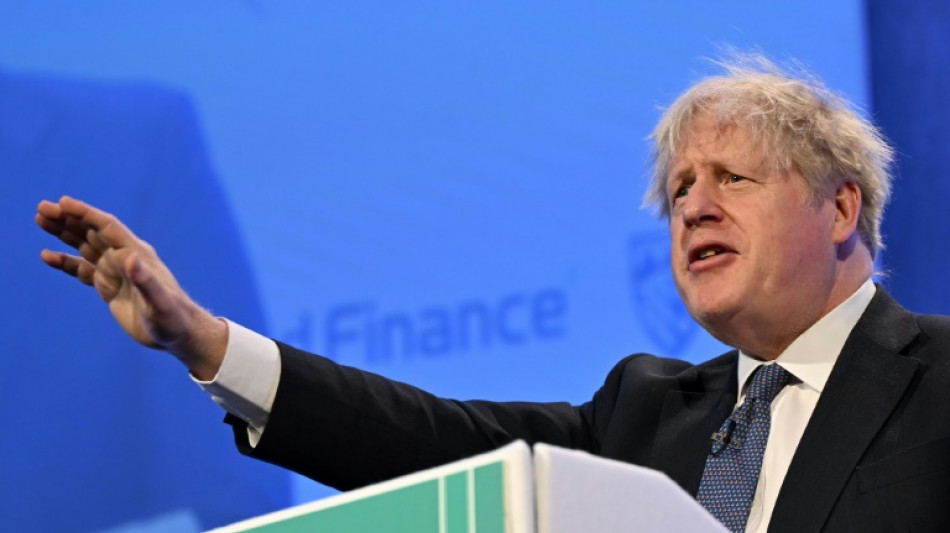
UK's Johnson says 'difficult' to back new N.Irish Brexit deal / Photo: JUSTIN TALLIS - AFP
 West Midlands Shoppers Urged to Guard Against Black Friday Scams

 Surfshark Adds Real-Time Call Protection to iOS App in Version 5.3.0

 Saudi PIF Retains Top Sovereign Wealth Fund Brand Title for Third Year

 Professor Shahida Moosa Pioneers Medical Genomics in South Africa Amid Testing Shortages

 Texas Marijuana Decriminalization Faces Uncertain Future Under New Attorney General

 Early Black Friday Laptop Deals: MacBook Neo, IdeaPad Slim 5x, and Surface Laptop Prices Drop

 2026 East Bay Nosh Awards Voting Opens for Food and Drink Favorites
Former UK prime minister Boris Johnson said Thursday he would find it "very difficult" to vote for successor Rishi Sunak's new EU deal overhauling post-Brexit trade rules in Northern Ireland.
Johnson, whose supporters accuse Sunak of betrayal for having helped force the former leader out last year, broke his silence after the breakthrough deal was announced on Monday.
"I'm going to find it very difficult to vote for something like this myself, because I believed we should've done something very different," Johnson said in a speech in London.
"This is not about the UK taking back control," he said, but "a version of the solution that was being offered (by the EU) last year".
"This is the EU graciously unbending to allow us to do what we want to do in our own country, not by our laws, but by theirs," he added.
As prime minister, Johnson rammed through the old "Northern Ireland Protocol" in his rush to withdraw Britain from the EU.
He admitted in his speech that the set of trading rules, now supplanted by Sunak's deal, had proved problematic.
But he insisted that the better route was to maintain now-abandoned legislation that he introduced, imposing a unilateral overhaul of the rules without EU consent, even at the risk of a trade war.
"I have no doubt at all that that (legislation) is what brought the EU to negotiate seriously," he claimed.
The new "Windsor Framework" has been generally well received and is expected to win any vote in parliament with the support of the main Labour opposition.
But Sunak will be eager to secure the backing of the pro-UK Democratic Unionist Party (DUP) in Northern Ireland, and, to a lesser extent, Johnson -- who retains a following among hardline Brexiteers.
The Windsor Framework reduces the influence of EU law in Northern Ireland, and creates a new "green lane" for goods coming from Britain that are not intended to go on to the EU's single market via Ireland.
Johnson said it risked keeping Northern Ireland in the EU's regulatory orbit and would prove "a drag anchor on divergence" from EU rules for the UK as a whole.
Doing things differently from Brussels "is the point of Brexit", he said, vowing to keep fighting for "what I think of as Brexit".
F.Dubois--AMWN

