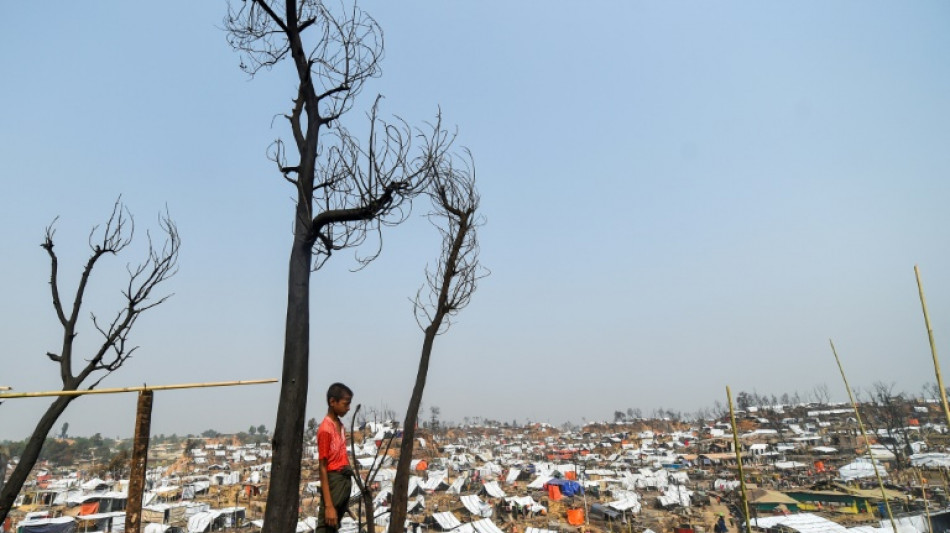
Rohingya refugees decry 'devastating' cuts to food aid / Photo: Munir Uz zaman - AFP/File
 West Midlands Shoppers Urged to Guard Against Black Friday Scams

 Surfshark Adds Real-Time Call Protection to iOS App in Version 5.3.0

 Saudi PIF Retains Top Sovereign Wealth Fund Brand Title for Third Year

 Professor Shahida Moosa Pioneers Medical Genomics in South Africa Amid Testing Shortages

 Texas Marijuana Decriminalization Faces Uncertain Future Under New Attorney General

 Early Black Friday Laptop Deals: MacBook Neo, IdeaPad Slim 5x, and Surface Laptop Prices Drop

 2026 East Bay Nosh Awards Voting Opens for Food and Drink Favorites
Rohingya refugees in Bangladesh said on Thursday they are struggling to survive after the United Nations slashed their food aid due to a massive funding gap.
After a $125 million donation shortfall, monthly food vouchers were cut from $12 to $10 per person starting in March, the UN World Food Programme (WFP) announced, warning further cuts were "imminent" without an immediate cash injection.
The drop has already caused hardship among the roughly one million Rohingya refugees living in Bangladesh's overcrowded camps, where they are reliant on aid and malnutrition is already rampant.
"We don't have any income and the rations are reduced," said refugee Rahela Begum, 40, whose son is ill and malnourished.
"He does not eat rice or other foods but only nutritious nut cream. They have stopped giving the nut cream and I don't know if he will survive."
This is the first time assistance has been scaled back since an estimated 750,000 Rohingya fled over the border during a 2017 crackdown by Myanmar's military that is now subject to a UN genocide investigation.
Bangladesh has struggled to support its immense refugee population since, with the prospect of a wholesale return to Myanmar vanishingly remote.
Tom Andrews, the UN's special rapporteur on human rights in Myanmar, said he spoke with families in the camps who have already had to cut back on food staples.
"Reversing these cuts in food aid is literally a matter of life and death for Rohingya families," he said, adding that the situation was "a stain on the conscience of the international community".
Andrews -- who is mandated by the UN but is not an official for the body -- said that malnutrition, anaemia and stunted growth were already rife in the camps.
Twelve civilian groups representing the mostly Muslim minority community said the cuts would be "devastating".
"We strongly believe that the shortage of funding for the Rohingya response is a failure of the United Nations," the groups, including the Arakan Rohingya National Union, said in a joint statement.
They said the cuts would worsen an already dire economic and humanitarian situation in the squalid camps, "and will have severe implications, including child labour, human trafficking, child marriage, illegal activities, prostitution and a hostile environment".
Aid workers agreed that the ration cut could further destabilise security and increase drug trafficking in the camps, which last year saw scores of deadly drug-related clashes between Rohingya criminal groups.
Privately, UN and foreign diplomats have urged the government to allow Rohingya to work outside the camps, especially in Cox's Bazar's booming tourism sector, farming and industry.
O.M.Souza--AMWN

