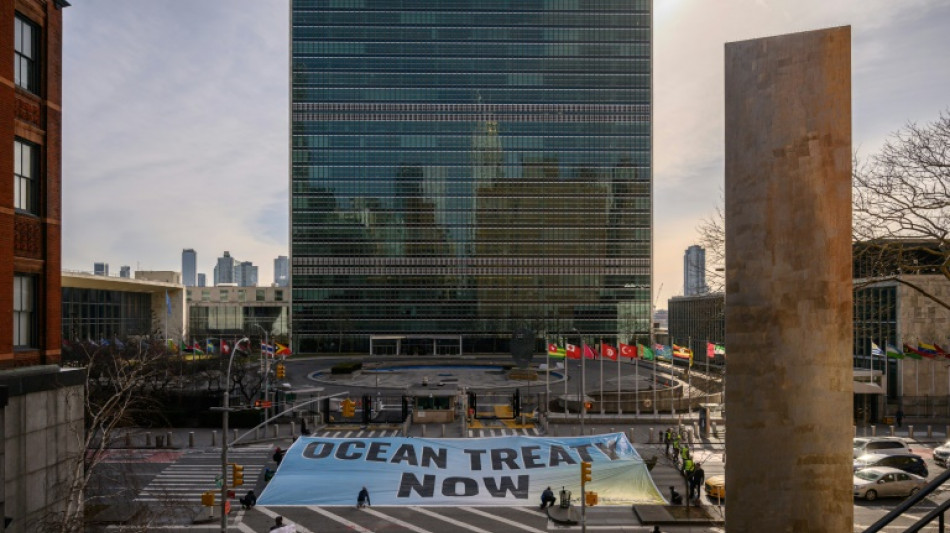
Treaty ahoy? Talks to protect high seas near finish line / Photo: Ed JONES - AFP/File
 West Midlands Shoppers Urged to Guard Against Black Friday Scams

 Surfshark Adds Real-Time Call Protection to iOS App in Version 5.3.0

 Saudi PIF Retains Top Sovereign Wealth Fund Brand Title for Third Year

 Professor Shahida Moosa Pioneers Medical Genomics in South Africa Amid Testing Shortages

 Texas Marijuana Decriminalization Faces Uncertain Future Under New Attorney General

 Early Black Friday Laptop Deals: MacBook Neo, IdeaPad Slim 5x, and Surface Laptop Prices Drop
 2026 East Bay Nosh Awards Voting Opens for Food and Drink Favorites
UN countries appeared Friday to be nearing an agreement on a long-awaited treaty to protect the high seas, a fragile and vital treasure that covers nearly half the planet.
After more than 15 years of informal and then formal talks, negotiators are coming to the end of two more weeks of discussions, the third "final" session in less than a year.
"I do not believe that a solution is not in sight," conference chair Rena Lee told a short plenary session Friday afternoon, calling on delegates to "stock up on snacks" as they try to get the treaty over the finish line before the scheduled end of talks later in the day.
"We have a window of opportunity to seal the deal, and we mustn't let this opportunity slip through our hands," she added, conceding though that the highly political issue of benefit-sharing for marine genetic resources remained a sticking point.
Even if compromises are found on all the remaining disputes, the treaty cannot be formally adopted at this session, she explained.
But it could be "finalized" without the possibility of reopening discussions on substantive sections, before a formal adoption at a later date, Lee added.
Even without adoption Friday, "It's a massive step," Veronica Frank of Greenpeace told AFP.
Disputes include the procedure for creating marine protected areas, the model for environmental impact studies of planned activities on the high seas, and the sharing of potential benefits of newly discovered marine resources.
The high seas begin at the border of countries' exclusive economic zones, which extend up to 200 nautical miles (370 kilometers) from coastlines. They thus fall under the jurisdiction of no country.
While the high seas comprise more than 60 percent of the world's oceans and nearly half the planet's surface, they have long drawn far less attention than coastal waters and a few iconic species.
Only about one percent of the high seas are currently protected.
Ocean ecosystems create half the oxygen humans breathe and limit global warming by absorbing much of the carbon dioxide emitted by human activities.
- North-South 'equity' -
But they are threatened by climate change, pollution and overfishing.
For many, any agreement hinges on equity between the rich North and poor South.
Developing countries, without the means to afford costly research, say they fear being left aside while others make profits from the commercialization of potential substances discovered in the international waters.
In a move seen as an attempt to build trust between rich and poor countries, the European Union pledged 40 million euros ($42 million) in New York to facilitate the ratification of the treaty and its early implementation.
The EU also pledged $860 million for research, monitoring and conservation of oceans in 2023 at the Our Ocean conference in Panama where the United States announced $6 billion in commitments.
Observers interviewed by AFP say that resolving these politically sensitive financial issues could help ease other sticking points.
If agreement is reached, it remains to be seen whether the compromises made will result in a text robust enough to protect oceans effectively.
"The text is not perfect, but it's got a clear path towards 30 by 30," said Greenpeace's Frank, referring to world governments' commitment to protect 30 percent of the world's land and ocean by 2030, as agreed in Montreal in December.
P.Costa--AMWN

