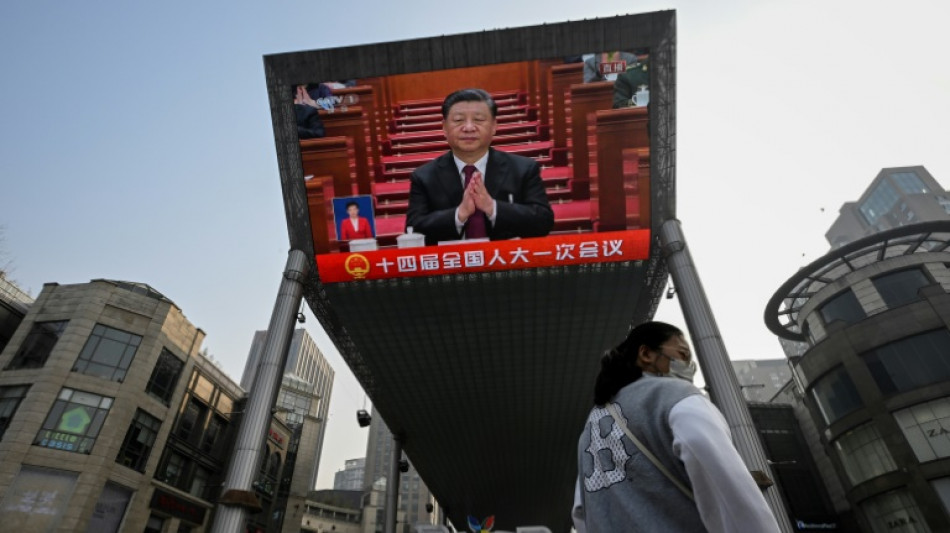
President Xi vows to boost China's manufacturing / Photo: JADE GAO - AFP
 West Midlands Shoppers Urged to Guard Against Black Friday Scams

 Surfshark Adds Real-Time Call Protection to iOS App in Version 5.3.0

 Saudi PIF Retains Top Sovereign Wealth Fund Brand Title for Third Year

 Professor Shahida Moosa Pioneers Medical Genomics in South Africa Amid Testing Shortages

 Texas Marijuana Decriminalization Faces Uncertain Future Under New Attorney General

 Early Black Friday Laptop Deals: MacBook Neo, IdeaPad Slim 5x, and Surface Laptop Prices Drop

 2026 East Bay Nosh Awards Voting Opens for Food and Drink Favorites
President Xi Jinping vowed to boost the country's manufacturing capacity and not rely on overseas markets, state media reported Monday.
Speaking at the annual gathering of the rubber-stamp parliament in Beijing on Sunday, Xi said China should be able to fend for itself.
"I've always said there are two critical areas for China: one is to safeguard our rice bowl, and the other is to build up a strong manufacturing sector," Xi said, according to the state-run People's Daily.
"As a great nation of 1.4 billion people, we must rely on ourselves," Xi added. "We can't depend on international markets to save us."
The comments, during a meeting with delegates representing China's economically advanced Jiangsu province, belie concerns in Beijing over an increasingly hostile international environment and lagging growth at home.
As China's technology ambitions have been hit with a raft of restrictions by the United States and its Western allies, Beijing has doubled down on the need to build a self-reliant industry and shift away from imports for sectors perceived as vital to national security, such as semiconductors and artificial intelligence.
Washington has in recent months tightened sanctions on Chinese chipmakers, citing national security concerns and the ability for the technology to be used by China's military.
The highly choreographed National Party Congress (NPC) kicked off with outgoing Premier Li Keqiang announcing an increase in military spending and modest economic growth.
The 2023 GDP growth goal of "about five percent" fell slightly short of market expectations and comes as Chinese authorities are grappling with how to stem the recent reorientation of global manufacturing chains to countries such as India and Vietnam.
Xi, who will start his third presidential term after securing a precedent-breaking third stint as party chairman last October, spoke during the Sunday meeting about the need to ensure high-quality manufacturing that is "innovative, coordinated, green, open and shared".
China's state news agency Xinhua published other comments from Xi saying that development in these key areas will propel China forward in its bid to become a "great modern socialist country in all respects".
Ch.Havering--AMWN

