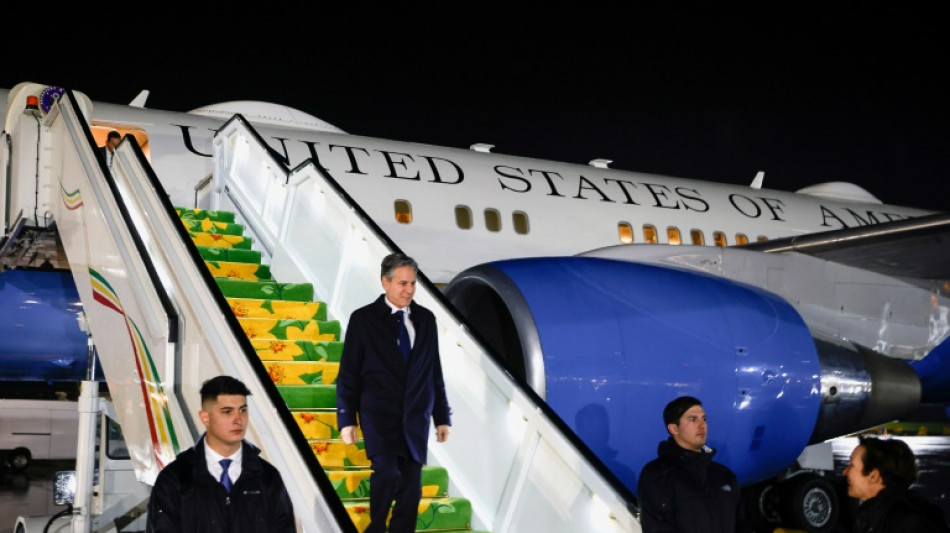
Blinken asks Ethiopia to strengthen peace on first post-war visit / Photo: TIKSA NEGERI - POOL/AFP
 Surge in Early Social Security Claims Linked to Agency Turmoil
 Panthers Seek NFC South Lead Against Ravens as Baltimore Ends Skid

 GIRLBAND! Headline Show at Rough Trade Marks National Breakthrough

 Samsung Galaxy Buds Active Leak Reveals ANC, Ear-Hook Design and One UI 9.5 Integration

 Egypt and Syria Sign Agreement to Restore Direct Flights After 14-Year Hiatus

 Van Gogh’s ‘Châtaigniers en Fleurs’ Sets $285m Record at Sotheby’s

 Anthropic Sets Record $81.3 Billion IPO Valuing AI Firm at $1.5 Trillion

 eThekwini Faces R6.5bn Flood Claim from Toyota’s Insurer
US Secretary of State Antony Blinken on Wednesday urged Ethiopia to "deepen the peace" in the war-torn north as he moved cautiously to repair relations shaken by the brutal two-way conflict.
The top US diplomat was paying his first visit to the longstanding ally since the war in Tigray, which claimed some 500,000 lives according to US estimates and led Washington to sever trade preferences with Africa's second most populous nation.
Opening a day of talks that will include a meeting with Prime Minister Abiy Ahmed, Blinken sipped Ethiopia's celebrated coffee at the foreign ministry and said he hoped for better relations.
"It is a very important moment, a moment of hope given the peace in the north that has taken hold," he said.
"There is a lot to be done. Probably the most important thing is to deepen the peace that has taken hold in the north."
Blinken said he hoped to restore cooperation "with the goal of strengthening the relationship" with Ethiopia, home of the African Union, amid a push by President Joe Biden to deepen relations with Africa.
Foreign Minister Demeke Mekonnen, receiving Blinken, said: "We have longstanding relations and it is time to revitalise them and move forward."
- Souring of relations -
Following the meeting with Demeke, Blinken arrived at the Prime Minister's Office for talks with Abiy, a Nobel Peace Prize winner, who was once seen as at the vanguard of a new generation of forward-looking African leaders, but whose reputation later took a beating in Washington over the war.
The violence erupted when the Tigray People's Liberation Front (TPLF), which once dominated Ethiopian politics, attacked military installations, prompting a major offensive by Abiy's government with backing from neighbouring Eritrea.
The TPLF briefly came close to marching on the capital but, beaten back by pro-Abiy forces, agreed to disarm under a November 2 accord negotiated in South Africa by the African Union with US participation.
Molly Phee, the top US diplomat for Africa, told reporters before Blinken's departure that his visit would aim to "help consolidate" the peace in the north but that the relationship was not ready to go "back to normal".
A key wish of Ethiopia is a return to the African Growth and Opportunity Act, which gave it duty-free access for most products to the world's largest economy, but the United States has made no commitments.
Abiy has pledged to restore basic services in war-wracked Tigray, though it is impossible to assess the situation on the ground due to restrictions on media access.
The Tigray war has been one of the deadliest in the 21st century with a US-estimated toll higher than that from Russia's invasion of Ukraine, which has drawn far more global attention.
Moscow has since gone on a diplomatic offensive in Africa, including in Ethiopia, hoping the continent will stay neutral rather than join Western sanctions against it.
Russia's efforts follow years of inroads in Africa by China, which has also offered the continent's leaders relationships that are unencumbered by Western pressure on human rights.
Soon after Blinken's visit, his third to sub-Saharan Africa, US Vice President Kamala Harris will travel to Ghana, Tanzania and Zambia, three countries seen as committed to making progress on democracy.
P.Costa--AMWN

