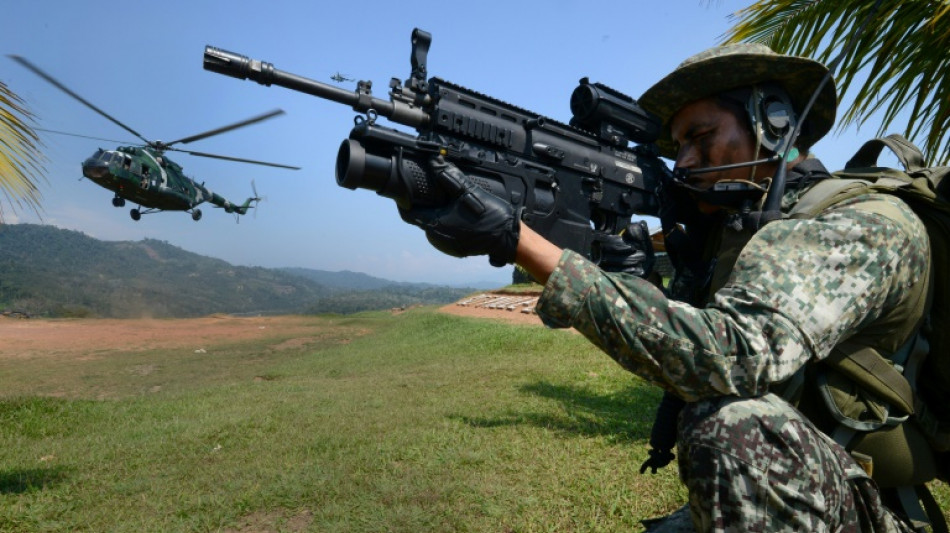
At least six killed in Peru clash with Shining Path / Photo: CRIS BOURONCLE - AFP/File
 Surge in Early Social Security Claims Linked to Agency Turmoil

 Panthers Seek NFC South Lead Against Ravens as Baltimore Ends Skid

 GIRLBAND! Headline Show at Rough Trade Marks National Breakthrough

 Samsung Galaxy Buds Active Leak Reveals ANC, Ear-Hook Design and One UI 9.5 Integration

 Egypt and Syria Sign Agreement to Restore Direct Flights After 14-Year Hiatus

 Van Gogh’s ‘Châtaigniers en Fleurs’ Sets $285m Record at Sotheby’s

 Anthropic Sets Record $81.3 Billion IPO Valuing AI Firm at $1.5 Trillion

 eThekwini Faces R6.5bn Flood Claim from Toyota’s Insurer
At least six people were killed in a clash between remnants of the defunct Shining Path rebel group and a military patrol in a coca-growing valley in central Peru, a Defense Ministry unit reported Saturday.
The statement from the Joint Command of the Armed Forces did not give the date of the confrontation, in which it said that five members of the Sendero Luminoso, as the guerrilla group is known in Spanish, and an Army soldier died.
It said the clash took place in Vizcatan del Ene, in central Peru, as part of an operation that tried to capture Victor Quispe Palomino, alias Comrade Jose. He is the leader of holdout troops of the leftist rebels defeated militarily in the 1990s.
Quispe Palomino was not found, the statement said. One member of the Maoist group, known as "Paulino," "died when he was preparing to mine the combat area."
The Vizcatan del Ene area is in the central department of Junin, part of a large coca-growing area where remnants of the Shining Path allied to drug traffickers have long taken refuge, authorities said.
Coca leaves are the raw material from which cocaine is made.
Shining Path emerged in 1980 when it launched a "people's war" in what the government said was an act of "terrorism." Two decades of clashes with security forces left 69,000 people dead or disappeared, according to Peru's Truth and Reconciliation Commission.
Most of the guerrilla leaders are dead or imprisoned, but the military estimates that 200 to 350 ex-combatants are still active in an area known as the VRAE -- the Spanish-language acronym for the Apurimac and Ene River Valley, some 175 miles (280 kilometers) southeast of Lima.
M.Fischer--AMWN

