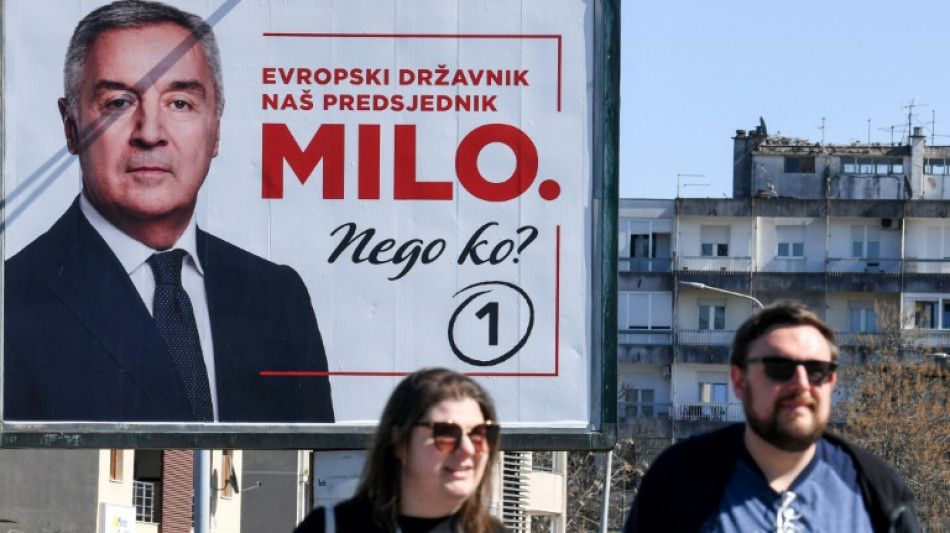
Montenegro votes in presidential polls after months of deadlock / Photo: SAVO PRELEVIC - AFP
 Surge in Early Social Security Claims Linked to Agency Turmoil

 Panthers Seek NFC South Lead Against Ravens as Baltimore Ends Skid

 GIRLBAND! Headline Show at Rough Trade Marks National Breakthrough

 Samsung Galaxy Buds Active Leak Reveals ANC, Ear-Hook Design and One UI 9.5 Integration

 Egypt and Syria Sign Agreement to Restore Direct Flights After 14-Year Hiatus

 Van Gogh’s ‘Châtaigniers en Fleurs’ Sets $285m Record at Sotheby’s

 Anthropic Sets Record $81.3 Billion IPO Valuing AI Firm at $1.5 Trillion

 eThekwini Faces R6.5bn Flood Claim from Toyota’s Insurer
Montenegrins cast ballots Sunday in a presidential contest pitting the Adriatic nation's longest serving leader Milo Djukanovic against a range of rivals hoping to shake up the country's political scene.
The election follows months of deadlock after the government was hit with a no-confidence vote in August but continued to rule, kicking off a wave of protests and calls for snap polls for the parliament.
The latter were called for June 11 by Djukanovic on Friday a day after he had dissolved parliament as a three-month deadline expired for the prime minister-designate to form a new government.
Montenegro's president has a largely ceremonial role, with most political power resting with the prime minister.
Nonetheless, Djukanovic remains one of the most instrumental figures in the country, famed for wielding power and influence across Montenegro for years, since he broke with Serbia and helped oversee its independence in 2006.
A loss at the polls for Djukanovic and his DPS party would signal the beginning of a new political era for the country as it pursues European Union membership -- a long-sought goal that has been held up by lagging reforms and endemic corruption.
If none of the seven candidates in the race secures more than 50 percent of the vote -- a likely outcome -- a run-off will be held on April 2.
- 'Disappointed' -
Djukanovic remains the heavy favourite heading into the contest but will likely face stiff competition from the pro-Russian Democratic Front's Andrija Mandic, Jakov Milatovic -- a young economist from the increasingly popular Europe Now Movement -- and the leader of the centre-right Democrats Aleksa Becic.
"These elections will also determine whether Montenegro remains within the framework of foreign policy priorities established so far or whether they change under Russian-Serbian influence," political analyst Daliborka Uljarevic told AFP.
Under the leadership of Djukanovic and his party, Montenegro joined NATO, kick-started the negotiating process for EU membership and moved away from Russia's influence.
Still, his party's rule was also associated with widespread corruption and links to organised crime, allegations he strongly denies.
Since the 2020 parliamentary elections -- which saw DPS's grip on power weaken after taking a beating at the polls -- the country has pivoted from crisis to crisis.
For many in the country of 620,000 people, the prolonged political dysfunction has left them disillusioned with the upcoming election.
"For the first time, I will not participate in the elections. I am disappointed in the new government, which promised reforms and faster entry into the EU," Anja, a 32-year-old attorney in the capital Podgorica, told AFP, who asked to withhold her surname.
"Young people are leaving the country because they have no prospects here."
P.Stevenson--AMWN

