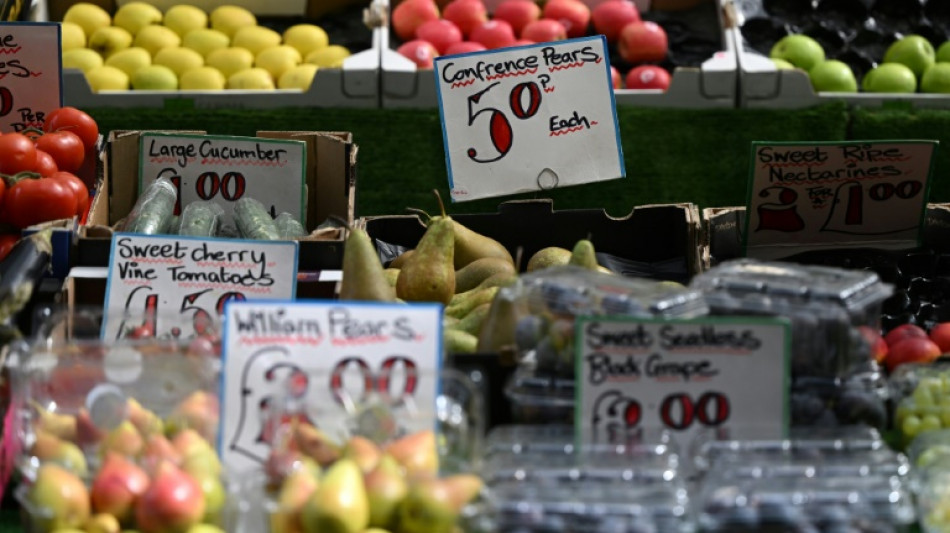
UK inflation unexpectedly accelerates / Photo: JUSTIN TALLIS - AFP/File
 Surge in Early Social Security Claims Linked to Agency Turmoil

 Panthers Seek NFC South Lead Against Ravens as Baltimore Ends Skid

 GIRLBAND! Headline Show at Rough Trade Marks National Breakthrough

 Samsung Galaxy Buds Active Leak Reveals ANC, Ear-Hook Design and One UI 9.5 Integration

 Egypt and Syria Sign Agreement to Restore Direct Flights After 14-Year Hiatus

 Van Gogh’s ‘Châtaigniers en Fleurs’ Sets $285m Record at Sotheby’s

 Anthropic Sets Record $81.3 Billion IPO Valuing AI Firm at $1.5 Trillion

 eThekwini Faces R6.5bn Flood Claim from Toyota’s Insurer
British inflation unexpectedly accelerated in February, data showed Wednesday, deepening a cost-of-living crisis and pressuring the Bank of England to hike interest rates despite global markets turmoil.
After slowing for three straight months, the UK Consumer Prices Index (CPI) climbed to 10.4 percent in February -- not far from 40-year highs and more than five times the BoE's two-percent target.
That compared with 10.1 percent in January and dashed market expectations for a slowdown to 9.9 percent.
Food prices surged, particularly for fresh produce that faced shortages, the Office for National Statistics (ONS) added in a statement.
Strikes have spread across Britain as workers protest over pay failing to keep pace with prices.
The BoE -- caught between hiking rates to dampen hot inflation or pausing as turmoil rages over the commercial banking sector -- will unveil its latest monetary policy decision Thursday.
Global markets have been shattered by fallout from the recent collapse of two regional US banks and the enforced UBS buyout of troubled Swiss giant Credit Suisse.
Some experts had predicted the BoE will hold off from raising rates further due to markets volatility, but the latest inflation data complicates the picture.
- 'Bolsters rate-hike case' -
"The significant (inflation) rebound ... bolsters the case for raising rates tomorrow, a case that markets thought was strong before the recent challenges in the banking sector," said Martin Beck, economic advisor to the EY ITEM Club.
"However, the developments of the past ten days have led to a significant decrease in market expectations for bank rate, with markets pricing implying a roughly 50/50 chance of a 25-basis-point hike."
The BoE has so far ramped its key rate from a record-low 0.1 percent in December 2021 to the current level of 4.0 percent in a bid to bring down consumer prices.
"The re-acceleration in overall CPI inflation... may be enough to tilt the BoE towards raising interest rates from 4.0 percent to 4.25 percent tomorrow despite the recent turmoil in the banking system," added Paul Dales, chief UK economist at research consultancy Capital Economics.
"The recent tightening in financial conditions caused by the banking turmoil will probably weaken UK economic activity and underlying price pressures.
"But the Bank of England may well want to see hard evidence of that before it stops raising interest rates."
- Shortages -
The ONS said widespread vegetable shortages had sent food prices rocketing to their highest rate in almost half a century.
"Food and non-alcoholic drink prices rose to their highest rate in over 45 years, with particular increases for some salad and vegetable items as high energy costs and bad weather across parts of Europe led to shortages and rationing," said ONS chief economist Grant Fitzner.
Inflation was also driven by rising alcohol prices in pubs and restaurants after discounting in the previous month.
Wednesday's data comes after the UK government last week forecast inflation would slow sharply to 2.9 percent by year-end, with the nation set to avoid recession.
The predictions were published alongside finance minister Jeremy Hunt's massive £94-billion ($114-billion) cost-of-living measures for this year and next.
"We recognise just how tough things are for families across the country, so as we work towards getting inflation under control we will help families with cost-of-living support," Hunt said on Wednesday.
Inflation around the world had struck the highest levels in decades last year as the invasion of Ukraine by Russia fuelled energy and food prices.
UK inflation had peaked at 11.1 percent in October, but cooled somewhat over the following three months.
burs-rfj/lth
F.Dubois--AMWN

