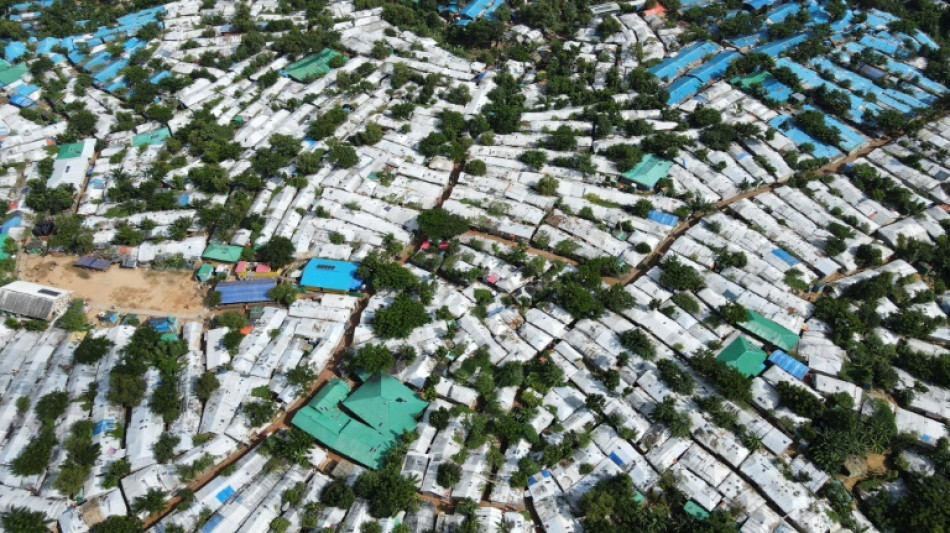
Rohingya sceptical of Myanmar refugee return offer / Photo: Munir uz Zaman - AFP/File
 Surge in Early Social Security Claims Linked to Agency Turmoil
 Panthers Seek NFC South Lead Against Ravens as Baltimore Ends Skid

 GIRLBAND! Headline Show at Rough Trade Marks National Breakthrough

 Samsung Galaxy Buds Active Leak Reveals ANC, Ear-Hook Design and One UI 9.5 Integration

 Egypt and Syria Sign Agreement to Restore Direct Flights After 14-Year Hiatus

 Van Gogh’s ‘Châtaigniers en Fleurs’ Sets $285m Record at Sotheby’s

 Anthropic Sets Record $81.3 Billion IPO Valuing AI Firm at $1.5 Trillion

 eThekwini Faces R6.5bn Flood Claim from Toyota’s Insurer
Rohingya refugees said Wednesday they doubted Myanmar was offering a genuine return to their homeland, as a spokesman for the country's military junta said it would begin welcoming back members of the persecuted minority as soon as next month.
A delegation of 17 officials from Myanmar's junta was in Bangladesh this week to interview potential candidates for return, more than five years after a brutal military crackdown drove immense numbers of Rohingya out of their homes.
The visit, brokered by China and partly facilitated by the United Nations, jumpstarted a repatriation agreement between the two countries that has languished for years, partly over fears that the refugees would not be safe on their return.
But Rohingya interviewed by the delegation told AFP that none of their queries about security or recognition of their right to citizenship in Myanmar had been answered.
"They used to treat us badly there. I asked whether we would be able to live a normal life there, but then they stopped me," Shamsun Nahar, a 40-year-old Rohingya woman, told AFP.
"They did not want any more questions," she added. "I don't think they will take us to Myanmar. If they do, they won't give us any rights."
The Myanmar delegation left Wednesday after a week in the sprawling refugee camps home to around a million Rohingya.
Junta spokesman Zaw Min Tun told AFP after their departure that Myanmar would likely begin the repatriation process by mid-April and would welcome around 1,000 refugees at first.
Myanmar's representatives were officially there to assess refugees for potential return, based partly on whether they could prove their residence in the country before the 2017 crackdown.
But another refugee interviewed by the delegation said documentation proving his residency was treated with scepticism.
"I provided all the documents, they said 'hmm'," Soyod Hossain, 50, told AFP. "I don't think they believe that our documents were genuine."
- 'Token' return -
The Rohingya are widely viewed in Myanmar as interlopers from Bangladesh, despite roots in the country stretching back centuries, and are stateless after Myanmar ceased recognising their citizenship in 2015.
Junta chief Min Aung Hlaing, who has dismissed the Rohingya identity as "imaginary", was head of the armed forces during the 2017 crackdown.
That year's violence is now subject to a genocide investigation, with the International Court of Justice probing allegations of rape, murder and arson against entire Rohingya villages by Myanmar's security forces.
The Arakan Rohingya National Alliance, a prominent Rohingya diaspora group, accused Myanmar last week of planning to orchestrate a "token" return of refugees to avoid the court's censure.
The UN refugee agency said once again Sunday that conditions in Myanmar remained unsuitable for the "sustainable return" of Rohingya refugees.
But civil society groups have criticised the agency for facilitating the transport of Myanmar officials into Bangladesh last week as part of the return scheme.
A repatriation plan was first agreed upon soon after the 2017 crackdown but failed to make any significant headway.
Rights groups said Myanmar had no interest in facilitating the return of refugees, while the UN and humanitarian agencies said the Rohingya would not be safe if they went back.
Bangladesh's refugee commissioner Mizanur Rahman said his country was hopeful refugee returns would start soon, with more clarity on timing to come next week.
"We don't have any option other than repatriation. But the whole process is complex," Rahman told AFP.
China is mediating between both countries on the renewed repatriation push and Beijing's ambassador to Dhaka, Yao Wen, also told reporters last week that repatriation would start "very soon".
Myanmar's state media has so far not reported on the delegation's visit to Bangladesh.
M.Fischer--AMWN

