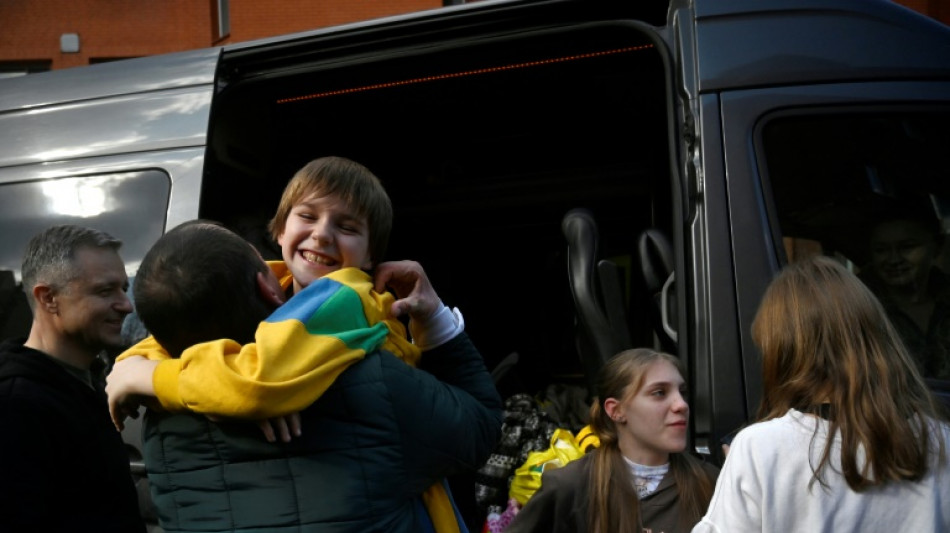
Ukraine children held by Russia reunited with parents / Photo: SERGEI CHUZAVKOV - AFP
 Surge in Early Social Security Claims Linked to Agency Turmoil

 Panthers Seek NFC South Lead Against Ravens as Baltimore Ends Skid

 GIRLBAND! Headline Show at Rough Trade Marks National Breakthrough

 Samsung Galaxy Buds Active Leak Reveals ANC, Ear-Hook Design and One UI 9.5 Integration

 Egypt and Syria Sign Agreement to Restore Direct Flights After 14-Year Hiatus

 Van Gogh’s ‘Châtaigniers en Fleurs’ Sets $285m Record at Sotheby’s

 Anthropic Sets Record $81.3 Billion IPO Valuing AI Firm at $1.5 Trillion

 eThekwini Faces R6.5bn Flood Claim from Toyota’s Insurer
Moments after the bus returning him and more than a dozen other children from Russian-held territory arrived in Kyiv, a ten-year-old boy jumped straight into his father's arms.
Denys Zaporozhchenko held his son and kissed his forehead, before also hugging his two daughters who were among the 17 children separated from their parents for months.
The reunion was organised by Save Ukraine, an NGO that fights what it says are illegal deportations of Ukrainian children to Russian-controlled territory.
More than 16,000 Ukrainian children have been deported to Russia since the February 24, 2022 invasion, according to Kyiv, with many allegedly placed in institutions and foster homes.
Russia denies the allegations, saying instead it has saved Ukrainian children from the horrors of the war.
But the International Criminal Court (ICC) last week issued an arrest warrant against President Vladimir Putin for unlawfully deporting Ukrainian children.
Zaporozhchenko last saw his children in October in Kherson, the only regional capital that Russian forces captured following the invasion, when they left for a so-called Russian summer camp.
He expected tough fighting in his home city as Ukrainian forces were pushing closer to recapturing it, which they ultimately did in November.
Sending his kids to Crimea -- a scenic and touristy peninsula annexed by Moscow in 2014 -- seemed the lesser evil.
- 'Blackmail, intimidation' -
Russian officials "promised to send them to these camps for a week or two," he told AFP.
"By the time we realised we shouldn't have done it (let them go), it was too late," he said.
Families were sometimes pressured into sending their kids on the so-called holidays, said Myroslava Kharchenko, a lawyer working with Save Ukraine.
"(Russian officials) told parents that they have one hour to think, and that if Ukrainians get there before, they will bring American mercenaries who will beat and rape the children."
After "blackmail, manipulation and intimidation, they take the children away," Kharchenko added.
Parents have previously had to embark on the fraught journey themselves to find their children on their own, Kharchenko said.
But for the first time, Save Ukraine group organised a group collection for the separated children by assuming power of attorney for those parents unable to make the journey.
They chartered a bus that went through Poland and Belarus and then to Russia, before picking up the children in annexed Crimea.
Some of children interviewed by AFP described a level of political indoctrination.
"If we didn't sing the (Russian) national anthem, they made us write an explanatory note. Over the New Year, we were shown Putin's speech," 15-year-old Taisia said.
Zaporozhchenko's 11-year-old daughter, Yana, said "everything was like in normal camps" but camp officials "made us sing and dance when inspectors came" from Moscow.
Forty-three-year-old Inesa Vertosh said her son had become "more serious" after the long separation.
"He looks at me and says 'Mom, I don't want to tell you about it, you wouldn't sleep at night'."
All children will be given psychological support, said Kharchenko.
Her organisation was "doing everything so that children and their parents do not return to dangerous territories", she added.
L.Mason--AMWN

