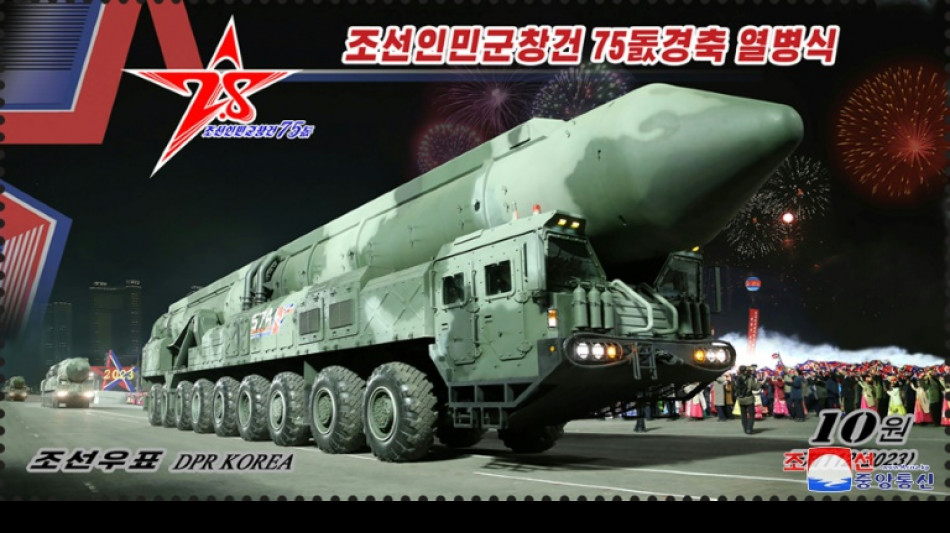
North Korea tests new underwater nuclear attack 'drone': KCNA / Photo: STR - KCNA VIA KNS/AFP
 Kiss of Life Teases First Winter Single 'Greedy'

 Eight-Year-Old Georgia Wins Penrith Valley Public Speaking Competition

 5 Fun Date Night Ideas That Don't Cost a Fortune

 GIRLBAND! Headline Show at Rough Trade Marks National Breakthrough

 Samsung Galaxy Buds Active Leak Reveals ANC, Ear-Hook Design and One UI 9.5 Integration

 Egypt and Syria Sign Agreement to Restore Direct Flights After 14-Year Hiatus

 Van Gogh’s ‘Châtaigniers en Fleurs’ Sets $285m Record at Sotheby’s

 Anthropic Sets Record $81.3 Billion IPO Valuing AI Firm at $1.5 Trillion

North Korea has tested an underwater nuclear attack drone designed to unleash a "radioactive tsunami" that would destroy enemy naval vessels and ports, state media said Friday.
During the drills from Tuesday through Thursday the North Korean military deployed and test-fired this new weapon system, the mission of which is to set off such a "super-scale" destructive wave, the KCNA news agency said.
"This nuclear underwater attack drone can be deployed at any coast and port or towed by a surface ship for operation," KCNA said.
The "secret weapon" was put in the water off South Hamgyon province Tuesday, and on Thursday it detonated a test warhead, the agency said.
Up to that point it had cruised for 59 hours and 12 minutes at a depth of 80 to 150 meters, the agency reported.
The North's Central Military Commission of the Worker's Party commanded the drills "in order to alert the enemy to an actual nuclear crisis and verify the reliability of the nuclear force for self-defence".
North Korean leader Kim Jong Un "guided" this exercise and said it should serve as a warning for the United States and South Korea to "realise the DPRK's unlimited nuclear war deterrence capability being bolstered up at a greater speed". DPRK is the acronym for North Korea's official name.
"He expressed his will to make the US imperialists and the South Korean puppet regime plunge into despair for their choice through the high-profile demonstration of the powerful war deterrence," KCNA said.
After a record-breaking year of weapons tests and growing nuclear threats from Pyongyang, Seoul and Washington have ramped up security cooperation, and on March 13 kicked off their largest joint military drills in five years, known as Freedom Shield.
KCNA said that on Wednesday the North fired strategic cruise missiles "tipped with a test warhead simulating a nuclear warhead".
KCNA said two "Hwasal-1"-type strategic cruise missiles and two "Hwasal-2"-type strategic cruise missiles, launched in South Hamgyong province, accurately hit the target set in the East Sea, also known as the Sea of Japan.
The South Korean military had reported the firing of multiple cruise missiles from the North on Wednesday.
That launch comes about a week after Pyongyang test-fired its largest and most powerful missile, a Hwasong-17 -- its second intercontinental ballistic missile (ICBM) test this year.
The North's state media described the ICBM launch as a response to the ongoing, "frantic" US-South Korea drills.
North Korea last year declared itself an "irreversible" nuclear power and Kim recently called for an "exponential" increase in weapons production, including tactical nuclear weapons.
P.Santos--AMWN

