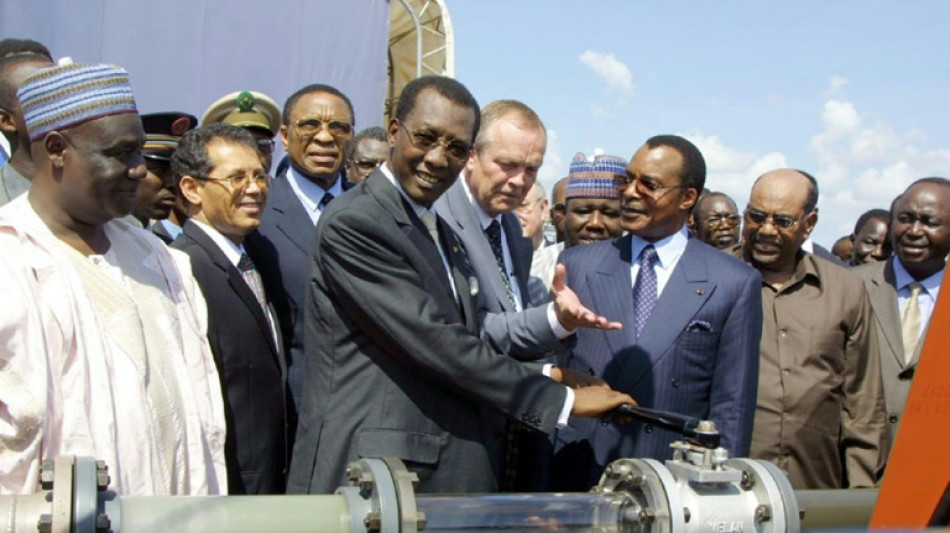
Chad nationalises former ExxonMobil firm after disputed sale / Photo: DESIREY MINKOH - AFP
 Kiss of Life Teases First Winter Single 'Greedy'

 Eight-Year-Old Georgia Wins Penrith Valley Public Speaking Competition

 5 Fun Date Night Ideas That Don't Cost a Fortune

 GIRLBAND! Headline Show at Rough Trade Marks National Breakthrough

 Samsung Galaxy Buds Active Leak Reveals ANC, Ear-Hook Design and One UI 9.5 Integration

 Egypt and Syria Sign Agreement to Restore Direct Flights After 14-Year Hiatus

 Van Gogh’s ‘Châtaigniers en Fleurs’ Sets $285m Record at Sotheby’s

 Anthropic Sets Record $81.3 Billion IPO Valuing AI Firm at $1.5 Trillion

Chad has announced it has nationalised a former subsidiary of US oil and gas giant ExxonMobil, whose sale to a British company last year it had contested.
A decree signed by President Mahamat Idriss Deby Itno on Thursday declared that all the assets, prospection rights, operating permits and oil-transport authorisations held by Esso Exploration and Production Chad Inc. "are nationalised".
The firm's sale to Savannah Energy plc had been announced by the UK firm on December 9.
Chad had immediately contested the sale, saying it had gone ahead despite the government's "express objections" and in violation of its right of first refusal.
The company holds concessions in a number of productive fields, as well as rights over oil extracted there and a share in a pipeline transporting crude to neighbouring Cameroon for export via the port of Kribi.
The dispute was taken to arbitration at the International Chamber of Commerce in Paris, which ruled in favour of Savannah Energy on January 7.
In a statement on Friday, Savannah said Chad actions were in "direct breach" of commercial conventions to which Chad was a party.
It said that under Savannah Chad Inc. -- as the company has been renamed -- "the historic production decline (of oil) was immediately reversed".
Since December 9, daily production averaged 29,349 barrels per day, an increase of around nine percent compared to the equivalent period prior to Savannah taking control, it said.
"The company intends to pursue all of its legal rights," Savannah said.
Oil Minister Djerassem Le Bemadjiel did not immediately respond to AFP questions as to the reasons for the nationalisation.
In December, his ministry said the government was concerned about the "vital and sovereign assets" of the Doba oil fields and the pipeline in the event of any "irregular operation".
The vast semi-desert country, lying at the crossroads of eastern and western Africa, is one of the poorest countries in the world.
It became an oil producer and exporter in 2003 and has since become heavily dependent on the sector. Sales account for more than 11 percent of gross domestic product (GDP), according to the World Bank.
L.Durand--AMWN

