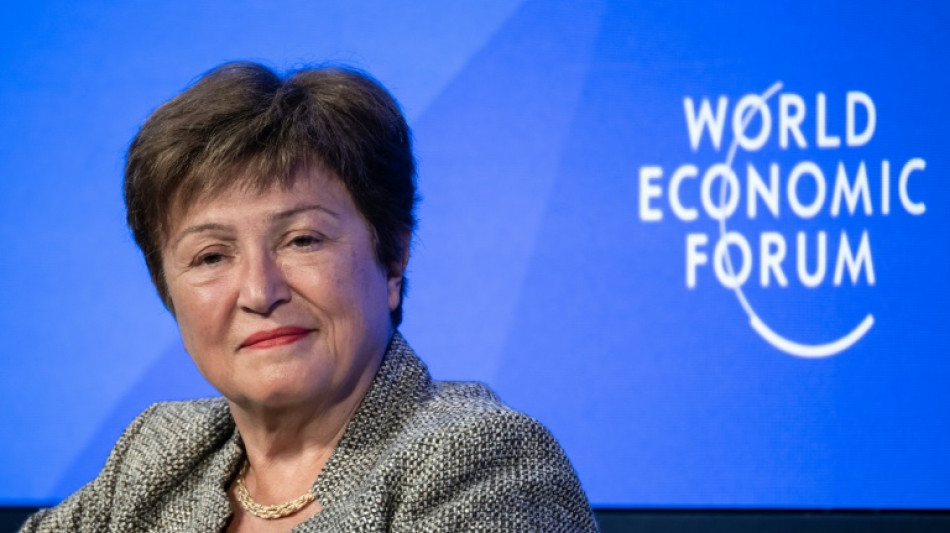
IMF chief warns risks to financial stability have increased / Photo: Fabrice COFFRINI - AFP/File
 Kiss of Life Teases First Winter Single 'Greedy'

 Eight-Year-Old Georgia Wins Penrith Valley Public Speaking Competition

 5 Fun Date Night Ideas That Don't Cost a Fortune

 GIRLBAND! Headline Show at Rough Trade Marks National Breakthrough

 Samsung Galaxy Buds Active Leak Reveals ANC, Ear-Hook Design and One UI 9.5 Integration

 Egypt and Syria Sign Agreement to Restore Direct Flights After 14-Year Hiatus

 Van Gogh’s ‘Châtaigniers en Fleurs’ Sets $285m Record at Sotheby’s

 Anthropic Sets Record $81.3 Billion IPO Valuing AI Firm at $1.5 Trillion

International Monetary Fund chief Kristalina Georgieva warned on Sunday that risks to financial stability had increased and stressed "the need for vigilance" following the recent turmoil in the banking sector.
Speaking at a forum in Beijing, the IMF managing director said she expected 2023 "to be another challenging year", with global growth slowing to below 3.0 percent due the war in Ukraine, monetary tightening and "scarring" from the pandemic.
"Uncertainties are exceptionally high," with the outlook for the global economy likely to remain weak over the medium term, she told the China Development Forum.
"It is also clear that risks to financial stability have increased," she added.
"At a time of higher debt levels, the rapid transition from a prolonged period of low interest rates to much higher rates -- necessary to fight inflation -- inevitably generates stresses and vulnerabilities, as evidenced by recent developments in the banking sector in some advanced economies."
Her comments came after the financial sector was shaken by the collapse of Silicon Valley Bank and the enforced takeover of Swiss bank Credit Suisse by rival UBS, leading to fears of contagion.
Bank shares tumbled on Friday as fears about the health of the financial sector resurfaced, with German Chancellor Olaf Scholz forced to give reassurances about Deutsche Bank after the long-troubled lender became a focus of investor concerns.
Georgieva said policymakers had acted decisively in response to financial stability risks.
"These actions have eased market stress to some extent, but uncertainty is high which underscores the need for vigilance," she said.
The IMF chief, however, pointed to China's rebound as a bright spot for the world economy.
The IMF forecasts China's economy to grow 5.2 percent this year, driven by a rebound in private consumption as the country reopens after its pandemic isolation.
"The robust rebound means China is set to account for around one third of global growth in 2023 -- giving a welcome lift to the world economy," she said.
"A 1.0 percentage point increase in GDP growth in China leads to 0.3 percentage point increase in growth in other Asian economies, on average -- a welcome boost."
Georgieva urged China's policymakers to seek to raise productivity and rebalance the economy away from investment and towards more durable consumption-driven growth.
"Market-oriented reforms to level the playing field between the private sector and state-owned enterprises, together with investments in education, would significantly lift the economy's productive capacity," she said.
J.Williams--AMWN

