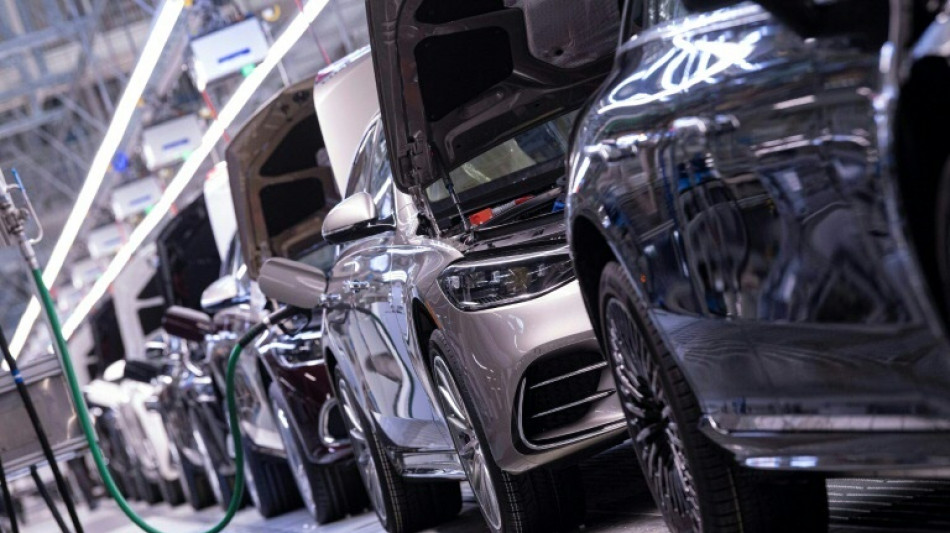
EU fossil fuel car ban gets final green light / Photo: THOMAS KIENZLE - AFP
 Kiss of Life Teases First Winter Single 'Greedy'

 Eight-Year-Old Georgia Wins Penrith Valley Public Speaking Competition

 5 Fun Date Night Ideas That Don't Cost a Fortune

 GIRLBAND! Headline Show at Rough Trade Marks National Breakthrough

 Samsung Galaxy Buds Active Leak Reveals ANC, Ear-Hook Design and One UI 9.5 Integration

 Egypt and Syria Sign Agreement to Restore Direct Flights After 14-Year Hiatus

 Van Gogh’s ‘Châtaigniers en Fleurs’ Sets $285m Record at Sotheby’s

 Anthropic Sets Record $81.3 Billion IPO Valuing AI Firm at $1.5 Trillion

The 27 EU member states gave final approval Tuesday to a ban on sales of new fossil fuel cars by 2035, after Germany dropped a last-minute blocking effort.
The vote was a formality after ambassadors on Monday backed the milestone agreement.
The majority of the bloc's energy ministers rubber-stamped the ban on Tuesday during a meeting in Brussels, with only Poland against. Bulgaria, Italy and Romania abstained.
The ban on internal combustion engines is a critical part of the bloc's push to be climate-neutral by 2050, with net-zero greenhouse gas emissions.
It was actually due to be approved earlier this month but Berlin frustrated its EU partners by withdrawing its support and demanding an exemption for synthetic fuels.
Germany's move was controversial since the deal had already passed under the traditional EU legislative process.
The fuels that Berlin sought exceptional rules for are still under development and must be produced using low-carbon electricity. Environmental activists oppose such fuels.
But manufacturers in Germany, one of the world's largest vehicle-producing nations, said the fuels could allow combustion engines to be used beyond 2035.
Critics said Germany's block was a result of domestic politics, with Chancellor Olaf Scholz under pressure to keep a coalition made up of his social democrats and rival Greens and liberals together.
His liberal partners wanted the exemption.
There was a breakthrough on Saturday after weeks of wrangling between the European Commission, the EU's executive arm, and the German transport ministry to resolve the row.
Vehicles with combustion engines can continue to be registered after 2035 if they only use fuels that are neutral in their CO2 emissions, German transport minister Volker Wissing said on Saturday.
"With the EU Council's final vote today the EU has taken an important step towards zero-emission mobility," the commission's climate chief Frans Timmermans tweeted.
P.Martin--AMWN

