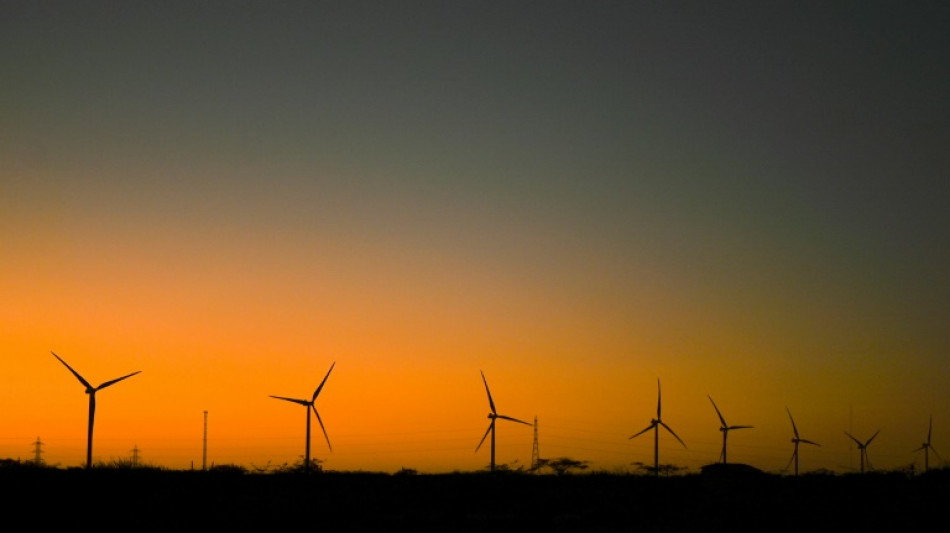
Indigenous Colombians in standoff over wind farms / Photo: JOAQUIN SARMIENTO - AFP
 Student Activism Shifts Underground After University Crackdown on Gaza Encampments

 Surge in Early Social Security Claims Linked to Agency Turmoil

 Panthers Seek NFC South Lead Against Ravens as Baltimore Ends Skid

 Tosca's 2026 Sustainability Report Makes the Case for Packaging as Critical Supply Chain Infrastructure

 5 Fun Date Night Ideas That Don't Cost a Fortune

 GIRLBAND! Headline Show at Rough Trade Marks National Breakthrough

 Samsung Galaxy Buds Active Leak Reveals ANC, Ear-Hook Design and One UI 9.5 Integration

 Egypt and Syria Sign Agreement to Restore Direct Flights After 14-Year Hiatus

 Van Gogh’s ‘Châtaigniers en Fleurs’ Sets $285m Record at Sotheby’s

In Colombia's far north, wind farm expansion is unsettling the Indigenous Wayuu inhabitants of a semi-desert region earmarked as an El Dorado of renewable energy.
The government of leftist new President Gustavo Petro aims to make La Guajira a "green energy capital of the world," but some locals claim they are being exploited and left behind.
For them, electricity and drinking water are scarce.
As part of a vast energy transition plan, in which solar and wind energy would represent eight percent of national supply, two wind farms have recently been built on this Caribbean peninsula.
Wind energy today accounts for 0.1 percent of Colombia's power generation, far behind hydroelectric power at 68.3 percent and thermal at 30.7 percent.
But the government aims to change this with 57 new wind farms -- some 3,000 turbines in total -- to be built at a cost of more than $15 billion over the next 10 years.
- 'Deceit' -
La Guajira is the ancestral territory of the Wayuu, and some 600 communities here will be impacted by the wind farm project, according to the Indepaz research institute.
The think tank has signaled that the Wayuu are being made to cede their land through "deceit" and "irregular" agreements.
And what's more, "La Guajira will not see a single kilowatt it produces," said Indepaz researcher Joanna Barney.
There are also claims of overt harassment.
Goat farmer Moises Jusayu said he lodged a criminal complaint, seen by AFP, after being attacked with a machete in 2018 at his village near the Windpeshi construction site.
He said he had refused to sell part of the family plot to energy companies EDPR and ENEL.
His daughter, Elba, said pressure exerted by the companies -- which also offered money to her uncle -- caused a family rift that resulted in one family member being killed and Moises fleeing with the members of his household.
Upon his return, his brother had supplanted him as chief and authorized wind turbine construction.
ENEL told AFP that none of its workers had ever caused harm to a member of the Wayuu community, while EDPR did not reply to a request for comment.
- 'It is strange ' -
In one of the two La Guajira wind farms operated since early 2022 by ISAGEN -- a subsidiary of Canadian company Brookfield -- 14 turbines tower over a fast-changing landscape.
"We wake up looking at our new neighbors. It is strange because we always grew up surrounded by vegetation," said Luis Iguaran, a teacher in Lanshalia, the only community here that does have electric power.
Since the turbines came, "animals can no longer graze," he claimed.
Indepaz registered a 50 percent drop in the goat population during the first five months of the park's operation.
ISAGEN had conducted a "prior consultation" with locals and agreed to finance "productive projects" in exchange for land use for 30 years, Indepaz's Barney told AFP.
In Lanshalia, that included installing solar panels and delivering 20,000 liters of drinking water per month.
According to Iguaran, this was insufficient for the ten families that live there.
The company told AFP it had complied with the terms of the agreement, approved by the local environmental authority.
But Iguaran said he wished he had had better advice to allow him to negotiate "better conditions."
"On paper, they (the conditions) seem generous: ENEL offers 1 billion (Colombian pesos) per year" -- or 220,000 dollars, said Barney.
"But there are 19 communities, each with between 40 and 80 people" in the affected region, she added -- which amounts to an investment of about $12 per person per month.
H.E.Young--AMWN

