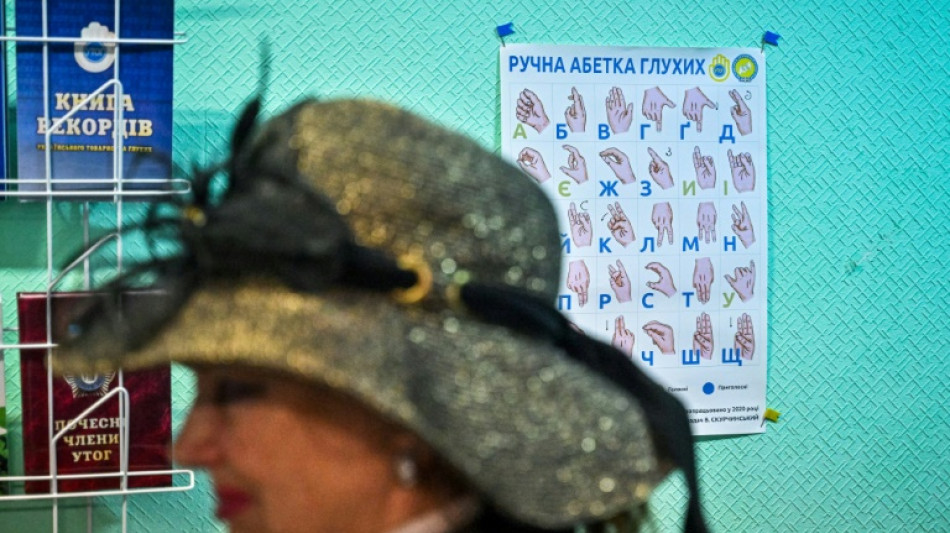
For deaf Ukrainians, smart watches can be life-saving / Photo: Sergei SUPINSKY - AFP
 Student Activism Shifts Underground After University Crackdown on Gaza Encampments

 Surge in Early Social Security Claims Linked to Agency Turmoil

 Panthers Seek NFC South Lead Against Ravens as Baltimore Ends Skid

 Tosca's 2026 Sustainability Report Makes the Case for Packaging as Critical Supply Chain Infrastructure

 5 Fun Date Night Ideas That Don't Cost a Fortune

 GIRLBAND! Headline Show at Rough Trade Marks National Breakthrough

 Samsung Galaxy Buds Active Leak Reveals ANC, Ear-Hook Design and One UI 9.5 Integration

 Egypt and Syria Sign Agreement to Restore Direct Flights After 14-Year Hiatus

 Van Gogh’s ‘Châtaigniers en Fleurs’ Sets $285m Record at Sotheby’s

It took a second for Andrii Yeger, a deaf Ukrainian, to realise that the waves of energy he felt were coming from a Russian rocket landing near his car.
"It all slowed down inside of me... I felt a vibration in my whole body," Yeger told AFP.
"I saw people and smoke, I took my phone, read the news and that's when I understood there was an explosion," the 61-year-old said.
The deaf community in Ukraine has been facing many challenges during the war, including inaudible air siren alerts, which an organisation hopes to solve with smart watches.
Yeger is a volunteer at the Ukrainian Society for the Deaf (UTOG), which has helped many through war's added hardships.
"The main issue was the access to information for hearing-impaired people. At the beginning of the war, there was almost nothing for them," UTOG's interim president Tetyana Kornyenko told AFP.
Kornyenko said residents evacuating from the southern Kherson and the eastern Donetsk and Lugansk regions near the frontline told the organisation they had struggled at checkpoints.
"It was very scary, they could not hear (the orders)," Kornyenko said.
Once at the railway stations, "train numbers and platforms were given via loudspeakers, which they couldn't hear," she added.
Kyiv and its region counted around 4,000 deaf residents before the war, according to UTOG.
Around 700 to 1,000 remain.
- Vital device -
Those still in the country are made vulnerable to shelling because they cannot hear air sirens alerted over loudspeakers or on phone applications.
Olena Mentchenko, 80, said people help her take cover when sirens resonate.
"I stayed in a shelter for three days, with nothing to eat, I was hungry," Mentchenko told AFP.
"But there were people who could hear in the shelter, they helped me and gave me food."
The Ukrainian Society for the Deaf created channels on the messaging platform Telegram to inform people of air raid alerts.
It has started translating video statements from officials into sign language, and advocates for the use of technology from smartphones to wearable devices to warn of upcoming strikes and rescue victims.
In January, a smart watch saved a young woman's life after a Russian missile strike on a residential block in Dnipro, which killed 45 people.
Deaf people cannot hear rescuers coming, so they cannot shout to guide them, UTOG's interim president explained.
The 27-year-old woman was "pulled out from the rubble after she used her smart watch to tell her mother she was alive," Kornyenko said.
Since then, the organisation -- which does not have the means to provide watches itself -- has been asking the government to help improve access to the life-saving devices.
The watches can cost up to a few hundred dollars and remain a luxury item in a country at war.
Yeger has gotten used to feeling missile strikes rather than hearing them.
Still, he is wearing the watch he got for his birthday "just in case, after what happened in Dnipro."
C.Garcia--AMWN

