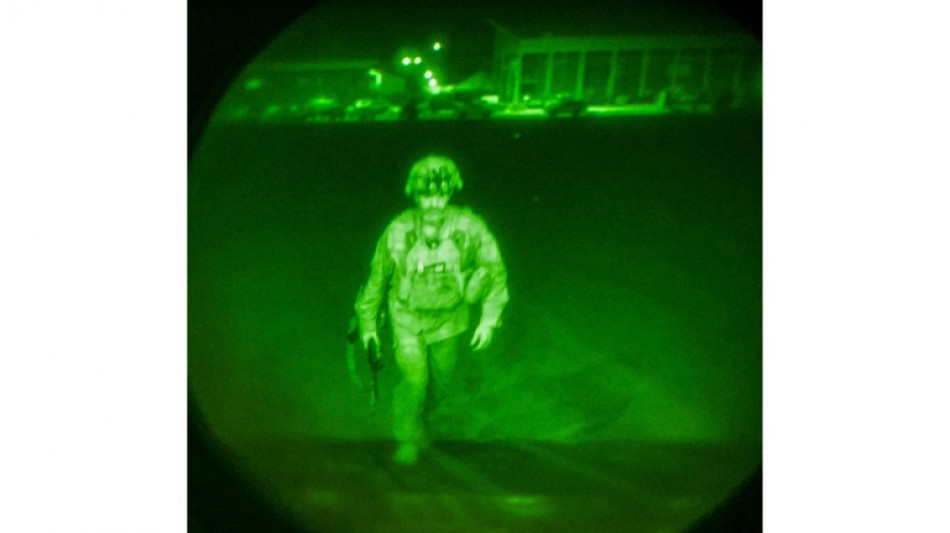
W. House admits massive intel failure in traumatic Afghan exit / Photo: Jack Holt - US Central Command (CENTCOM)/AFP/File
 ALIX LASERS shareholders remove Michael Sobitsch as managing director in view of the circumstances

 Kiss of Life Teases First Winter Single 'Greedy'

 Eight-Year-Old Georgia Wins Penrith Valley Public Speaking Competition

 5 Fun Date Night Ideas That Don't Cost a Fortune

 Tosca's 2026 Sustainability Report Makes the Case for Packaging as Critical Supply Chain Infrastructure

 West Midlands Shoppers Urged to Guard Against Black Friday Scams

 Surfshark Adds Real-Time Call Protection to iOS App in Version 5.3.0

 Saudi PIF Retains Top Sovereign Wealth Fund Brand Title for Third Year

 Professor Shahida Moosa Pioneers Medical Genomics in South Africa Amid Testing Shortages

The White House on Thursday released a long-awaited review of the traumatic US exit from Afghanistan, admitting there had been a massive intelligence failure in not predicting rapid Taliban victory, but defending overall US conduct.
"Clearly we didn't get things right" on intelligence, National Security Council spokesman John Kirby told reporters after the still classified report was sent to Congress.
But "ending a war, any war, is not an easy endeavor, certainly not after 20 years," he said. "It doesn't mean it wasn't worth doing -- ending that war in Afghanistan."
In a declassified summary of the review, the White House blamed conditions created by President Joe Biden's predecessor Donald Trump for the way the planned 2021 withdrawal turned into a rout, culminating in a desperate evacuation from Kabul airport.
But it also acknowledged that the US intelligence services had failed to understand the strength of the Taliban and the weakness of the Afghan government's forces that Western countries had spent years propping up.
In the end, nothing "would have changed the trajectory" of the exit and "ultimately, President Biden refused to send another generation of Americans to fight a war that should have ended for the United States long ago," the report said.
The pullout, ending on August 30, 2021, shocked Americans and US allies as the Taliban swept aside Western-trained Afghan forces within weeks.
Thirteen US troops and 170 Afghans were killed in an August 26 suicide bomb attack at the crowded perimeter to the airport, where an unprecedented military airlift operation managed to get more than 120,000 people out of the country in a matter of days.
- Afghan territories fell 'like dominos' -
In the summary, the White House blamed a deal struck previously between Trump's administration and the Taliban for putting the incoming Biden government in an impossible position.
"The departing Trump administration had left the Biden administration with a date for withdrawal, but no plan for executing it. And after four years of neglect -- and in some cases deliberate degradation -- crucial systems, offices, and agency functions that would be necessary for a safe and orderly departure were in disrepair," the document said.
"After more than 20 years, more than $2 trillion dollars, and standing up an Afghan army of 300,000 soldiers, the speed and ease with which the Taliban took control of Afghanistan suggests that there was no scenario -- except a permanent and significantly expanded US military presence -- that would have changed the trajectory," it added.
Kirby acknowledged that the US government did not manage to predict "how fast the Taliban were moving across the country" or "the degree to which they were constructing these deals in the hinterlands that kind of fell like dominos."
"We didn't anticipate how fast the Afghan national security forces were going to fold," he said. "I don't think we fully appreciated the degree of corruption that was in the officer ranks in the military."
"Intelligence is a hard business and they get it right a lot too," Kirby said.
M.A.Colin--AMWN


