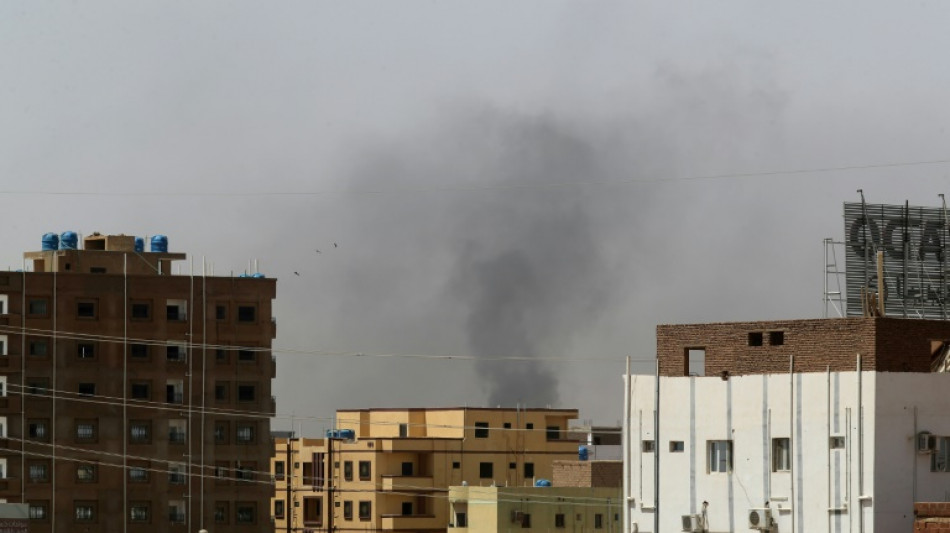
Fighting rocks Sudan capital as regular army battles paramilitaries / Photo: - - AFP
 ALIX LASERS shareholders remove Michael Sobitsch as managing director in view of the circumstances
 Kiss of Life Teases First Winter Single 'Greedy'

 Eight-Year-Old Georgia Wins Penrith Valley Public Speaking Competition

 5 Fun Date Night Ideas That Don't Cost a Fortune

 Tosca's 2026 Sustainability Report Makes the Case for Packaging as Critical Supply Chain Infrastructure

 West Midlands Shoppers Urged to Guard Against Black Friday Scams

 Surfshark Adds Real-Time Call Protection to iOS App in Version 5.3.0

 Saudi PIF Retains Top Sovereign Wealth Fund Brand Title for Third Year

 Professor Shahida Moosa Pioneers Medical Genomics in South Africa Amid Testing Shortages

Explosions rocked the Sudanese capital Saturday as paramilitaries and the regular army traded attacks on each other's bases, days after the army warned the country was at a "dangerous" turning point.
The eruption of violence came after weeks of deepening tensions between military leader Abdel Fattah al-Burhan and his number two, paramilitary commander Mohamed Hamdan Daglo, over the planned integration of the paramilitary Rapid Support Forces (RSF) into the regular army.
Witnesses reported "confrontations" and loud explosions and gunfire near an RSF base in south Khartoum.
The RSF said its forces had taken control of Khartoum airport, after witnesses reported seeing truckloads of fighters entering the airport compound.
AFP reporters heard gunfire near the airport, as well near Burhan's residence and in Khartoum North. Civilians were seen running for cover as artillery exchanges rocked the streets.
The two sides traded blame for starting the fighting.
"The Rapid Support Forces were surprised Saturday with a large force from the army entering camps in Soba in Khartoum and laying siege to paramilitaries there," it said in a statement.
It said a "sweeping attack with all kinds of heavy and light weapons" was under way.
The RSF said its fighters had also taken control of the airport in Merowe, north of Khartoum.
- 'Clashes' -
The army blamed the paramilitaries for the heavy fighting.
"Fighters from the Rapid Support Forces attacked several army camps in Khartoum and elsewhere around Sudan," army spokesman Brigadier General Nabil Abdallah told AFP.
"Clashes are ongoing and the army is carrying out its duty to safeguard the country."
Troops blocked off the bridges across the Nile linking Khartoum with its sister cities of Omdurman and Khartoum North. They also sealed off the road to the presidential palace.
Military leader Burhan has been at loggerheads with his number two, the RSF commander, over talks to finalise a deal to return the country to civilian rule and end the crisis sparked by their 2021 coup.
A plan to integrate the RSF into the regular army is one of the key points of contention, analysts have said.
Eleventh-hour haggling between the two men over the details has twice forced postponement of the signing of an agreement with civilian factions setting out a roadmap for the transition.
In its statement Thursday, the regular army said it was "sounding the alarm as the country is at a dangerous historical turning point".
"The risks are increasing as the RSF command mobilised and spread forces in the capital and other cities," the army said.
It said the deployment, which "took place without the approval of, or even just coordination with, the armed forces command" has "exacerbated security risks and increased tensions among security forces".
The RSF defended its deployment, saying it works in coordination with the regular army and its fighters "move throughout the country to achieve security and stability".
Created in 2013, the RSF emerged from the Janjaweed militia that then president Omar al-Bashir unleashed against non-Arab ethnic minorities in the western Darfur region a decade earlier, drawing accusations of war crimes.
In recent months, Daglo has said the 2021 coup was a "mistake" that failed to bring about change in Sudan and reinvigorated remnants of Bashir's regime, which was ousted by the army in 2019 following month of mass protests.
Burhan, a career soldier from northern Sudan who rose the ranks under Bashir's three-decade rule, maintained that the coup was "necessary" to bring more groups into the political process.
F.Schneider--AMWN


