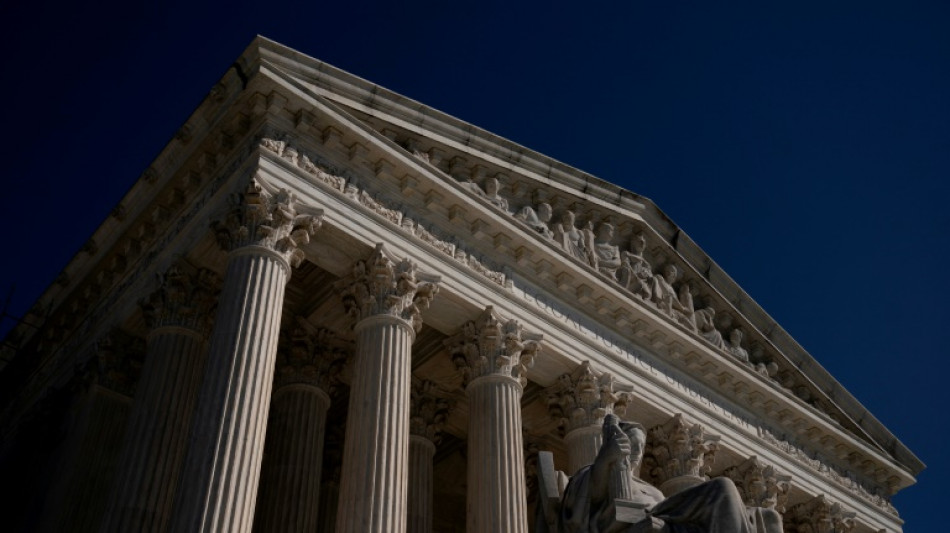
Sacred Sundays: US high court debates religious rights at work / Photo: Stefani Reynolds - AFP
 ALIX LASERS shareholders remove Michael Sobitsch as managing director in view of the circumstances
 Kiss of Life Teases First Winter Single 'Greedy'

 Eight-Year-Old Georgia Wins Penrith Valley Public Speaking Competition

 The DEA Laid The Trap - And State Marijuana Operators Took The Bait

 Tosca's 2026 Sustainability Report Makes the Case for Packaging as Critical Supply Chain Infrastructure

 West Midlands Shoppers Urged to Guard Against Black Friday Scams

 Surfshark Adds Real-Time Call Protection to iOS App in Version 5.3.0

 Saudi PIF Retains Top Sovereign Wealth Fund Brand Title for Third Year

 Professor Shahida Moosa Pioneers Medical Genomics in South Africa Amid Testing Shortages
The US Supreme Court opened debate Tuesday on the rights of a Christian mail carrier who refuses to work on Sundays, in a case that could force employers to do more to accomodate religious beliefs in the workplace.
The high court, which has been sensitive to religious rights since Donald Trump placed three conservatives on the bench during his 2017-2021 presidency, will hear the case of evangelical Christian Gerald Groff.
As a result of a contract between the US Postal Service and Amazon, Groff, who began working for USPS in 2012, was required to work on Sundays to process packages at a mail sorting center.
Citing his religious beliefs, Groff asked for an accommodation so that he would not have to work on the Sabbath.
His postmaster tried to oblige him, including transferring him to a smaller facility.
But in 2017, he again was asked to start delivering Amazon packages, and the postmaster was not always successful at finding colleagues to cover Groff's Sunday shifts.
Groff was disciplined for abandoning his job, and in 2019 he resigned and filed a complaint against the US Postal Service for religious discrimination.
After losing his initial case and an appeal, Groff turned to the Supreme Court to weigh in.
By agreeing to take up the case the high court suggested it was not satisfied with the lower courts' views of his religious rights.
- 'Minimal cost' -
Experts say the nine-justice bench could use the case to review its existing law on religion in the workplace.
A 1964 federal law, amended in 1972, prohibits religious discrimination in the workplace and requires employers accomodate employees' beliefs as long as it does not "unduly burden" their business.
In 1977, in a case involving an airline employee who did not want to work on Saturdays, the Supreme Court ruled that accommodations should not require the employer "to bear more than a (negligible) cost."
The ruling was strongly criticized by religious rights advocates, who want believers to have stronger protections in such cases.
Harvard law professor Joshua McDaniel wrote that, as it stands, the law "let businesses avoid accommodating religious practices in most cases."
In asking the Supreme Court to revisit the issue, Groff said the existing standard amounted to an "egregious and consequential error."
In a separate filing, however, the powerful AFL-CIO labor confederation urged the court to consider the "burden" imposed by religious accommodations on all coworkers, not just the employer.
Arguments from the parties will run for about an hour Tuesday and the justices must make its decision by June 30.
Ch.Havering--AMWN


