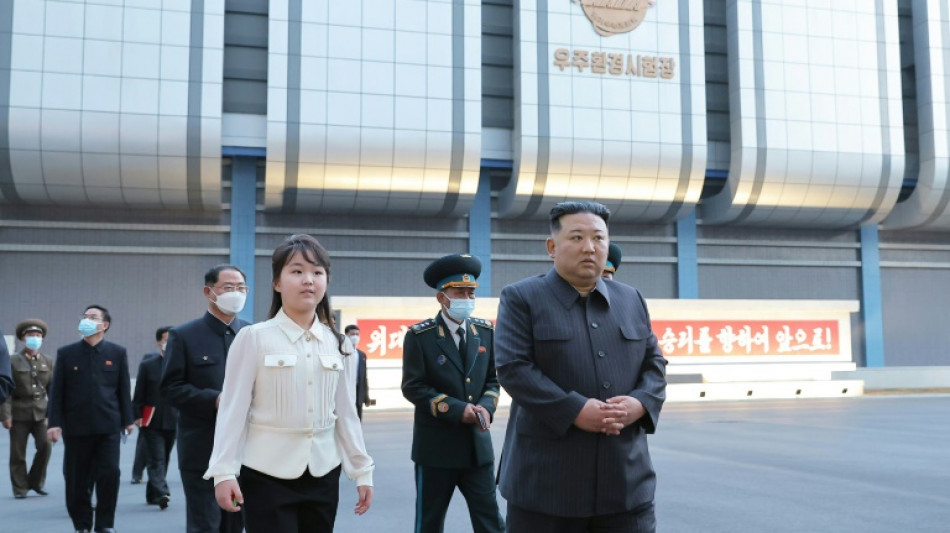
Kim orders launch of North Korea's first spy satellite / Photo: STR - KCNA VIA KNS/AFP
 ALIX LASERS shareholders remove Michael Sobitsch as managing director in view of the circumstances

 Kiss of Life Teases First Winter Single 'Greedy'

 Eight-Year-Old Georgia Wins Penrith Valley Public Speaking Competition

 The DEA Laid The Trap - And State Marijuana Operators Took The Bait

 Tosca's 2026 Sustainability Report Makes the Case for Packaging as Critical Supply Chain Infrastructure

 West Midlands Shoppers Urged to Guard Against Black Friday Scams

 Surfshark Adds Real-Time Call Protection to iOS App in Version 5.3.0

 Saudi PIF Retains Top Sovereign Wealth Fund Brand Title for Third Year

 Professor Shahida Moosa Pioneers Medical Genomics in South Africa Amid Testing Shortages
North Korean leader Kim Jong Un said the country has finished building its first military spy satellite and gave the green light for its launch, state media said Wednesday.
The report of its completion comes about a week after Pyongyang launched what it said was a new solid-fuel intercontinental ballistic missile, marking a major breakthrough in its banned weapons programmes.
Analysts have said there is significant technological overlap between the development of ICBMs and space launch capabilities.
Kim gave instructions on Tuesday to "make sure that the military reconnaissance satellite No. 1 completed as of April will be launched at the planned date," the official Korean Central News Agency (KCNA) reported.
During a visit to North Korea's National Aerospace Development Administration on Tuesday, he also called on staff to "firmly establish the satellite intelligence-gathering capability by deploying several reconnaissance satellites on different orbits in succession".
State media images showed Kim touring the space agency with his daughter. The items he was inspecting, as well as charts and other wall displays in some of the images were blurred out.
The development of a military reconnaissance satellite was one of the key defence projects outlined by Kim in 2021.
On Tuesday, he said gaining this reconnaissance technology was a "primary task to be indispensably fulfilled" because of what he descibed as threats and aggression from the United States and South Korea.
In December 2022, North Korea said it had carried out an "important final-stage test" for the development of a spy satellite, which it said it would complete by April this year.
At the time, experts in South Korea quickly raised doubts about the results, saying the quality of the black-and-white images released by North Korea -- purportedly taken from a satellite -- was poor.
Pyongyang has not provided a launch date, though on Tuesday, Kim said the satellite would be sent up "at the planned date".
- 'Significant threat' -
"It looks like the North will launch its 'symbolic' satellite for now, and upgrade it gradually," An Chan-il, a defector-turned-researcher who runs the World Institute for North Korea Studies, told AFP.
"If China and Russia do not provide high-tech support, it will be difficult to carry out spying with North Korea's own technology."
Even so, the latest announcement should be taken seriously, said Yang Moo-jin, president of the University of North Korean Studies in Seoul.
"Since North Korea's reconnaissance satellites are an important factor in the event of a nuclear pre-emptive strike, they pose a significant threat to the South," he told AFP.
North Korea declared itself an "irreversible" nuclear power last year, effectively ending the possibility of denuclearisation talks.
Washington and Seoul have ramped up defence cooperation in response, staging joint military exercises with advanced stealth jets and high-profile US strategic assets.
North Korea views such exercises as rehearsals for invasion and described them last week as "frantic" drills "simulating an all-out war against" Pyongyang.
C.Garcia--AMWN


