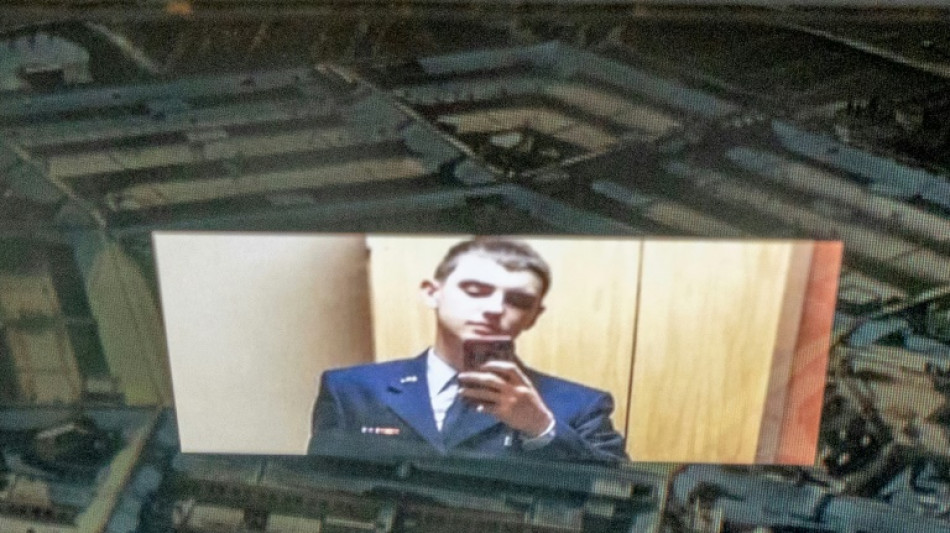
Why a junior US guardsman had top secret access / Photo: Stefani REYNOLDS - AFP/File
 ALIX LASERS shareholders remove Michael Sobitsch as managing director in view of the circumstances

 Kiss of Life Teases First Winter Single 'Greedy'
 Eight-Year-Old Georgia Wins Penrith Valley Public Speaking Competition

 The DEA Laid The Trap - And State Marijuana Operators Took The Bait

 Tosca's 2026 Sustainability Report Makes the Case for Packaging as Critical Supply Chain Infrastructure

 West Midlands Shoppers Urged to Guard Against Black Friday Scams

 Surfshark Adds Real-Time Call Protection to iOS App in Version 5.3.0

 Saudi PIF Retains Top Sovereign Wealth Fund Brand Title for Third Year

 Professor Shahida Moosa Pioneers Medical Genomics in South Africa Amid Testing Shortages
Jack Teixeira gained a high-level security clearance through his job as an IT specialist just two years after joining the Air National Guard -- a relatively common situation he allegedly exploited to leak top secret US documents.
As the US government works to assess the damage from its worst unauthorized revelation of restricted material in a decade, officials face questions over why Teixeira -- a 21-year-old airman first class who has been arrested and charged with mishandling classified information -- had such access at his young age and junior rank.
While it is not unusual for lower-ranking US military personnel to have high-level clearances, Teixeira's case does however point to multiple apparent breakdowns in the procedures aimed at safeguarding government secrets.
Teixeira "was a systems administrator, so he was a computer specialist that worked in an intelligence unit," US Defense Secretary Lloyd Austin told journalists in Sweden on Wednesday. "Part of his responsibility was... maintaining the network that they operate on."
Teixeira's age is "really not the issue," Austin said, noting that "it's not exceptional that young people are doing important things in our military."
Instead, the issue is "how you responsibly execute or carry out your duties and how you protect the information," he said.
"All of us have a requirement to do that. And supervisors have a requirement to make sure that that's being done."
Teixeira joined the Air National Guard, a military reserve force, in September 2019. He gained a top secret clearance as well as "sensitive compartmented access (SCI) to other highly classified programs" in 2021, according to an FBI affidavit supporting the criminal complaint against him.
- 'Multiple failures' -
He allegedly used that access to photograph sensitive documents and share them with an online chat group he managed. From there, dozens of the images spread across the internet, publicizing secret information such as US concerns over Ukraine's military capacity and pointing to apparent spying on close allies.
"It's not unusual for someone at this age to have a top secret clearance," said Glenn Gerstell, former general counsel of the National Security Agency and Central Security Service.
"There are a lot of people in the military who, whether because they're IT specialists or because they are assembling briefing books for more senior people, have access at very high levels," said Gerstell, who is now a senior advisor at the Center for Strategic and International Studies.
But "it's not clear why he would need access to substantive intelligence reports," he told AFP, noting that Teixeira also should not have been able to print sensitive documents or take them out of a secure facility.
"That's... multiple failures of security," Gerstell said.
Air Force Chief of Staff General Charles Brown told US lawmakers Tuesday that Teixeira had access to classified information through his job and "took advantage of that access."
"We do have protections in place to protect classified information," Brown said. "Obviously in this case, this process fell apart."
P.M.Smith--AMWN


