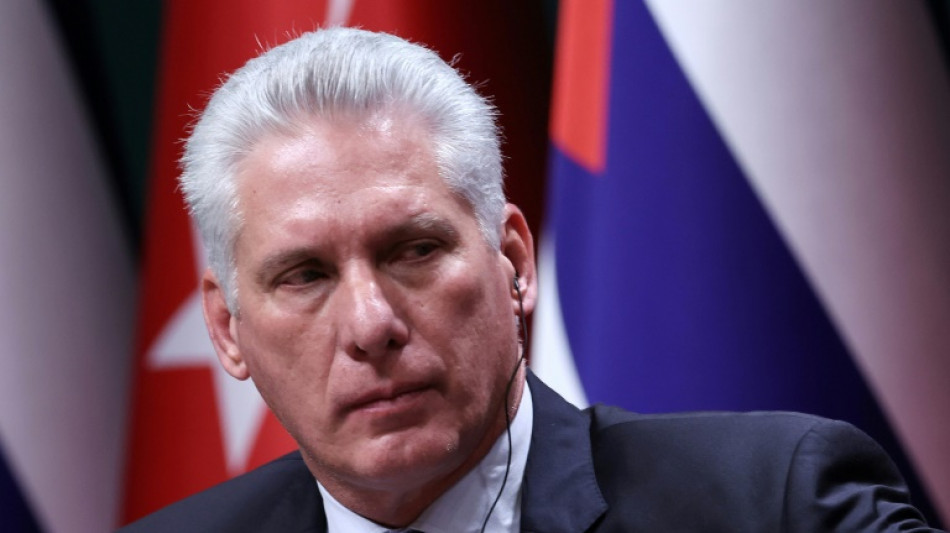
Cuban President Diaz-Canel to tackle 'inefficiencies' after reelection / Photo: Adem ALTAN - AFP/File
 ALIX LASERS shareholders remove Michael Sobitsch as managing director in view of the circumstances
 Kiss of Life Teases First Winter Single 'Greedy'
 Eight-Year-Old Georgia Wins Penrith Valley Public Speaking Competition

 The DEA Laid The Trap - And State Marijuana Operators Took The Bait

 Tosca's 2026 Sustainability Report Makes the Case for Packaging as Critical Supply Chain Infrastructure

 West Midlands Shoppers Urged to Guard Against Black Friday Scams

 Surfshark Adds Real-Time Call Protection to iOS App in Version 5.3.0

 Saudi PIF Retains Top Sovereign Wealth Fund Brand Title for Third Year

 Professor Shahida Moosa Pioneers Medical Genomics in South Africa Amid Testing Shortages
Cuba's President Miguel Diaz-Canel vowed to "resolve inefficiencies" after clinching a second five-year term on Wednesday in a parliamentary vote for which he was the sole candidate in a country where political opposition is illegal.
Diaz-Canel's bid was confirmed with 459 of the 462 legislators present in the Communist Party of Cuba-aligned National Assembly voting for his reelection, its president Esteban Lazo announced in the chamber.
The president then urged his cabinet to "face up to obstacles and resolve inefficiencies" in order to "increase the supply of goods and services and to control inflation."
Diaz-Canel also criticized "the bureaucratism, indifference (and) the unacceptable corruption" that he said was holding the country back during difficult times.
The 62-year-old took over the reins in 2018 as Cuba's first civilian leader after nearly 60 years of hegemony by the Castro brothers, and set out in pursuit of cautious economic liberalization.
His first five years in office were marked by the worst economic crisis in three decades and a widely criticized response to historic anti-government protests that triggered a tightening of US sanctions.
Diaz-Canel's 459 votes amounted to 97.66 percent of the 470 members of the National Assembly, eight of whom were not present for the vote.
"Taking into account the announced results, I declare lawmaker Miguel Mario Diaz-Canel Bermudez the elected president of the Republic," said Lazo.
The National Assembly also voted to reelect Lazo, 79, his deputy Ana Maria Mari Machado, 59, and the country's vice-president Salvador Valdes Mesa, 77.
- Incomplete reforms -
Diaz-Canel is determined to have another stab at reform, recently telling the pan-Arab television channel Al Mayadeen he was "dissatisfied" that his efforts at addressing Cuba's economic woes had not been "more efficient, more effective."
Under Diaz-Canel, an electronic engineer by training, Cuba sought to accelerate the opening of the economy to small businesses in hundreds of sectors previously under exclusive state control.
Two years ago, he initiated a monetary reform that ended artificial parity with the US dollar but fueled inflation and sharply devalued the local currency -- another blow to an ailing economy hard hit by US sanctions in place since 1962 and a tourism dip brought on by the coronavirus pandemic.
The reforms under Diaz-Canel "have not meant a complete and comprehensive transition to a mixed economy" of private and public enterprises, analyst Arturo Lopez-Levy, of the Autonomous University of Madrid, told AFP.
Most companies in Cuba are still state-controlled.
"Some economic changes have not taken place, and others that have taken place, have left much skepticism," said Lopez-Levy.
Long-suffering Cubans face daily shortages of food, medicine and fuel, and since the arrival of mobile internet in 2018 have increasingly taken to social media to voice their dissatisfaction.
But in 2021, the largest protests since the 1959 Castro-led revolution was met with a harsh response that left one dead, dozens injured and more than 1,300 imprisoned, according to rights observers.
Since then, Cuba has experienced an unprecedented exodus, with more than 300,000 of its nationals leaving for other shores in 2022 alone.
Under Cuban law, a president can serve no more than two successive terms.
Since 2021, Diaz-Canel has also served as first secretary of the communist party -- the country's most powerful position long held by revolutionary leader Fidel Castro and then his brother Raul.
M.A.Colin--AMWN


