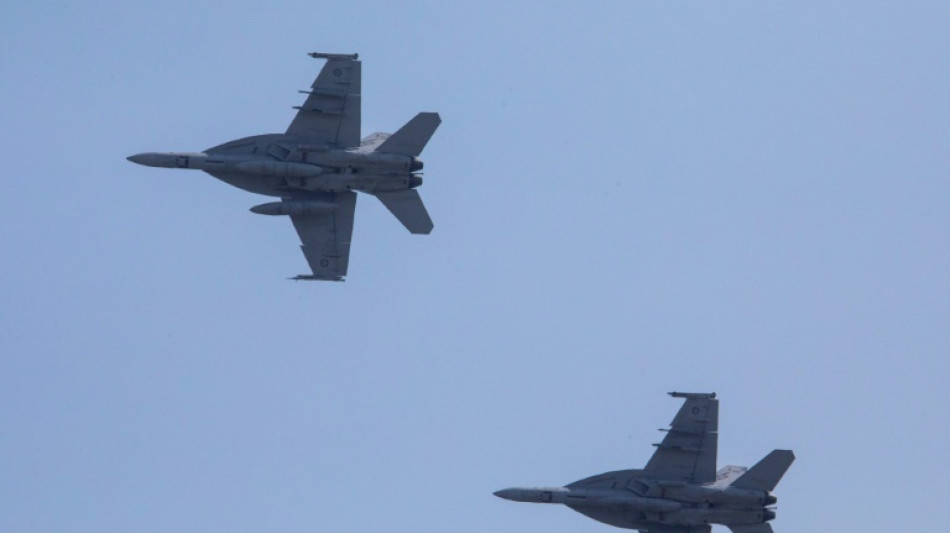
Australia unveils biggest defence reform in decades / Photo: Ness Kerton - AFP/File
 ALIX LASERS shareholders remove Michael Sobitsch as managing director in view of the circumstances

 Kiss of Life Teases First Winter Single 'Greedy'

 Eight-Year-Old Georgia Wins Penrith Valley Public Speaking Competition

 The DEA Laid The Trap - And State Marijuana Operators Took The Bait

 Tosca's 2026 Sustainability Report Makes the Case for Packaging as Critical Supply Chain Infrastructure

 West Midlands Shoppers Urged to Guard Against Black Friday Scams

 Surfshark Adds Real-Time Call Protection to iOS App in Version 5.3.0

 Saudi PIF Retains Top Sovereign Wealth Fund Brand Title for Third Year

 Professor Shahida Moosa Pioneers Medical Genomics in South Africa Amid Testing Shortages
Australia unveiled its biggest military shakeup in decades on Monday, refocusing the armed forces on deterring would-be foes far from its shores.
Sketching a future in which Australia would have substantially longer-range strike capability, Defence Minister Richard Marles said the decades-old territory-focused strategy was "no longer fit for purpose".
Facing a more combative China, he said Australia will shift its focus to deterring enemies before they reach its shores -- at sea, in the air and online.
"Today, for the first time, in 35 years, we are recasting the mission of the Australian Defence Force," Marles said.
The long-awaited strategic review by the defence ministry said Beijing's military build-up is now the largest and most ambitious of any country since World War II.
"This build-up is occurring without transparency or reassurance to the Indo-Pacific region of China's strategic intent," the review said, using another term for the Asia-Pacific.
"China's assertion of sovereignty over the South China Sea threatens the global rules-based order in the Indo-Pacific in a way that adversely impacts Australia's national interests."
Australia has already announced a key tool in its new strategy -- the development of stealthy long-range nuclear-powered submarines.
Building on that, the Australian Defence Force will acquire long-range missile strike capabilities, both air- and land-launched.
There will be a short independent review this year of the navy's surface combatant fleet to ensure its size, structure and composition complement the capabilities provided by the new nuclear-powered submarines.
The Australian army will focus more sharply on coastal defence, particularly along the country's vast north.
As a result, a plan to purchase 450 infantry fighting vehicles will be scaled back to just 129.
Australian military planners have viewed China's military rise warily, fearing that Beijing's now-vast capabilities could effectively cut Australia off trading partners and global supply chains.
The return of major power strategic competition between China and the United States "should be seen as the defining feature of our region and time", the review said.
O.Karlsson--AMWN


