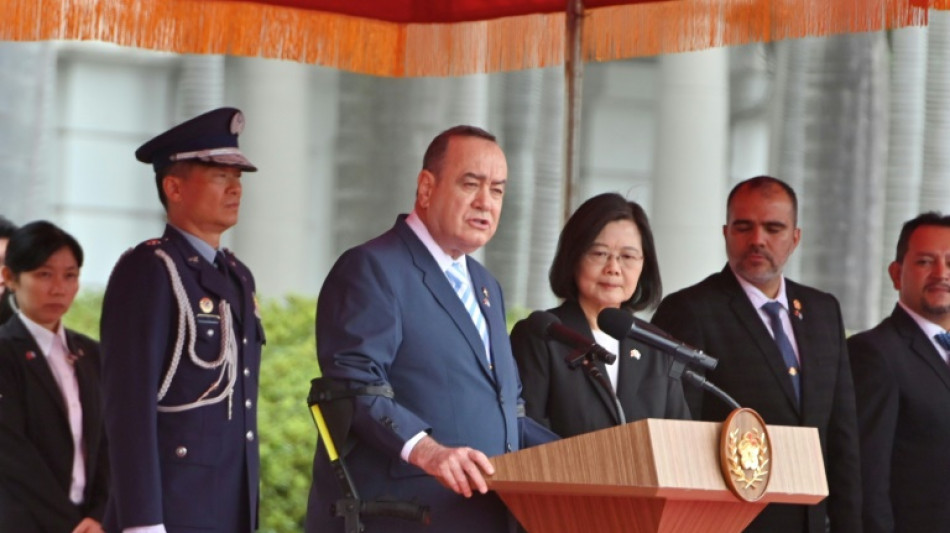
Guatemala vows to stand by 'solid' ally Taiwan / Photo: Sam Yeh - AFP
 ALIX LASERS shareholders remove Michael Sobitsch as managing director in view of the circumstances
 Kiss of Life Teases First Winter Single 'Greedy'

 Eight-Year-Old Georgia Wins Penrith Valley Public Speaking Competition

 The DEA Laid The Trap - And State Marijuana Operators Took The Bait

 Tosca's 2026 Sustainability Report Makes the Case for Packaging as Critical Supply Chain Infrastructure

 West Midlands Shoppers Urged to Guard Against Black Friday Scams

 Surfshark Adds Real-Time Call Protection to iOS App in Version 5.3.0

 Saudi PIF Retains Top Sovereign Wealth Fund Brand Title for Third Year

 Professor Shahida Moosa Pioneers Medical Genomics in South Africa Amid Testing Shortages
Guatemalan President Alejandro Giammattei pledged support on Tuesday for "solid diplomatic ally" Taiwan during a visit to the self-ruled island that has been slammed by China.
The Central American nation is one of the few remaining countries to recognise Taiwan, a list that has shrunk in recent years as Beijing moves to isolate Taipei on the international stage.
China considers democratic Taiwan a part of its territory to be taken one day, and does not allow nations to recognise both Beijing and Taipei.
Giammattei, who arrived Monday for a four-day visit, vowed at a military welcome ceremony to "stand by the Republic of Taiwan as a solid diplomatic ally".
He addressed Taiwan's parliament hours later and called for an end to Chinese aggression toward the island, once again calling it the "Republic of Taiwan" instead of its official name, the Republic of China (Taiwan).
"Let us be in solidarity with those who are under constant siege from the other side of the Taiwan Strait," Giammattei said.
"Guatemala is a pacifist country. That is why I demand the immediate silence of the war drums."
He also reiterated support for Taiwan's sovereignty: "Guatemala maintains its unalterable position in favour of the recognition of Taiwan as an independent nation".
Taiwan President Tsai Ing-wen thanked Giammattei.
"I look forward to our countries deepening relations and exploring more opportunities for cooperation through this visit," she said at the welcoming event.
The two leaders also held bilateral talks later in the day.
China's foreign ministry issued a strongly worded rebuke to Giammattei's use of the "Republic of Taiwan".
"There is no way out for those advocating for a so-called Taiwan independence," foreign ministry spokesperson Mao Ning said at a press briefing.
"If we may offer a bit of advice to the government of Alejandro Giammattei: don't take the side of the ill-intended, do not act for your own selfish interests and go against international affairs and the wishes of the Guatemalan people."
- Diplomatic battleground -
Giammattei is scheduled to visit a technology company in Taichung City and attend an event promoting Guatemalan coffee, according to Tsai's office.
This month, Tsai travelled to Guatemala and Belize, the only other Central American country that recognises Taipei, to firm up diplomatic relations after Honduras switched allegiance to Beijing in March.
She stopped in the United States to meet Speaker of the House Kevin McCarthy on her way back to Taipei.
In response, Beijing staged three days of military exercises simulating targeted strikes and a blockade of Taiwan.
Taiwan's defence ministry said Tuesday it had detected nine Chinese aircraft and 11 warships around the island in the past 24 hours, the highest number of naval vessels since the war drills ended two weeks ago.
China, one of Guatemala's major trading partners, has emphasised that it would be in the Central American nation's interest to switch recognition to Beijing.
Latin America has been a key diplomatic battleground for China and Taiwan since the two split in 1949 after a civil war.
Beijing has spent decades convincing Taipei's diplomatic allies to switch sides, gaining nine since Tsai took office in 2016.
Taiwan's ties with Paraguay are also at risk, with opposition candidate Efrain Alegre reportedly saying he would switch recognition to Beijing if he wins the presidential election on April 30.
O.M.Souza--AMWN


