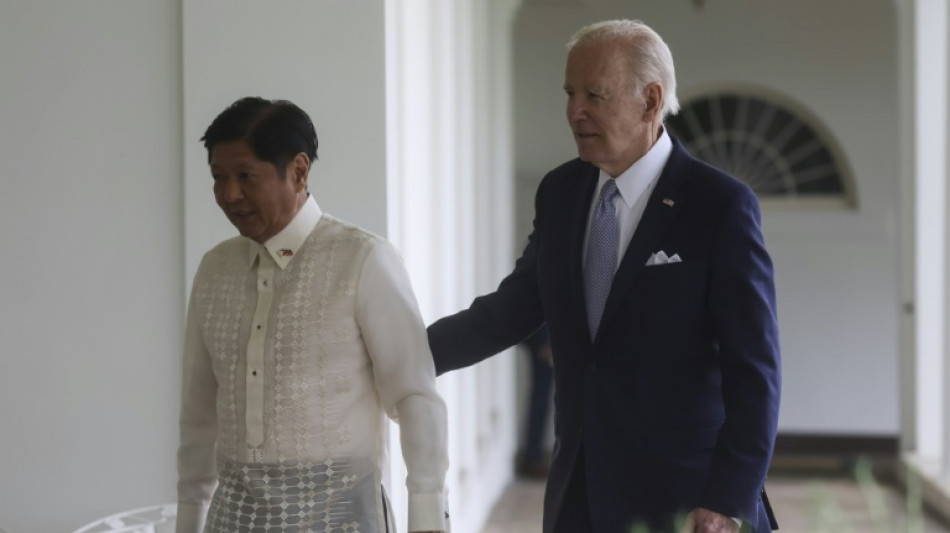
Biden, Marcos discuss securing tense South China Sea / Photo: LEAH MILLIS - POOL/AFP
 ALIX LASERS shareholders remove Michael Sobitsch as managing director in view of the circumstances

 Kiss of Life Teases First Winter Single 'Greedy'

 Eight-Year-Old Georgia Wins Penrith Valley Public Speaking Competition

 Tosca's 2026 Sustainability Report Makes the Case for Packaging as Critical Supply Chain Infrastructure

 The DEA Laid The Trap - And State Marijuana Operators Took The Bait

 Ryde Group Ltd Announces Non-Binding Term Sheet for Proposed Minority Investment in Multi Genius Limited and MOU on Technology Collaboration

 West Midlands Shoppers Urged to Guard Against Black Friday Scams

 Surfshark Adds Real-Time Call Protection to iOS App in Version 5.3.0

 Saudi PIF Retains Top Sovereign Wealth Fund Brand Title for Third Year

 Professor Shahida Moosa Pioneers Medical Genomics in South Africa Amid Testing Shortages
Responding to Beijing's aggressive expansion into the trade routes and strategic islands of the South China Sea headlined talks Monday between President Joe Biden and his Philippines counterpart Ferdinand Marcos at the White House.
Marcos is on a four-day trip that follows last week's state visit to Washington by South Korean President Yoon Suk Yeol and a White House meeting in January between Biden and Japanese Prime Minister Fumio Kishida.
Greeting Marcos in the Oval Office, Biden underlined the "ironclad" US commitment to defending the country.
Marcos referred to "difficult times" and said the Philippines finds itself in a region with "arguably the most complicated geopolitical situation in the world right now."
"So it is only natural for the Philippines to look to its sole treaty partner in the world to strengthen, to redefine, the relationship that we have and the roles that we play in the face of those rising tensions that we see now around the South China Sea and Asia Pacific," he said.
A senior US official said the Marcos visit -- which began with a military honor guard outside the White House -- was the first "at this level and intensity" between the two countries for decades.
"It is clear that we're in a deeply consequential period in terms of our Indo-Pacific engagements," the official told reporters, speaking on condition of anonymity.
- Ships in near collision -
Alarm bells are ringing for Washington and its Asian allies as China moves ever more confidently to assert claims to sovereignty over almost the whole South China Sea -- ignoring an international ruling that this has no legal basis.
The tension, combined with constant saber rattling over Taiwan -- the democratically run island that Beijing claims but Washington vows to help defend -- has prompted the Biden administration to rapidly bolster its military capabilities.
The Philippines, which lies close to key sea lanes and Taiwan, is of particular interest.
Marcos signaled as he left for Washington that he is wary of being caught between the superpowers, telling reporters: "We will not allow the Philippines to be used as a staging post for any kind of military action."
However, this month, the Philippines identified four military bases -- in addition to five existing sites -- where US forces will be given access, including one located near the tense Spratly Islands.
The two allies also carried out their largest-ever military maneuvers in recent weeks.
That has alarmed China, which accuses Washington of trying to drive a wedge between Beijing and Manila.
In a reminder of how diplomatic tensions can quickly echo in the real world, a Chinese ship on April 23 narrowly missed colliding with a much smaller Philippine Coast Guard vessel in the Spratly Islands.
- New military muscle -
The focus of talks between Biden and Yoon last week was on another regional flashpoint: nuclear-armed, communist North Korea.
Expressing disappointment that China has not done more to rein in North Korea, US officials announced that a US nuclear submarine would make a visit to South Korea soon -- the first in decades.
During Kishida's visit, Biden also underlined the US treaty commitment to defend Japan. Tokyo is meanwhile on a shopping spree to buy an arsenal of US-made Tomahawk missiles.
The senior official briefing journalists ahead of Marcos's visit said Manila is likewise "looking for reassurance and a strong desire to maintain peace and stability in this complex period."
"Recent events have caused much greater focus in both capitals on taking the necessary steps to up our game, to improve engagement on the security side between the United States and the Philippines."
Although giving few details, the official said new "bilateral defense guidelines" would see "a series of steps to support the Armed Forces of the Philippines modernization."
In an acknowledgement of Philippine sensitivities about the US troop presence, White House National Security Council spokesman John Kirby emphasized that the sites slated to be used by the United States remain part of the Filipino military and "every single step of the way will be done in complete coordination."
"It's about our ability to be better allies to one another and meet our commitments to each other," he said.
The shifting geostrategic situation in the Asia-Pacific region will be a major topic when Biden visits Japan for a G7 meeting later in the month.
The US official said Biden would also meet separately during that trip in a trilateral format with the leaders of Japan and South Korea. He then heads to Australia for a session of the Quad group: Australia, India, Japan and the United States.
P.Stevenson--AMWN


