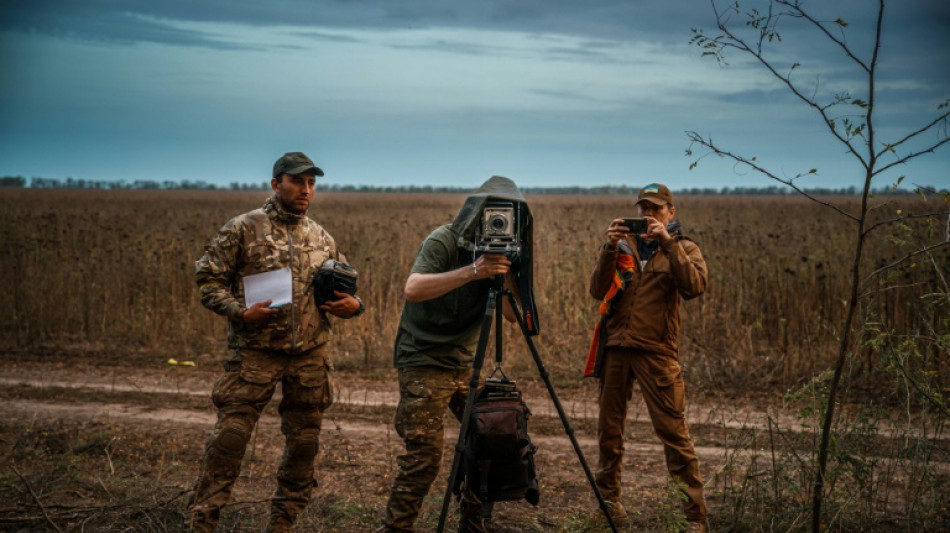
Ukrainian snaps vintage portraits of soldiers on the frontline / Photo: Dimitar DILKOFF - AFP
 ALIX LASERS shareholders remove Michael Sobitsch as managing director in view of the circumstances
 Kiss of Life Teases First Winter Single 'Greedy'

 Eight-Year-Old Georgia Wins Penrith Valley Public Speaking Competition

 Tosca's 2026 Sustainability Report Makes the Case for Packaging as Critical Supply Chain Infrastructure

 The DEA Laid The Trap - And State Marijuana Operators Took The Bait

 Ryde Group Ltd Announces Non-Binding Term Sheet for Proposed Minority Investment in Multi Genius Limited and MOU on Technology Collaboration

 West Midlands Shoppers Urged to Guard Against Black Friday Scams

 Surfshark Adds Real-Time Call Protection to iOS App in Version 5.3.0

 Saudi PIF Retains Top Sovereign Wealth Fund Brand Title for Third Year

 Professor Shahida Moosa Pioneers Medical Genomics in South Africa Amid Testing Shortages
Near the battle front in southern Ukraine, photographer Arseniy Gerasymenko lifted a dark cloth over his head and peered into the lense of a vintage camera on a tripod to snap a portrait of posing troops.
Two Ukrainian soldiers waited patiently in front of a Soviet tank as the 35-year-old slid a film holder the size of a book into the back of the device.
He worked the buttons of his Korean War-era Graflex camera to get the right exposure and speed, then ducked back under the cloth to fire the shutter.
Gerasymenko never thought he would be a war photographer.
But after Russia invaded his country in February last year, he felt he needed to contribute to the war effort.
"I just wanted to do something. I can't shoot with a rifle, but I can take pictures," said the professional photographer.
Capturing portraits of soldiers can be a little challenging, but it is well worth it, he said.
"The most interesting part begins when you ask the subject to freeze, because many of the fighters are very restless" and struggle to stay still for a few seconds, he said.
It's crucial "because a millimetre forward or backward and the photo is lost."
But most soldiers soon embrace the experience.
"For them it's a distraction. They get a little break from the stress and everything they have to deal with every day," he said.
- A second conflict -
AFP first met the photographer near the frontline in the southern region of Kherson in October, then again last month as he developed some of his images in his dark room in the capital Kyiv.
His camera, a Graflex Speed Graphic bought from an American on internet auction giant eBay, had likely already covered a conflict before, he said.
"An American journalist had bought it in the early 1950s to capture the Korean War," the seller told him.
"After that, it was kept in a basement for about 60 years, so that's why it looks new."
US-made Graflex cameras were the preferred cameras of photojournalists and war correspondents for much of the early to mid-twentieth century, according to the Smithsonian Institution.
The US defence ministry even commissioned combat-green versions of the brand for military photographers to use during World War II and the Korea War, when the United States supported South Korea against its northern neighbour, it says.
During the war in Ukraine, Gerasymenko has lugged his camera and film holders -- some 15 kilos (33 pounds) of equipment in a backpack -- to the battlefront half a dozen times.
He has travelled to Bakhmut, a town in eastern Ukraine that has been at the epicentre of fighting since last summer.
On its outskirts, "we faced heavy shelling many times. That was the scariest place I have ever been to," he said.
- 'You have one frame ' -
With its slow shutter speed and single-frame slides, Gerasymenko's camera is more suited to still portraits than action shots.
"Unfortunately, this old camera can't shoot 10 or 30 frames per second. You have one click, you have one frame. You can only take one picture in a few minutes," he said.
But he has still managed to capture some images of war.
One he is particularly proud of shows a soldier standing next to a cannon firing a huge ball of orange fire away from the camera.
The picture now hangs on the wall of his home.
"It took me about 15 shots to catch that," he said.
"It was very difficult, because you have about three-hundredths of a second to react, to press the button in time."
Misha, the soldier in the picture, was killed in combat in March.
"In some way war photographs are a kind of tribute to the heroism of soldiers and volunteers," he said.
"But for me a photograph is (also) a memory."
D.Kaufman--AMWN


