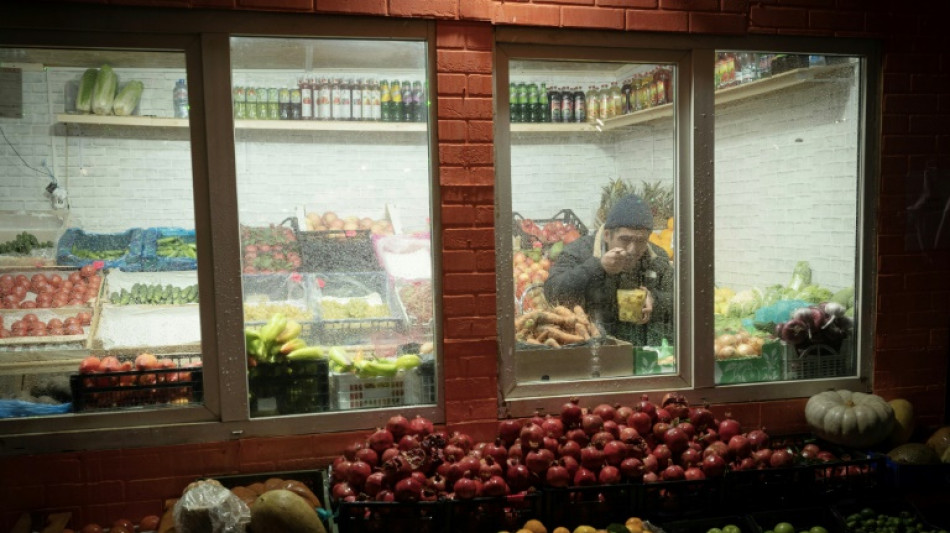
Russian inflation climbs as Ukraine offensive weighs on economy / Photo: Natalia KOLESNIKOVA - AFP
 ALIX LASERS shareholders remove Michael Sobitsch as managing director in view of the circumstances
 Kiss of Life Teases First Winter Single 'Greedy'

 Eight-Year-Old Georgia Wins Penrith Valley Public Speaking Competition

 Tosca's 2026 Sustainability Report Makes the Case for Packaging as Critical Supply Chain Infrastructure
 The DEA Laid The Trap - And State Marijuana Operators Took The Bait

 Ryde Group Ltd Announces Non-Binding Term Sheet for Proposed Minority Investment in Multi Genius Limited and MOU on Technology Collaboration

 West Midlands Shoppers Urged to Guard Against Black Friday Scams

 Surfshark Adds Real-Time Call Protection to iOS App in Version 5.3.0

 Saudi PIF Retains Top Sovereign Wealth Fund Brand Title for Third Year

 Professor Shahida Moosa Pioneers Medical Genomics in South Africa Amid Testing Shortages
Inflation in Russia accelerated in 2024, official statistics published Wednesday showed, as the costs of Moscow's full-scale offensive on Ukraine weigh on the domestic economy.
The Kremlin has ramped up spending to record levels to fund its military campaign, a surge that has saved the Russian economy from recession but triggered deep labour shortages and rapid price rises.
Russia's central bank, tasked with reining in an economy it has described as "overheating", has been unable to bring inflation down, despite taking interest rates to a two-decade high of 21 percent.
Russia's Rosstat statistics service said inflation in 2024 was 9.5 percent, up from 7.4 percent a year earlier.
It was the fourth consecutive year when prices have risen faster than Moscow's official 4.0-percent target.
Independent analysts have warned the economy could be heading for "stagflation" -- low growth with high inflation -- as the economy is set to slow down in 2025.
Rising prices have become headline news in Russia, with state media -- usually uncritical of the Kremlin -- highlighting worries over soaring butter and oil prices.
The cost of butter rose by 36 percent over 2024, Rosstat said Wednesday.
Overall food prices were 11.4 percent higher.
- 'Worrying signal' -
Higher prices risk stoking social tensions in Russia, where memories of the economic crisis and hyperinflation in the 1990s after the Soviet collapse run deep.
President Vladimir Putin conceded last year that inflation was a "worrying signal", but has given no indication that economic headwinds will have any impact on Moscow's military campaign against Ukraine, soon to enter its fourth year.
The central bank has come under pressure from business leaders over its series of aggressive rate hikes.
"The economy can't survive like this for long," said Sberbank CEO German Gref in early December, while Sergei Chemezov, head of the Rostec military-industrial conglomerate and a close Putin ally, called high borrowing costs "madness".
The Kremlin has typically refrained from overtly interfering with the central bank, but the governor Elvira Nabiullina held off a widely expected rate rise in December, days after Putin said he hoped the bank's decision would be "well-balanced".
Analysts say rate rises are less effective at bringing inflation under control in Russia at the moment, because so much stimulus in the economy is coming from government spending or subsidised loans.
Higher interest rates would typically sap demand by making it more expensive for businesses and households to borrow, while encouraging saving through higher rates of return.
- Stubborn inflation -
Russia is spending almost nine percent of its GDP on defence and security, according to Putin, and military spending is set to jump by almost 30 percent again in 2025.
Inflation has also been driven higher by unprecedented labour shortages across civilian industries.
Hundreds of thousands of Russian men have joined the army, been recruited by booming arms manufacturers or fled the country since Moscow launched its military offensive in February 2022.
Analysts at the Russian unit of Austria's Raiffeisen bank said it was "hard to believe" that inflation will come down in 2025.
"A fall in inflation will be hampered by a set of both direct and indirect consequences of sanctions," they said in a post on Telegram.
The United States ramped up its targeting of Russia's vital oil sector in its latest package of sanctions, unveiled last week.
They included restrictions on two major oil producers and dozens of tankers Russia uses to ship oil around the world.
Ukraine is pushing for tougher restrictions on Moscow to cut off revenues that fund its army.
L.Miller--AMWN


