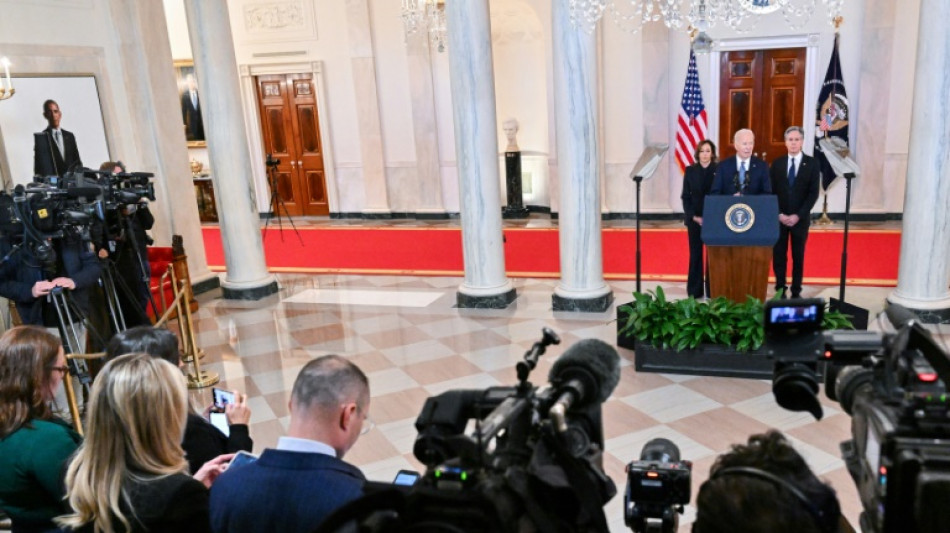
Behind the Gaza deal: a US odd couple and last-minute snags / Photo: ROBERTO SCHMIDT - AFP
 ALIX LASERS shareholders remove Michael Sobitsch as managing director in view of the circumstances

 Kiss of Life Teases First Winter Single 'Greedy'

 Eight-Year-Old Georgia Wins Penrith Valley Public Speaking Competition

 Tosca's 2026 Sustainability Report Makes the Case for Packaging as Critical Supply Chain Infrastructure

 The DEA Laid The Trap - And State Marijuana Operators Took The Bait

 Ryde Group Ltd Announces Non-Binding Term Sheet for Proposed Minority Investment in Multi Genius Limited and MOU on Technology Collaboration

 West Midlands Shoppers Urged to Guard Against Black Friday Scams

 Surfshark Adds Real-Time Call Protection to iOS App in Version 5.3.0

 Saudi PIF Retains Top Sovereign Wealth Fund Brand Title for Third Year

 Professor Shahida Moosa Pioneers Medical Genomics in South Africa Amid Testing Shortages
The Israel-Hamas deal was made possible by 18-hour days and a "remarkable" partnership between Joe Biden and Donald Trump's Mideast envoys -- but even then it seemed it might come apart at the last minute.
In the final four days of talks, Biden's pointman Brett McGurk was joined in the region by Trump's envoy, Steve Witkoff, to get the deal over the line, US officials said.
As they did so, Israeli and Hamas negotiators were huddling on separate floors of a building in the Qatari capital Doha, while moderators from Qatar and Egypt shuttled between them with their proposals.
McGurk and Witkoff were talking "multiple times a day, and Mr Witkoff actually helped clinch down some of the details. There was great coordination," National Security Council spokesman John Kirby told CNN.
A senior Biden administration official said that the unlikely pairing -- there is little love lost between the outgoing and incoming presidents -- had been a decisive factor in reaching a deal.
"Four days ago, Steve Witkoff came out to join Brett in his final push, which I think is, historically, almost unprecedented. And it was a highly constructive, very fruitful partnership," the official said on condition of anonymity.
"It was really quite, quite remarkable, and I think speaks to what can be done in the country."
Veteran diplomat McGurk has served in a number of US administrations, including in Trump's first term.
Witkoff is a businessman and real estate expert but has jumped into the negotiations -- even insisting that Netanyahu break the sabbath on Saturday for a meeting in his office as he pushed to seal the ceasefire.
The cooperation between the two US administrations didn't stop them battling over who should claim credit for a deal that had seemed out of reach for so many months.
Trump said the "epic" win would never have happened without his election putting pressure for a deal, while Biden said "is that a joke?" when a reporter asked which of them should get credit.
- 'Breakthrough' -
But the fact that they worked together at all underscores how crucial a deal was viewed by both presidents.
The seed was planted when Biden invited Trump to the Oval Office for a meeting eight days after the Republican's election win in November, and their national security teams agreed to meet, the US official said.
The knowledge that a new US administration would be starting on January 20 then galvanized the Israeli and Hamas sides alike.
"In any breakthrough diplomacy, sometimes you need a deadline," the official said.
But another key factor was the dramatic strategic shift in the region in the last half of 2024 that isolated Hamas from its Iranian backers.
Biden introduced the outline of the peace plan in May, but Washington had concluded that there would "never be a ceasefire" while Hamas's leader Yahya Sinwar was still alive, and while Hamas's Lebanese ally Hezbollah still opposed a deal, the Biden administration official said.
Then, Israel killed Hezbollah leader Hassan Nasrallah in September, and Sinwar in October, while also taking out Iran's air defenses. The fall of Syrian leader Bashar al-Assad in December was a further blow to Hamas.
Negotiations intensified after McGurk returned to the region on January 5 -- "18 hours a day, sometimes longer" -- but sticking points between Israel and Hamas remained.
The final 96 hours were the most intense of all.
One of the biggest hang-ups were the "incredibly complicated" lists for the exchanges of hostages held by Hamas with Palestinian prisoners held by Israel.
"All of that was not fully nailed down until the recent hours," the senior Biden administration official said.
Even then, nothing was agreed until everything was agreed.
"I have to say, it wasn't until this afternoon that we had full confidence that it's going to come together."
Biden himself expressed relief that the deal was finally done.
"At long last," he said as he announced the deal at the White House.
L.Mason--AMWN


