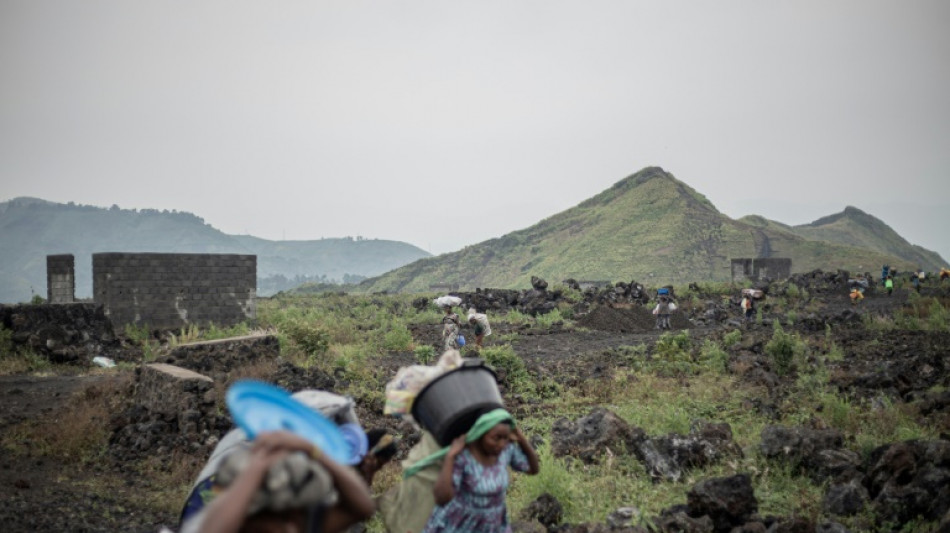
Fear abounds as M23 fighters close in on DR Congo's Goma / Photo: Jospin Mwisha - AFP
 ALIX LASERS shareholders remove Michael Sobitsch as managing director in view of the circumstances
 Kiss of Life Teases First Winter Single 'Greedy'

 Eight-Year-Old Georgia Wins Penrith Valley Public Speaking Competition

 The DEA Laid The Trap - And State Marijuana Operators Took The Bait

 Tosca's 2026 Sustainability Report Makes the Case for Packaging as Critical Supply Chain Infrastructure

 West Midlands Shoppers Urged to Guard Against Black Friday Scams

 Surfshark Adds Real-Time Call Protection to iOS App in Version 5.3.0

 Saudi PIF Retains Top Sovereign Wealth Fund Brand Title for Third Year

 Professor Shahida Moosa Pioneers Medical Genomics in South Africa Amid Testing Shortages
Luggage on their backs, they trudged all Wednesday morning along the road leading to downtown Goma, fleeing the advancing fighters in the eastern Democratic Republic of Congo.
Streams of displaced people have flocked from Minova, a port city the Rwanda-backed M23 armed group has already captured as it conquers swathes of territory at the expense of the Congolese army.
Some displaced people have already had to flee their homes several times as a conflict which has been ongoing for more than 30 years ebbs and flows.
But since 2021 those successive M23 breakthroughs and army retreats have only become more frequent.
"Everywhere we go, we find ourselves in an uncertain situation," displaced person Anuarite Nabintu told AFP at the side of the road.
By seizing Minova, a port city some 20 kilometres (12 miles) west of North Kivu's provincial capital Goma, the M23, which had already practically surrounded the city, has further tightened its grip in the area.
The largely ethnic Tutsi M23 and the Congolese army's positions are now separated just by a narrow stretch of water.
To the southeast lies a peninsula leading to Minova and occupied by M23 fighters, with the port of Nzulo to the north.
To respond to the threat, the Congolese army announced in a press release on Wednesday the suspension of the movement of small boats on the lake in a bid to avoid enemy infiltration.
The army also deployed heavy artillery near Nzulo and displaced persons camps nearby, according to humanitarian sources, sparking a large-scale exodus.
- 'A more difficult life' -
Early on Wednesday, the displaced people fleeing Minova joined others who had left their camps located in areas under army control for fear of further clashes.
Some found families to put them up in the city centre. Others dispersed to numerous camps surrounding Goma, where more than 100,000 people are herded together in extremely precarious humanitarian conditions.
In the Sam Sam camp, a few hundred metres from the evacuated camps and potential outbreaks of future fighting, most residents have decided to stay put -- for now.
Yet their faces betrayed their concern.
"If the situation persists, even this camp's residents will have to leave for Goma city," worried one resident, Kadibanga Batungi.
"These people cannot accept living here with the M23 nearby. The presence of the displaced from Nzulo comforted us, but as they have just left, we shall probably all leave too," he said.
An already crowded camp has received about 500 displaced people from Minova since violence intensified in the area, said camp secretary Aristide Sadiki Bichichi.
"They lead a more difficult life than us," said Sadiki Bichichi.
Aid agencies have found it difficult to intervene in the surrounding area because of the risk of being bombed.
Left to their own devices, some in the Sam Sam camp vented their anger.
"We left our households, our children, our property. We don't know what the government is doing," said David Bonzi, a displaced person from the neighbouring territory of Masisi, now partly occupied by the M23.
In downtown Goma, where the distant sound of weapons echoes out now and then, a sense of apparent normality still reigned.
Shops and services remained open, while police and soldiers kept watch at street corners.
Despite the diplomatic tensions, the border post between the DRC and Rwanda has remained open, with many of the two neighbouring states' nationals able to travel in both directions.
D.Sawyer--AMWN