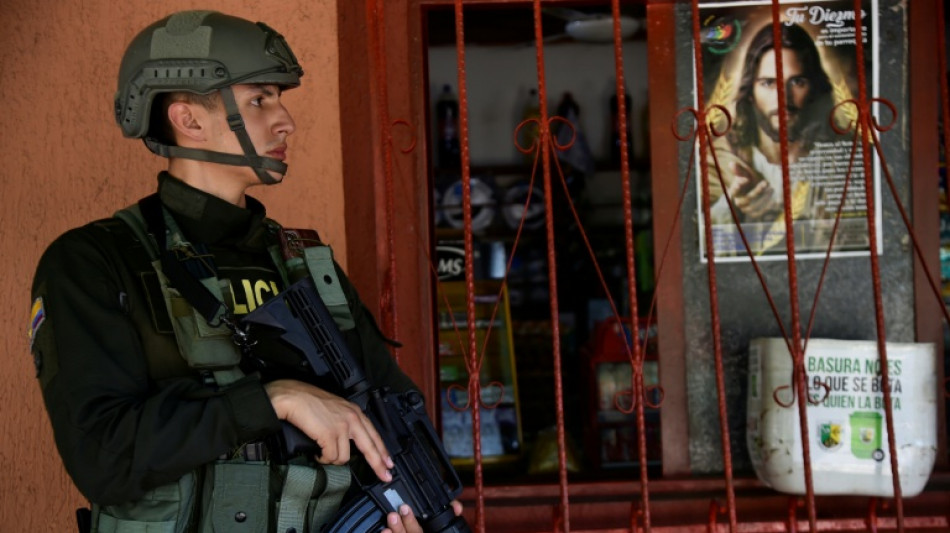
Colombia asks Venezuela to help quell border violence / Photo: Schneyder Mendoza - AFP
 ALIX LASERS shareholders remove Michael Sobitsch as managing director in view of the circumstances
 Kiss of Life Teases First Winter Single 'Greedy'

 Eight-Year-Old Georgia Wins Penrith Valley Public Speaking Competition

 The DEA Laid The Trap - And State Marijuana Operators Took The Bait

 Tosca's 2026 Sustainability Report Makes the Case for Packaging as Critical Supply Chain Infrastructure

 West Midlands Shoppers Urged to Guard Against Black Friday Scams
 Surfshark Adds Real-Time Call Protection to iOS App in Version 5.3.0

 Saudi PIF Retains Top Sovereign Wealth Fund Brand Title for Third Year

 Professor Shahida Moosa Pioneers Medical Genomics in South Africa Amid Testing Shortages
Colombia called on neighboring Venezuela Thursday to help tackle guerrillas blamed for a week of bloody violence that has displaced 40,000 people in the lawless border region.
"I've been in contact with the current Venezuelan government," Colombian President Gustavo Petro said, floating a "joint plan to eradicate armed gangs on the border."
Colombia is struggling to contain violence in the mountainous northeastern Catatumbo region, where a 5,800-strong leftist militia has targeted rival armed groups and their alleged sympathizers.
The National Liberation Army, or ELN, is trying to assert control over a swath of the border region that is home to plantations and trafficking routes which provide much of the world's cocaine.
The offensive has killed at least 80 people, while dozens more have been kidnapped and tens of thousands have been displaced, according to government and United Nations estimates.
The bodies of a baby and two young teens were among the bodies recovered from the region, according to Jorge Arturo Jimenez, Colombia's chief forensic officer.
The violence has plunged Colombia into one of its worst security crises in years while shattering government hopes of peacefully disarming one of the country's most powerful militias.
AFP journalists travelling in rebel-controled areas on Thursday saw armed ELN members openly guarding checkpoints.
Still, Petro's Venezuela gambit is fraught with potential pitfalls.
Colombia's intelligence agencies allege the ELN has long received backing and protection from Venezuela, with some of the group's leaders believed to live across the border.
And Petro's decision to engage with President Nicolas Maduro's government so soon after it was accused of stealing another election from the democratic opposition is likely to provoke anger.
For its part, Venezuela has accused Colombia of providing "shelter" to leaders of the Tren de Aragua -- one of Venezuela's biggest gangs, with an estimated 5,000 members operating across Latin America.
The group engages in migrant smuggling, drug trafficking, kidnappings and racketeering and has been targeted by President Donald Trump for inclusion on the US list of terror groups.
- 'Offensive operations' -
So far Colombia has responded to the border crisis by declaring a state of emergency, suspending ELN peace talks, reinstating arrest warrants against its leaders and deploying some 5,000 soldiers to the area.
Despite Petro's vow to bring "war" to the ELN, the Colombian military has so far only edged into rebel-controlled territory, establishing observation posts and carrying out patrols in urban areas.
In the frontier town of Tibu on Wednesday, AFP reporters heard at least five loud explosions, which the military said were artillery tests.
Later that day Colombia's military said it had begun "offensive operations" but it was not immediately clear what they were.
For thousands of residents still waiting in refuges, a solution cannot come soon enough.
Zilenia Pana, 48, fled the fighting with her eight- and 13-year-old children, finding the relative safety of Ocana, a small town on the western edge of the cordillera.
Seeing "the dead bodies was sad, painful. That breaks your soul, your heart," she told AFP.
She said she prays only that the fighting stops so she can return home with her children, saying "that's all we want, that's all we ask from those people."
F.Dubois--AMWN