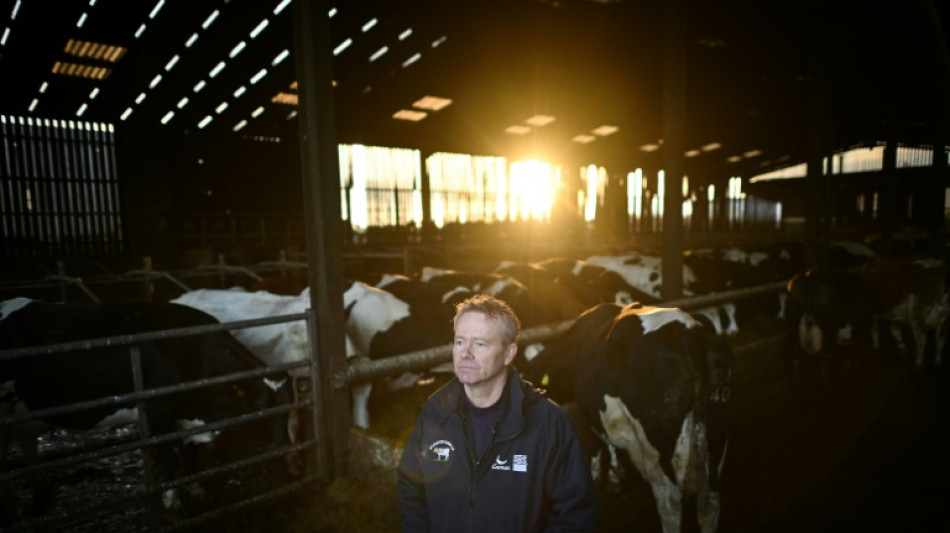
Tax change sows anger on England farms / Photo: JUSTIN TALLIS - AFP
 ALIX LASERS shareholders remove Michael Sobitsch as managing director in view of the circumstances
 Kiss of Life Teases First Winter Single 'Greedy'

 Eight-Year-Old Georgia Wins Penrith Valley Public Speaking Competition

 The DEA Laid The Trap - And State Marijuana Operators Took The Bait

 Tosca's 2026 Sustainability Report Makes the Case for Packaging as Critical Supply Chain Infrastructure

 West Midlands Shoppers Urged to Guard Against Black Friday Scams

 Surfshark Adds Real-Time Call Protection to iOS App in Version 5.3.0

 Saudi PIF Retains Top Sovereign Wealth Fund Brand Title for Third Year

 Professor Shahida Moosa Pioneers Medical Genomics in South Africa Amid Testing Shortages
In a field in southwest England where his dairy cows graze, Adam Stanbury said he feared the government's new farm tax, coupled with existing economic headwinds, will ruin his family business and many others.
The 55-year-old, the third generation to farm this land near Barnstaple in Devon, last month joined hundreds of other farmers in driving their tractors to London for an unprecedented protest in front of Downing Street.
"They were looking like a duck out of water, it's not their natural habitat, but they've got to do something," he told AFP.
Last year, Prime Minister Keir Starmer's Labour government announced that in order to find vital new revenue, some farms would no longer be exempt from inheritance tax, a long-standing measure designed to facilitate the family handover of farms.
From April 2026, the exemption will be capped at £1 million ($1.23 million). Beyond that, a 20 percent tax will apply, half the normal rate.
For Stanbury, the calculations were straight forward.
He said that when he adds up the value of his 750 cows, his equipment, his 240 hectares of land and his modest house, he exceeds the threshold by a large margin.
His three daughters would have to pay at least £400,000 in inheritance tax when he dies, he estimates.
Even with the possibility of spreading the cost over 10 years, as planned by the government, "it doesn't work" as "margins are small" in farming, he said.
"They will have to realise that money from somewhere, and that will very likely be selling off land that they inherit," he said.
- 'Downsize' -
His eldest daughter Lucy, 16, regularly helps her parents on the farm, but said she sees her future more in photography or international development than in breeding animals.
However, Stanbury would like to offer his daughters the option, without it being a financial "burden".
Talks with his accountant were not reassuring.
To avoid the tax, he would need to transfer the farm to his daughters before his death, but the process is extremely complex.
"We may have to downsize or sell certain things," said Stanbury.
Yet he still considers himself one of the lucky ones. Despite his many investments and loans, the 3.4 million litres (750,000 gallons) of organic milk that the farm produces each year ensures a profit.
But in the UK, 17 percent of farms made no profit in 2023 and only 41 percent made more than £50,000, according to government figures.
As in many countries, rising energy costs, pressure on prices from the food industry and large retailers and environmental constraints are hitting farmers hard.
Brexit has also complicated agricultural exports and the recruitment of seasonal workers, while new bilateral trade agreements have led to unfair competition, according to farmers.
The tax "would be the straw that broke the camel's back," warned Stanbury.
The government insists the tax will only affect the 500 largest properties and opportunists who have bought land to avoid taxes.
Economist Arun Advani pointed out that among farms that benefited from the current exemptions, "less than half of individuals had received any trading income from agriculture at any point in the five years prior to death".
"Of the remainder, 51 percent received income from rent, which is consistent with them being landlords rather than active farmers," he added.
But farming unions dispute this assessment, arguing that many more farms will be affected.
- 'Unfair' -
All of which has left Stanbury wondering: "What happens when we do have to sell bits of land off, or the whole farm off, to pay an inheritance tax -- where's that land going to go?
"It's going to go to a multinational who can afford it," he argued, calling it "unfair".
He said the tax should be adjusted to target only large landowners and not farms like his, and to exempt older farmers who will not have time to adapt before passing on their farms.
"I'm sorry that some of the action we had to take shocked you, but stable finances are the foundation of the economic growth needed," agriculture minister Steve Reed told farmers at their annual conference earlier this month.
He highlighted the government's £5 billion budget over two years, which includes support for environmental adaptation and diversification.
He is due to unveil a 25-year plan for agriculture this year.
"I just don't think the Secretary of State has grasped just how serious the situation is on the ground and instead wants to look five, ten years forward, which at the moment many farmers are worried they won't get that far," Tom Bradshaw, the president of the National Farmers' Union told AFP.
But for Stanbury, "I don't think farmers are looking for more support, but they are looking to be considered when making policies".
M.Thompson--AMWN


