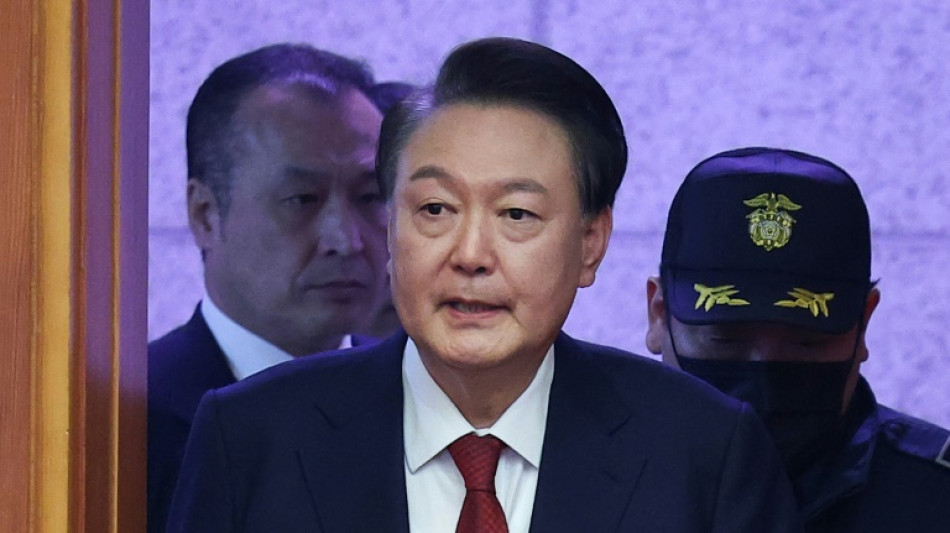
South Korea president's indictment: what happens next? / Photo: Kim Hong-Ji - POOL/AFP
 ALIX LASERS shareholders remove Michael Sobitsch as managing director in view of the circumstances
 Kiss of Life Teases First Winter Single 'Greedy'

 Eight-Year-Old Georgia Wins Penrith Valley Public Speaking Competition

 The DEA Laid The Trap - And State Marijuana Operators Took The Bait

 Tosca's 2026 Sustainability Report Makes the Case for Packaging as Critical Supply Chain Infrastructure

 West Midlands Shoppers Urged to Guard Against Black Friday Scams

 Surfshark Adds Real-Time Call Protection to iOS App in Version 5.3.0

 Saudi PIF Retains Top Sovereign Wealth Fund Brand Title for Third Year

 Professor Shahida Moosa Pioneers Medical Genomics in South Africa Amid Testing Shortages
Impeached South Korean President Yoon Seok Yeol was indicted for his martial law declaration that plunged the country into political turmoil, with prosecutors accusing him of being a "ringleader of insurrection".
His indictment on Sunday makes him the country's first sitting head of state to face a criminal trial for his short-lived martial law declaration on December 3.
Yoon has been ordered to remain in a 12-square-metre (129-square-foot) cell at a detention centre in Seoul for the duration of his trial.
AFP takes a look at what lies ahead.
- What happens to Yoon now? -
Yoon has been charged with insurrection for his martial law declaration, which lawmakers voted down hours later before impeaching him.
The 64-year-old resisted arrest for two weeks in a tense stand-off between his security team and investigators at his official residence in Seoul but was finally taken into custody on January 15.
The court must rule on the case within six months, or he will be released.
If Yoon is found guilty of insurrection, he faces the death penalty or life imprisonment.
Prosecutors previously raised concerns about the risk of evidence destruction, citing it as a reason to detain him.
But Yoon's lawyers said the investigation lacked legitimacy from the start and have challenged the legality of his indictment.
"We are discussing a bail request (for Yoon) with the court," his lawyers told AFP on Monday, without giving any further details.
- Where is Yoon now? -
For now, Yoon is housed in a cell equipped with a television, sink, and a single-person desk that doubles as a dining table.
There is also a toilet, folding bed and Yoon has been provided with an electric mat to stay warm during the winter.
Meals are served in his cell and the impeached president must clean his dishes in the sink in accordance with prison regulations.
His solitary cell -- which typically holds several inmates -- resembles those occupied by two former presidents, Park Geun-hye and Lee Myung-bak, who also served jail time.
- Is he still president? -
Yoon remains head of state, but he is not in charge -- his duties have been suspended and delegated to acting President Choi Sang-mok.
Separate from the court deciding on his insurrection charges, the country's Constitutional Court has also been deliberating whether Yoon should be removed from office ever since MPs voted to impeach him.
Their ruling could come as early as February or as late as June, and is the only official way to remove Yoon from office.
Six of the eight sitting judges must approve the impeachment for this to happen.
Shin Yul, a professor of political science at Myongji University, said the Constitutional Court is expected to conclude its deliberations before two of the judges finish their terms mid-April.
If the court rejects impeachment and finds that Yoon's martial law declaration was lawful, he will be reinstated.
But if it is upheld, an election must be held within 60 days.
- Who would win? -
Leading in recent polls is Lee Jae-myung, the leader of the opposition Democratic Party -- with all the other rivals lagging behind, according to the latest Gallup poll.
But analysts caution that it is too early to say whether Lee will emerge victorious, as approval ratings for his party and Yoon's remain closely aligned.
"It will ultimately come down to moderate voters to determine the country's next phase," South Korean newspaper Hankook Ilbo reported Monday.
P.Costa--AMWN


