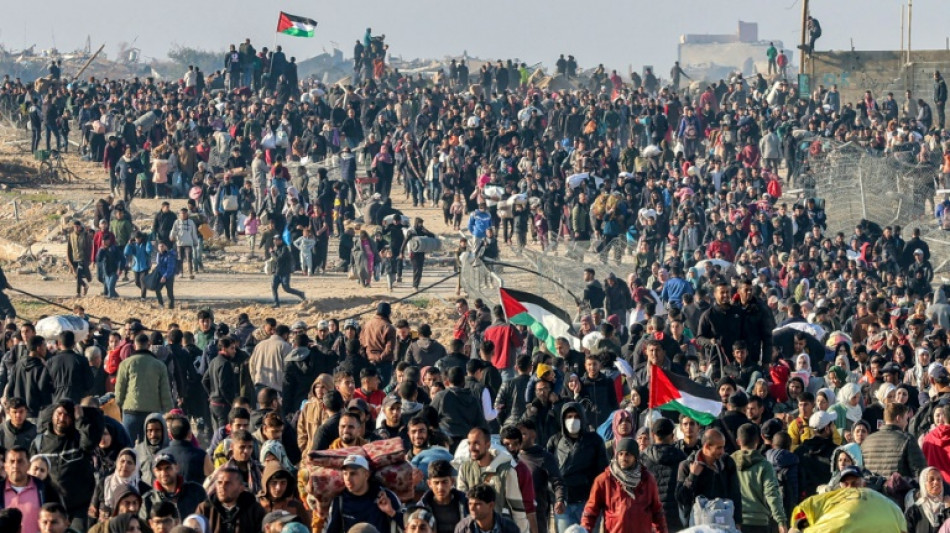
Palestinians return to north Gaza after breakthrough on hostages / Photo: Omar AL-QATTAA - AFP
 ALIX LASERS shareholders remove Michael Sobitsch as managing director in view of the circumstances

 Kiss of Life Teases First Winter Single 'Greedy'

 Eight-Year-Old Georgia Wins Penrith Valley Public Speaking Competition

 The DEA Laid The Trap - And State Marijuana Operators Took The Bait

 Tosca's 2026 Sustainability Report Makes the Case for Packaging as Critical Supply Chain Infrastructure

 West Midlands Shoppers Urged to Guard Against Black Friday Scams

 Surfshark Adds Real-Time Call Protection to iOS App in Version 5.3.0

 Saudi PIF Retains Top Sovereign Wealth Fund Brand Title for Third Year

 Professor Shahida Moosa Pioneers Medical Genomics in South Africa Amid Testing Shortages
Masses of displaced Palestinians began streaming towards the north of the war-battered Gaza Strip on Monday after Israel and Hamas said they had reached a deal for the release of another six hostages.
The breakthrough preserves a fragile ceasefire and paves the way for more hostage-prisoner swaps under an agreement aimed at ending the more than 15-month conflict, which has devastated the Gaza Strip and displaced nearly all its residents.
Israel had been preventing Palestinians from returning to their homes in northern Gaza, accusing Hamas of violating the terms of the truce, but Prime Minister Benjamin Netanyahu's office said late Sunday they would be allowed to pass after the new deal was reached.
Crowds began making their way north along a coastal road on foot Monday morning, carrying what belongings they could, AFPTV images showed.
"It's a great feeling when you go back home, back to your family, relatives and loved ones, and inspect your house -- if it is still a house," displaced Gazan Ibrahim Abu Hassera told AFP.
Hamas called the return "a victory" for Palestinians that "signals the failure and defeat of the plans for occupation and displacement".
Its ally Islamic Jihad, meanwhile, called it a "response to all those who dream of displacing our people".
The comments came after US President Donald Trump floated an idea to "clean out" Gaza and resettle Palestinians in Jordan and Egypt, drawing condemnation from regional leaders.
President Mahmud Abbas, whose Palestinian Authority is based in the Israeli-occupied West Bank, issued a "strong rejection and condemnation of any projects" aimed at displacing Palestinians from Gaza, his office said.
Bassem Naim, a member of Hamas's political bureau, told AFP that Palestinians would "foil such projects", as they have done to similar plans "for displacement and alternative homelands over the decades".
- Jordan, Egypt reject displacement -
For Palestinians, any attempt to move them from Gaza would evoke dark memories of what the Arab world calls the "Nakba", or catastrophe -- the mass displacement of Palestinians during Israel's creation in 1948.
"We say to Trump and the whole world: we will not leave Palestine or Gaza, no matter what happens," said displaced Gaza resident Rashad al-Naji.
Trump had floated the idea to reporters Saturday aboard Air Force One: "You're talking about probably a million and half people, and we just clean out that whole thing."
Moving Gaza's roughly 2.4 million inhabitants could be done "temporarily or could be long term", he said.
Israel's far-right Finance Minister Bezalel Smotrich -- who opposed the truce deal and has voiced support for re-establishing Israeli settlements in Gaza -- called Trump's suggestion of "a great idea".
The Arab League rejected the idea, warning against "attempts to uproot the Palestinian people from their land", saying their forced displacement could "only be called ethnic cleansing".
Jordanian Foreign Minister Ayman Safadi said "our rejection of the displacement of Palestinians is firm and will not change. Jordan is for Jordanians and Palestine is for Palestinians."
Egypt's foreign ministry said it rejected any infringement of Palestinians' "inalienable rights".
- More hostage exchanges -
Israel had said it would prevent Palestinians' passage to the north until the release of Arbel Yehud, a civilian woman hostage who it maintained should have been freed on Saturday.
But Netanyahu's office later said a deal had been reached for the release of three hostages on Thursday, including Yehud, as well as another three on Saturday.
Hamas confirmed the agreement in its own statement Monday.
During the first phase of the Gaza truce, 33 hostages are supposed to be freed in staggered releases over six weeks in exchange for around 1,900 Palestinians held by the Israelis.
The most recent swap saw four Israeli women hostages, all soldiers, and 200 prisoners, nearly all Palestinian, released Saturday in the second such exchange during the fragile truce entering its second week.
"We want the agreement to continue and for them to bring our children back as quickly as possible -- and all at once," said Dani Miran, whose hostage son Omri is not slated for release during the first phase.
The truce has brought a surge of food, fuel, medicines and other aid into rubble-strewn Gaza, but the UN says "the humanitarian situation remains dire".
The Hamas attack resulted in the deaths of 1,210 people, mostly civilians, according to an AFP tally based on official Israeli figures.
Israel's retaliatory offensive has killed at least 47,306 people in Gaza, the majority civilians, according to figures from the Hamas-run territory's health ministry that the United Nations considers reliable.
burs-tym/smw/ser
P.Mathewson--AMWN


