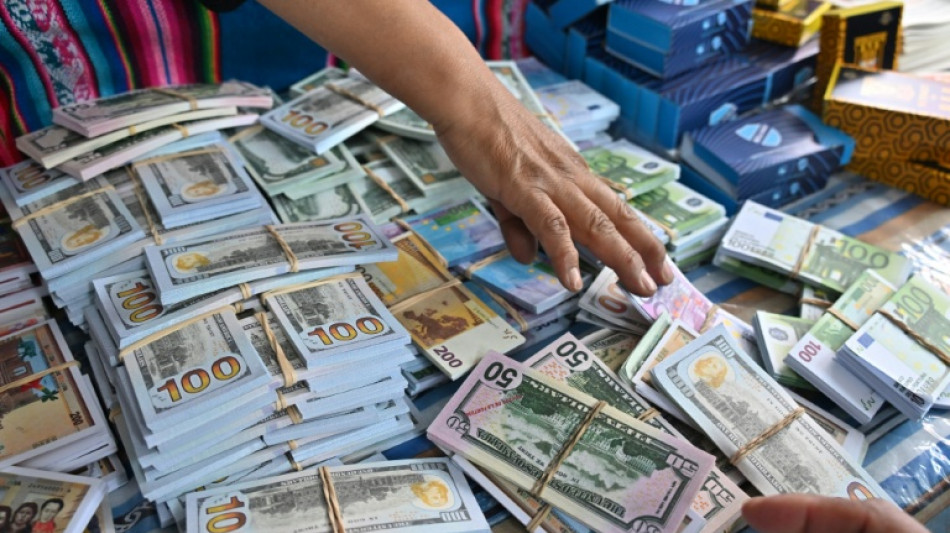
Facing Bolivia's economic crunch with toy houses, fake banknotes / Photo: AIZAR RALDES - AFP
 ALIX LASERS shareholders remove Michael Sobitsch as managing director in view of the circumstances
 Kiss of Life Teases First Winter Single 'Greedy'

 Eight-Year-Old Georgia Wins Penrith Valley Public Speaking Competition

 The DEA Laid The Trap - And State Marijuana Operators Took The Bait

 Tosca's 2026 Sustainability Report Makes the Case for Packaging as Critical Supply Chain Infrastructure

 West Midlands Shoppers Urged to Guard Against Black Friday Scams

 Surfshark Adds Real-Time Call Protection to iOS App in Version 5.3.0

 Saudi PIF Retains Top Sovereign Wealth Fund Brand Title for Third Year

 Professor Shahida Moosa Pioneers Medical Genomics in South Africa Amid Testing Shortages
For a month every year, thousands of Bolivians throng the stalls of an unusual market in La Paz, shopping for tiny toy houses and wads of fake cash -- substitutes for the real-life objects their hearts desire.
Customers of the Alasita market believe the trinkets, "blessed" by shamans, will somehow pave the way for the real thing.
This year, with Bolivia in economic and political turmoil, few items have been as popular as stacks of worthless, paper dollar notes similar to Monopoly money.
"The dollar is disappearing in Bolivia," said Vilma Mariaca, a homemaker who said she bought some fake greenbacks "in the hopes that we will have more" real ones.
She did not buy a single boliviano -- the national currency that has lost some 40 percent of its value to the US dollar since 2023.
At the same time, the Bolivian government is running low on dollar reserves -- forcing it to limit imports of subsidized fuel, causing shortages that have led to numerous protests.
Set in one of the world's highest cities, the Alasita market offers a stunning array of miniatures to choose from.
There are tiny buses and trucks, jewelry boxes, fuel canisters, stoves, visa cards, even replicas of university degrees.
In a reflection of recent shortages, there are tiny bottles of cooking oil, miniscule bags of rice, and canisters of diesel.
Pocket-sized houses, too, can be purchased, or for those on a budget, the doors, windows or construction materials needed to build one.
- 'Wishes come true' -
Some items go for less than a dollar, while a stack of fake bills costs about $2.
A house can fetch anything from $10 to $30 depending on the size and ornateness.
In an age-old tradition inspired by El Ekeko -- the indigenous Aymara deity of abundance -- the purchased items are "blessed" by shamans clutching bouquets of smoking incense, then taken home to put on display.
Trader Rosa Vito, 75, insists the system is foolproof.
"When I was young, I bought a miniature house. We didn’t have a penny. And my husband said: 'What are you buying? It's expensive!' I bought the little house with faith, and within a few years, I bought my (real) house."
Many clients, she told AFP, "have had their wishes come true."
Mine worker Luis Sosa, 40, said his purchases at the market last year brought him good luck -- particularly the dollar notes.
"I didn't lack any, I even had more than I needed," he told AFP.
This year, Bolivians may need more than a lucky charm to get ahead.
Experts warn of a difficult 2025, with inflation at its highest in 16 years and a ballooning fiscal deficit.
And while the populace is in uproar over high fuel, food and medicine prices, President Luis Arce and his predecessor Evo Morales are locked in a power struggle ahead of elections in August.
The Alasita market, listed on UNESCO's list of Intangible Cultural Heritage, will be open for nearly a month to mid-February.
D.Kaufman--AMWN


