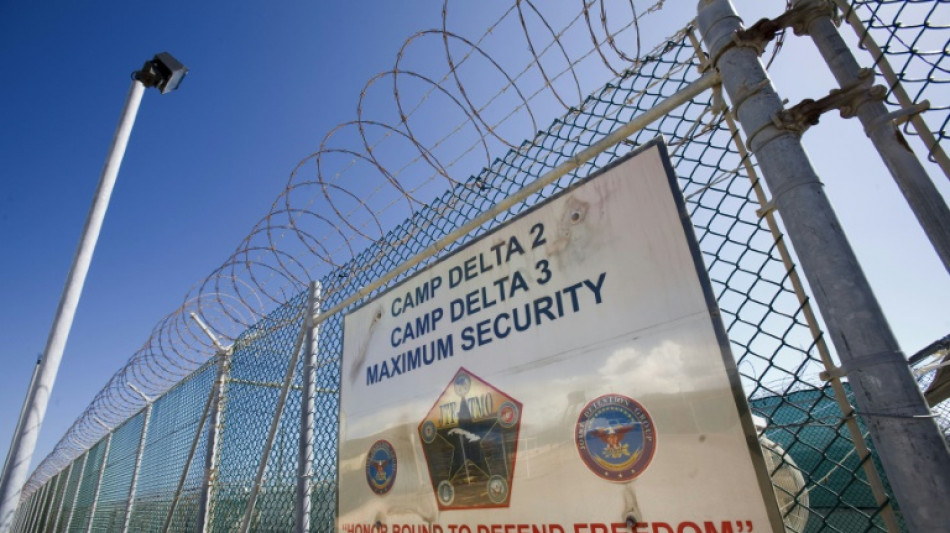
What to make of Trump's Guantanamo plan for migrants / Photo: Paul J. RICHARDS - AFP/File
 ALIX LASERS shareholders remove Michael Sobitsch as managing director in view of the circumstances
 Kiss of Life Teases First Winter Single 'Greedy'

 Eight-Year-Old Georgia Wins Penrith Valley Public Speaking Competition

 5 Fun Date Night Ideas That Don't Cost a Fortune

 Tosca's 2026 Sustainability Report Makes the Case for Packaging as Critical Supply Chain Infrastructure

 West Midlands Shoppers Urged to Guard Against Black Friday Scams

 Surfshark Adds Real-Time Call Protection to iOS App in Version 5.3.0

 Saudi PIF Retains Top Sovereign Wealth Fund Brand Title for Third Year

 Professor Shahida Moosa Pioneers Medical Genomics in South Africa Amid Testing Shortages

President Donald Trump has said he wants to send 30,000 "criminal illegal aliens" to the notorious Guantanamo Bay US military base in Cuba.
The site houses the prison where hundreds of terror suspects labelled "enemy combatants" were held -- many for years without charge -- after the 9/11 attacks. Some were tortured.
Trump said this week he had ordered the construction of a detention center there to "double our capacity immediately" to hold undocumented migrants.
The plan has raised questions and concerns.
- Is it new? -
Guantanamo Bay has for decades been used to hold Caribbean asylum seekers and refugees caught at sea. Migrants are held in a different part of the base than that used for terror suspects.
In the 1990s, it was used to house tens of thousands of Haitians and Cubans who fled crises in their homelands.
They were accommodated in tent cities, many eventually sent home after being held at Guantanamo for years.
Trump's move would entail a significant expansion of what is known as the Guantanamo Migrant Operations Center (GMOC).
But Deepa Alagesan of the New York-based International Refugee Assistance Project (IRAP) says migrants are already being held "in inhuman conditions, and expanding the facility will be nothing short of disastrous."
In a report last September, the IRAP reported conditions at the GMOC including "undrinkable water and exposure to open sewage, inadequate schooling and medical care for children, and collective punishment of detained Cuban and Haitian refugees."
- Is it legal? -
"Some of them are so bad that we don't even trust the countries to hold them because we don't want them coming back," Trump said of the migrants he plans to ship off to Guantanamo -- adding it is "a tough place to get out of."
Bill Frelick, refugee and migrants director at Human Rights Watch told AFP that Trump's intention appears to be "to detain people indefinitely."
He explained there was leeway under domestic and international law to detain migrants administratively for short periods of time until they can be sent back to their home countries.
If they cannot be returned, "there is no longer a legitimate reason for the detention, and it becomes arbitrary," said Frelick.
Making matters worse, Guantanamo is a remote, closed military base "which the US government has used to evade legal protections and public scrutiny" in the past.
"When detention becomes prolonged and indefinite and untethered from proper oversight, it violates human rights and may amount to torture," said Frelick.
The UN human rights office said Friday that migrants should only be detained "as a last resort. And only in exceptional circumstances."
Observers say migrants in Guantanamo would find it hard to access legal counsel.
Many would be legitimate asylum seekers who have the right under US and international law to live and work in America while their applications are considered.
- Is it necessary? -
Thousands of undocumented migrants have been arrested since Trump's January 20 inauguration, including some accused of crimes.
An unknown number have been repatriated to Colombia, Mexico, Guatemala, Brazil and other countries. Trump has vowed to expel "millions."
The US Immigration and Customs Enforcement (ICE) agency currently has funding for 41,500 detainee beds, according to the conservative Heritage Foundation think tank in Washington.
In a report this week, it said US military facilities such as Guantanamo "can play a central role in management of detention and deportation" -- and already have been used for this purpose under previous administrations including that of Joe Biden.
The United States leases the site holding the prison from Cuba under a treaty dating back to 1903.
The communist government in Havana considers it an illegal occupation, but the US Department of State website states the lease was the product of "international agreement and treaty" and can only be ended by mutual agreement.
L.Mason--AMWN


