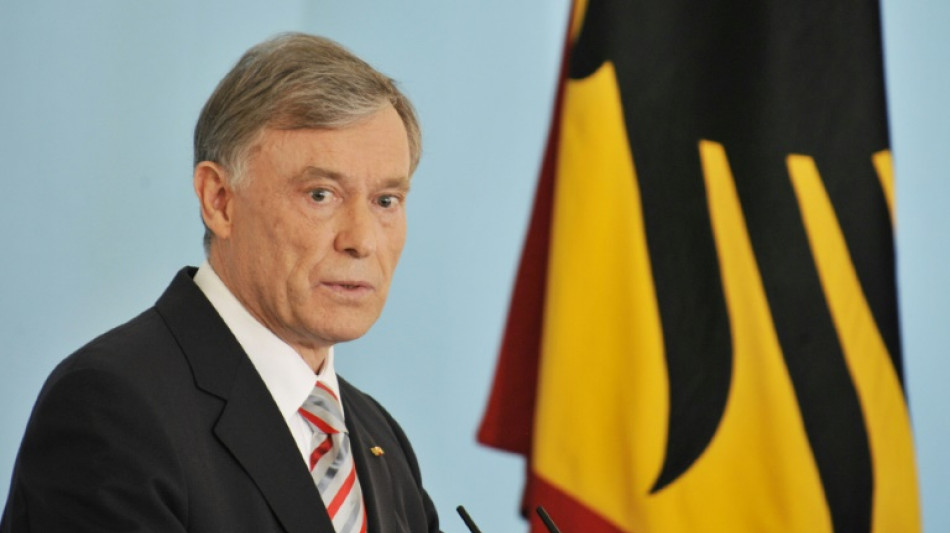
German ex-president Horst Koehler dead at 81 / Photo: John MACDOUGALL - AFP/File
 ALIX LASERS shareholders remove Michael Sobitsch as managing director in view of the circumstances
 Kiss of Life Teases First Winter Single 'Greedy'

 Eight-Year-Old Georgia Wins Penrith Valley Public Speaking Competition

 5 Fun Date Night Ideas That Don't Cost a Fortune

 Tosca's 2026 Sustainability Report Makes the Case for Packaging as Critical Supply Chain Infrastructure

 West Midlands Shoppers Urged to Guard Against Black Friday Scams

 Surfshark Adds Real-Time Call Protection to iOS App in Version 5.3.0

 Saudi PIF Retains Top Sovereign Wealth Fund Brand Title for Third Year

 Professor Shahida Moosa Pioneers Medical Genomics in South Africa Amid Testing Shortages

Germany's former president Horst Koehler, who served as head of state from 2004 to 2010, died on Saturday aged 81 after a brief illness, officials announced.
"With the death of Horst Koehler, we have lost a highly esteemed and extremely popular person who achieved great things –- for our country and in the world," President Frank-Walter Steinmeier said in a letter to Koehler's widow.
He passed away in Berlin in the early hours, surrounded by his family.
Koehler, an economist by training, was the first German president who was not a career politician.
Before becoming president he was the head of the International Monetary Fund in Washington.
He also held other roles in the civil service and banking.
He became Germany's head of state, a mostly ceremonial role, after being put forward by then opposition leader Angela Merkel, who went on to become chancellor.
Steinmeier said that when he was elected, Koehler was "virtually unknown" to the public but quickly gained "much recognition and sympathy".
He was elected for a second term in 2009.
But in May the following year he resigned after making remarks in an interview that critics said backed the idea of sending German military missions overseas to secure trade routes.
- 'Land of ideas' -
In his speeches, Koehler frequently emphasised the importance of believing in the strength of Germany and in the energy and creativity of its people.
He promoted Germany as a "land of ideas" that would shape its own future and act as a force for good in the world.
When it came to foreign policy, Koehler had a strong focus on Africa and visited the continent many times.
"He never tired of pointing out the importance and potential of the African continent for global development," wrote Sven Behnke, the head of the ex-president's office, on Saturday.
"For him, engaging with Africa seemed not only wise and forward-looking, but also ethically imperative."
Koehler was the United Nations' envoy to Western Sahara from 2017 to 2019, leading UN efforts to end the decades-old conflict between Morocco and the Algerian-backed Polisario Front.
He was also a member of a panel set up by then UN secretary general Ban Ki-moon in 2012 to advise on the global development agenda beyond 2015.
Koehler "has given a great deal" to Germany, said Steinmeier.
"We will remember him as a stroke of luck for our country."
F.Bennett--AMWN


