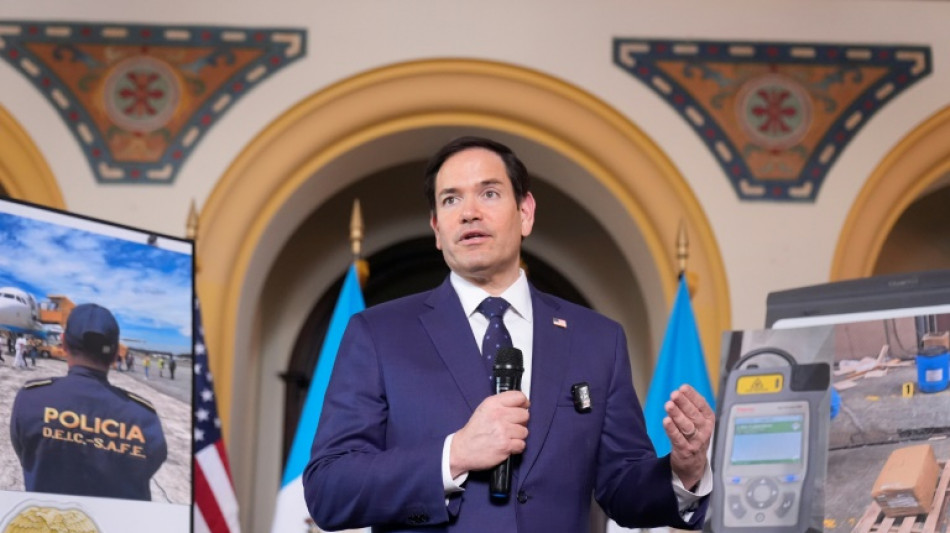
Rubio debuts as personable, bilingual face of 'America First'
/ Photo: Mark Schiefelbein - POOL/AFP
 ALIX LASERS shareholders remove Michael Sobitsch as managing director in view of the circumstances
 Kiss of Life Teases First Winter Single 'Greedy'

 Eight-Year-Old Georgia Wins Penrith Valley Public Speaking Competition

 5 Fun Date Night Ideas That Don't Cost a Fortune

 Tosca's 2026 Sustainability Report Makes the Case for Packaging as Critical Supply Chain Infrastructure

 West Midlands Shoppers Urged to Guard Against Black Friday Scams

 Surfshark Adds Real-Time Call Protection to iOS App in Version 5.3.0

 Saudi PIF Retains Top Sovereign Wealth Fund Brand Title for Third Year

 Professor Shahida Moosa Pioneers Medical Genomics in South Africa Amid Testing Shortages

Making his debut as the top US diplomat, Marco Rubio has conducted most business entirely in Spanish, forging quick bonds with Latin American leaders.
After his first stop in Panama, Rubio described his meeting as "respectful" and suggested he quietly worked out solutions to address President Donald Trump's demands on the Panama Canal.
And how did he communicate his supposed diplomatic success? The State Department put out a brusque statement saying Rubio had laid down an ultimatum and later said Panama had agreed to give free passage to US government vessels -- triggering a heated denial.
So goes the paradox of Rubio. A personable former senator, he has embraced skills he honed over decades in politics, hashing out compromises and relying on friendships with his interlocutors.
But he has also learned to speak the language of Trump, brashly trumpeting emerging deals and making threats on social media, sometimes blaring in capital letters.
Rubio, the first Hispanic secretary of state, said it was no accident that he was paying his first trip to Latin America, where he visited five countries ending Thursday with the Dominican Republic.
A Cuban-American who spoke Spanish before he learned English, Rubio has come to know key players across Latin America, particularly conservatives, over decades as a Miami politician.
On taking the job, Rubio said he thought, "Where do you want to go on your first visit?"
"I want to go to a place that's warm," Rubio said to laughter as he introduced himself to staff at the US embassy in Panama City, as another cold snap was approaching Washington.
And, Rubio said: "I want to go to a place where they speak Spanish, because I'm bilingual so that was a great opportunity."
- Embracing Trump agenda -
That "great opportunity" means serving an "America First" agenda at odds, at least in tone, with some of Rubio's earlier beliefs.
Early in his Senate career, Rubio told Time magazine that his mother -- who made ends meet as a cashier and hotel maid -- had pleaded with him, "Don't mess with the immigrants," telling him to remember that even undocumented people are humans seeking better lives.
Rubio called for a more inclusive vision of the United States -- and traded vulgar insults -- when he ran against Trump for the Republican presidential nomination in 2016.
Now serving at the pleasure of the mercurial Trump, Rubio watched from the tarmac in Panama City as authorities marched out dozens of undocumented migrants, most shabbily dressed and empty handed, being flown back to Colombia.
Rubio has defended his push against migration, pointing to the role of human smugglers.
"Mass migration is one of the great tragedies of the modern era," Rubio said in Panama. "It's not good for anyone. The only people who benefit from mass migration are traffickers."
- Cleaning up for Trump -
Much as Trump's aides did during his first term, Rubio has been forced to clean up some of the president's more jaw-dropping remarks.
After Trump spoke of sending US troops into the Gaza Strip and displacing its Palestinian population, Rubio said Trump was only making a "generous" offer to rebuild.
Rubio also insisted he was seeking to reform rather than end US assistance. Hours later, as he was dining with Guatemala's president, the US Agency for International Development, under pressure from Trump ally Elon Musk, said it was putting on leave virtually the entire staff.
But Rubio advanced key Trump priorities, including on reducing the influence of adversary China. Panama, while publicly denying an agreement on vessel fees, said it would exit China's signature infrastructure-building initiative.
Each country he visited offered assistance on ending migration. In El Salvador, President Nayib Bukele made the extraordinary offer to imprison not just foreigners but US citizens, an idea certain to meet massive legal challenges.
Rubio also sought to put a human face on Trump's return. In Panama City, Rubio, a devout Catholic, attended Mass at a centuries-old church and greeted crowds outside. He also engaged with press far more spontaneously than his recent predecessors.
"It's hard to deny that his tough approach has achieved results," said one diplomat who was observing the trip.
"The question is -- if you're winning just because you're pushing, what happens when another power can push harder?"
M.Fischer--AMWN


