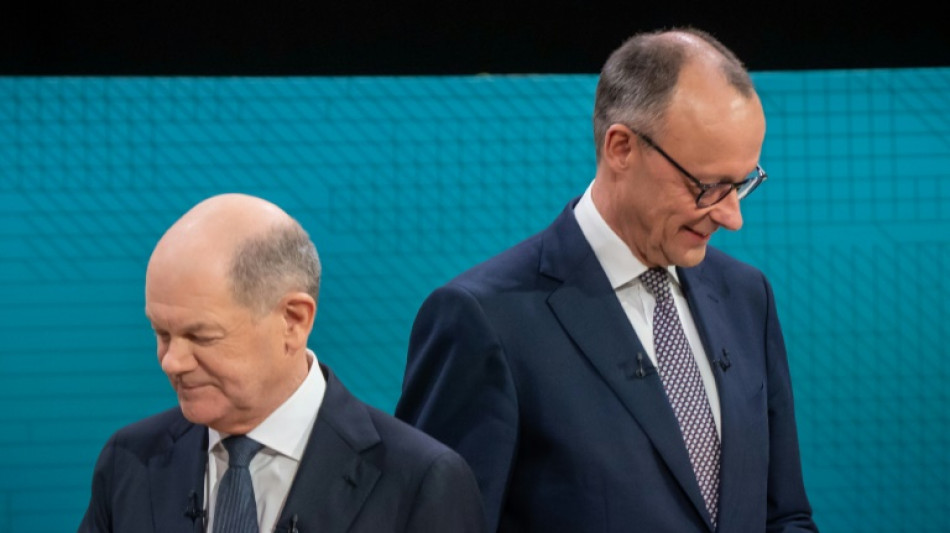
Germany's Scholz, Merz, clash over far-right AfD in election debate / Photo: Michael Kappeler - POOL/AFP
 Student Activism Shifts Underground After University Crackdown on Gaza Encampments

 Surge in Early Social Security Claims Linked to Agency Turmoil

 Panthers Seek NFC South Lead Against Ravens as Baltimore Ends Skid

 Tosca's 2026 Sustainability Report Makes the Case for Packaging as Critical Supply Chain Infrastructure

 5 Fun Date Night Ideas That Don't Cost a Fortune

 GIRLBAND! Headline Show at Rough Trade Marks National Breakthrough

 Samsung Galaxy Buds Active Leak Reveals ANC, Ear-Hook Design and One UI 9.5 Integration

 Egypt and Syria Sign Agreement to Restore Direct Flights After 14-Year Hiatus

 Van Gogh’s ‘Châtaigniers en Fleurs’ Sets $285m Record at Sotheby’s

German Chancellor Olaf Scholz on Sunday accused his election rival Friedrich Merz of having broken his word by accepting support from the far-right AfD to push an anti-immigration motion through parliament.
In their first direct TV debate ahead of the February 23 vote, Scholz said Merz's tactic of accepting parliamentary votes from the Alternative for Germany had meant "a breaking of his word and of a taboo.
"And therefore one cannot be sure what the future will be like when things become difficult again" added the centre-left leader.
Post-war Germany had done "very well in the past decades when the democratic parties agreed not to cooperate with the extreme right", Scholz added.
Merz, who has a strong poll lead two weeks ahead of the vote, stressed that his Christian Democratic Union (CDU) and their Bavarian allies the CSU would not cooperate or rule with the anti-immigration AfD.
"I want to make it clear here once again that we will not do that," Merz said during the TV debate, adding that "there is no common ground" between his CDU and the AfD.
He stressed that "we are worlds apart on the issues concerning Europe, NATO, the euro, Russia, America, there is no common ground between AfD and the Union".
- 'Wishful thinking' -
Merz said he had been driven to act quickly in parliament and accept AfD backing after a crime that shocked Germany, a knife attack on a kindergarten group that killed a two-year-old boy and a man trying to help the toddlers.
"I could no longer justify it with my conscience," said Merz of the option of waiting any longer before launching a motion on his promised crackdown on irregular immigration.
Scholz listed progress made by his coalition government at the national and EU level to control irregular migration, but Merz accused him of "wishful thinking" and "living in a different world" to German citizens.
The knife rampage was the latest in a series of deadly attacks that have darkened the mood in Germany over the arrival of millions of war refugees and other asylum seekers in recent years.
But tens of thousands of people have repeatedly taken to the streets of Germany to protest against the conservatives' recent cooperation with the AfD.
Merz, whose party is polling at around 30 percent, is banking on going "all in" on immigration to peel away voters tempted by the AfD's strident anti-migrant policies.
Critics argue this gamble will only pander to the extremes in Germany, a country still seeking to atone for the crimes of the Nazi regime and the Holocaust.
The AfD is polling behind the CDU-CSU in second place with at least 20 percent of the vote. The Social Democrats of Scholz and the Greens are both trailing at around 15 percent.
T.Ward--AMWN

