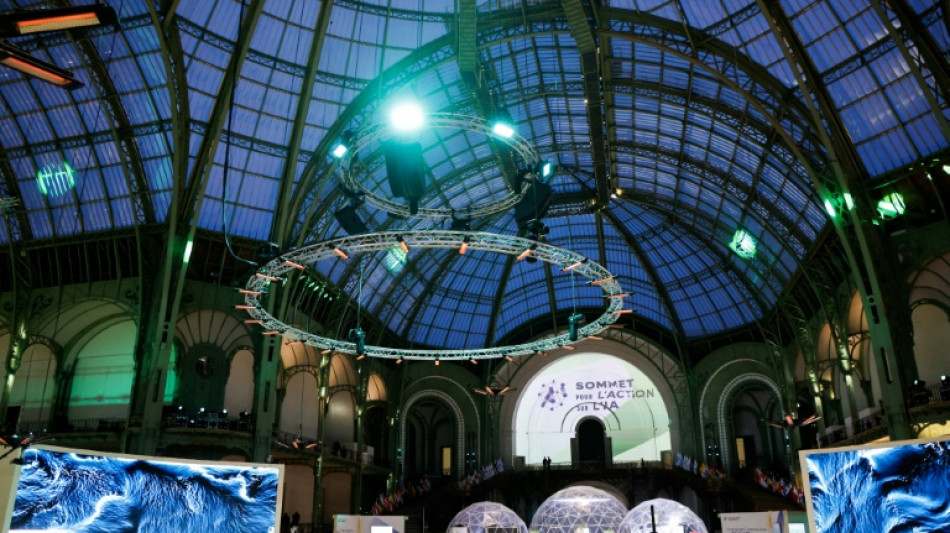
Paris summit grapples with real-world impact of AI / Photo: Ludovic MARIN - AFP
 Student Activism Shifts Underground After University Crackdown on Gaza Encampments

 Surge in Early Social Security Claims Linked to Agency Turmoil

 Panthers Seek NFC South Lead Against Ravens as Baltimore Ends Skid

 Tosca's 2026 Sustainability Report Makes the Case for Packaging as Critical Supply Chain Infrastructure

 5 Fun Date Night Ideas That Don't Cost a Fortune

 GIRLBAND! Headline Show at Rough Trade Marks National Breakthrough

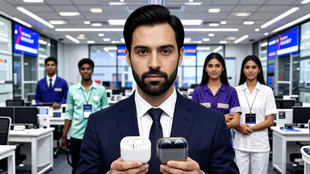 Samsung Galaxy Buds Active Leak Reveals ANC, Ear-Hook Design and One UI 9.5 Integration

 Egypt and Syria Sign Agreement to Restore Direct Flights After 14-Year Hiatus
 Van Gogh’s ‘Châtaigniers en Fleurs’ Sets $285m Record at Sotheby’s

Artificial intelligence (AI) risks reinforcing gender disparities rather than immediate widespread job destruction, the International Labour Organization chief said Monday as a summit of national leaders and tech bosses opened in Paris.
Co-hosted by French President Emmanuel Macron and Indian Prime Minister Narendra Modi, the Paris summit aims to lay the groundwork for governing the nascent sector, as global powers race to play leading roles in the fast-developing technology.
At present, AI is mostly replacing humans in clerical jobs disproportionately held by women, International Labour Organization (ILO) head Gilbert Houngbo told an audience in the French capital's opulent Grand Palais.
"The category of jobs that will be automated and hence be lost could contribute to deepen the gender gap" in pay between men and women, he added.
Looking at the wider picture, "we're not too much worried (about) a massive job loss" despite widespread fears Houngbo added.
While "there will be millions of jobs that will be lost", many more will be created thanks to AI, he predicted based on current "quite positive" trends.
Nevertheless, "there is a risk of those new jobs being paid less and sometimes with much less protection" for employees, as has happened with much "gig economy" work, Houngbo said.
Political leaders, including US Vice President JD Vance and Chinese Vice Premier Zhang Guoqing, are set to rub shoulders with the likes of OpenAI boss Sam Altman and Google chief Sundar Pichai.
A largely suit-wearing crowd of men and women speaking languages from all over the world gathered under the glass-and-steel dome of the great hall, built for the 1900 Universal Exhibition and now decked out with screens and geodesic domes.
- 'Immense hopes, exaggerated fear' -
Two years on from the emergence of OpenAI's ChatGPT chatbot, "artificial intelligence fuels both immense hopes and, at times, exaggerated fear," Macron's AI envoy Anne Bouverot told guests as she opened the summit.
She promised a "turning point" that would bring more countries on board with AI, as well as more "sustainable development" of the resource- and energy-hungry technology.
Macron had on Sunday trumpeted the economic benefits of artificial intelligence, saying 109 billion euros ($113 billion) would be invested in French AI in the coming years.
That was "the equivalent for France of what the US has announced with 'Stargate'," the $500-billion US programme led by ChatGPT maker OpenAI, he added.
The technical challenges and price of entry for nations hoping to keep abreast in the AI race have become clearer in recent weeks.
Around the same time Stargate was announced, Chinese startup DeepSeek stunned Silicon Valley heavyweights with its low-cost, high-performance AI models.
In the US-China face-off, "Europe has to find a way to take a position, take some initiative and take back control," said Sylvain Duranton of the Boston Consulting Group.
European Commission chief Ursula von der Leyen is expected to announce around 10 public supercomputers designed for use by researchers and startups while attending the summit.
Also Monday, a group of more than 60 European companies such as Airbus, Volkswagen and Mistral AI launched an "EU AI Champions Initiative".
They said they aimed to increase use of AI by industrial firms and stimulate the emergence of new companies.
- Global governance puzzle -
Away from the investment grandstanding, a group of countries, companies and philanthropic organisations said Sunday they would pump $400 million into a partnership called "Current AI" that would foster "public interest" approaches to the technology.
Current AI aims to raise as much as $2.5 billion for its mission to grant AI developers access to more data, offer open-source tools and infrastructure for programmers to build on, and "develop systems to measure AI's social and environmental impact".
On Tuesday, political leaders from around 100 countries will hold a plenary session, with notable attendees including Modi, Vance, Zhang and Von der Leyen.
France hopes governments will agree on voluntary commitments to make AI sustainable and environmentally friendly.
But any agreement may prove elusive between blocs as diverse as the European Union, United States, China and India, each with different priorities in tech development and regulation.
Th.Berger--AMWN

