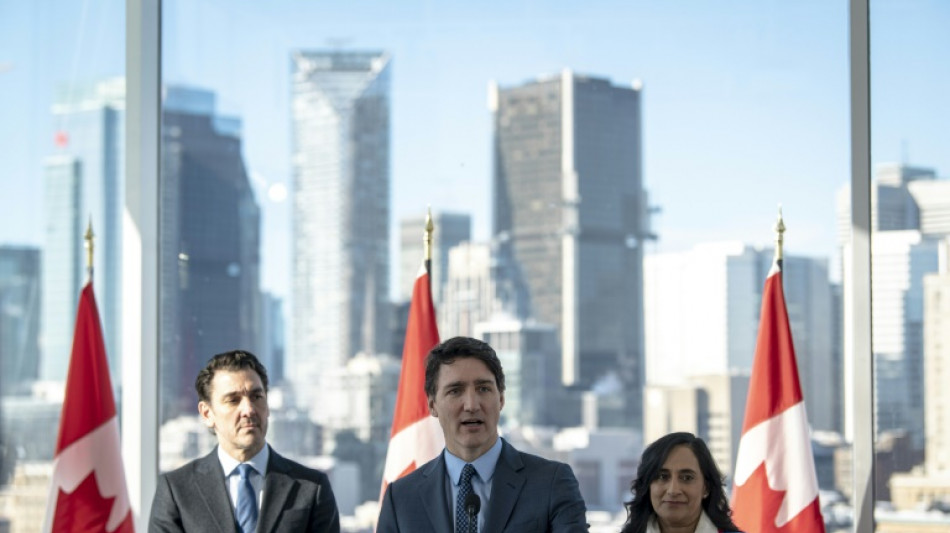
Canada announces first high-speed rail: Toronto to Quebec City / Photo: ANDREJ IVANOV - AFP
 Kiss of Life Teases First Winter Single 'Greedy'

 Eight-Year-Old Georgia Wins Penrith Valley Public Speaking Competition

 5 Fun Date Night Ideas That Don't Cost a Fortune

 GIRLBAND! Headline Show at Rough Trade Marks National Breakthrough

 Samsung Galaxy Buds Active Leak Reveals ANC, Ear-Hook Design and One UI 9.5 Integration

 Egypt and Syria Sign Agreement to Restore Direct Flights After 14-Year Hiatus

 Van Gogh’s ‘Châtaigniers en Fleurs’ Sets $285m Record at Sotheby’s

 Anthropic Sets Record $81.3 Billion IPO Valuing AI Firm at $1.5 Trillion

Prime Minister Justin Trudeau on Wednesday announced Canada's first high-speed rail line, connecting major hubs from Toronto to Quebec City, calling it "the largest infrastructure project in Canadian history."
The corridor is home to 18 million people or 44 percent of Canada's population.
The plan is for the 1,000-kilometer (620-mile) line to carry electric trains capable of reaching speeds of up to 300 km/hour, with stops including Toronto, the capital Ottawa, Montreal and Quebec City.
This will be "the largest infrastructure project in Canadian history," Trudeau told a news conference in Montreal.
"It's a project fit for Canada: big and bold," he said, slashing travel times between cities in eastern Canada by half with trips from Toronto to Montreal projected to average three hours.
Transport Minister Anita Anand called it "a nation-building exercise."
An initial Can$3.9 billion (US$2.75 billion), she said, has been earmarked by the government for design and development of the project, which was awarded in a bidding contest to a consortium led by Cadence.
This will include selecting the precise route and placement of stations, regulatory work and consultations.
No dates were provided for the project's completion, nor details on the total expected cost of construction.
The consortium includes CDPQ Infra, AtkinsRealis, Keolis, SYSTRA, SNCF Voyageurs, and Air Canada.
Canada has talked about building high-speed rail for decades, but this is the first time it has moved forward.
Government-owned Via Rail currently operates an aging fleet of passenger trains across Canada, sharing tracks with freight trains that have priority -- which often slows travel.
Trudeau said the high-speed rail line will address this overlap and the new electric trains will be better for the environment, providing "an alternative to taking a plane or a car."
Martin Imbleau, who has been named president of the project dubbed Alto, noted that in this densely populated corridor, "highways are more congested than ever (and) airports are stretched to their limits."
"Like many European countries, the benefits are clear: a significant reduction in travel times between key cities, a significant boost in economic productivity and a fundamental shift in future urban development."
Canada is expected to go to the polls in the coming months and a new administration could still derail the project.
P.Santos--AMWN

