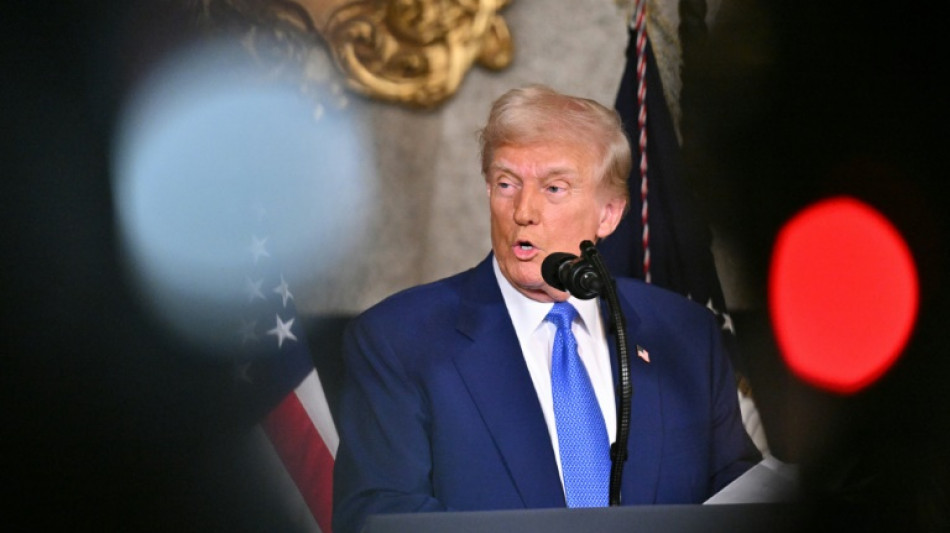
US Fed officials worried Trump policies could hinder inflation fight: minutes / Photo: ROBERTO SCHMIDT - AFP/File
 Kiss of Life Teases First Winter Single 'Greedy'

 Eight-Year-Old Georgia Wins Penrith Valley Public Speaking Competition

 5 Fun Date Night Ideas That Don't Cost a Fortune

 GIRLBAND! Headline Show at Rough Trade Marks National Breakthrough

 Samsung Galaxy Buds Active Leak Reveals ANC, Ear-Hook Design and One UI 9.5 Integration

 Egypt and Syria Sign Agreement to Restore Direct Flights After 14-Year Hiatus

 Van Gogh’s ‘Châtaigniers en Fleurs’ Sets $285m Record at Sotheby’s

 Anthropic Sets Record $81.3 Billion IPO Valuing AI Firm at $1.5 Trillion

US Federal Reserve policymakers expressed concern last month about the potentially inflationary effects of President Donald Trump's trade and immigration proposals, according to minutes of the meeting published Wednesday.
The US president has threatened to impose sweeping tariffs on some of America's largest trading partners, accusing them of unfair trade practices and of failing to do enough to tackle drug traffickers.
He has also pledged to carry out the largest mass deportation in US history which many economists predict could have an inflationary effect, along with tariffs.
The Fed's rate-setting Federal Open Market Committee (FOMC) voted last month to pause cuts after three consecutive rate reductions, and indicated it was in no hurry to continue lowering its key lending rate.
The Fed's decision to maintain its benchmark interest rate between 4.25 and 4.50 percent came just days after Trump took office and took place against the backdrop of a small uptick in consumer inflation.
"Participants expected that, under appropriate monetary policy, inflation would continue to move toward two percent, although progress could remain uneven," the Fed said in the minutes, referring to its long-term two percent target.
Policymakers raised concerns that "the effects of potential changes in trade and immigration policy" could complicate the disinflation process.
The minutes did not refer to Donald Trump by name.
Business contacts in several Fed districts "had indicated that firms would attempt to pass on to consumers higher input costs arising from potential tariffs," the Fed noted.
Given the rising uncertainty about trade since Trump's election and the small hike in inflation, US financial markets see a low chance of rate cuts in the coming months.
Futures traders currently assign a roughly 80 percent probability that the Fed will make no more than two quarter point cuts this year, according to CME Group.
"All told, the FOMC is in no rush to ease," Pantheon Macroeconomics chief US economist Samuel Tombs wrote in a note to clients.
G.Stevens--AMWN

