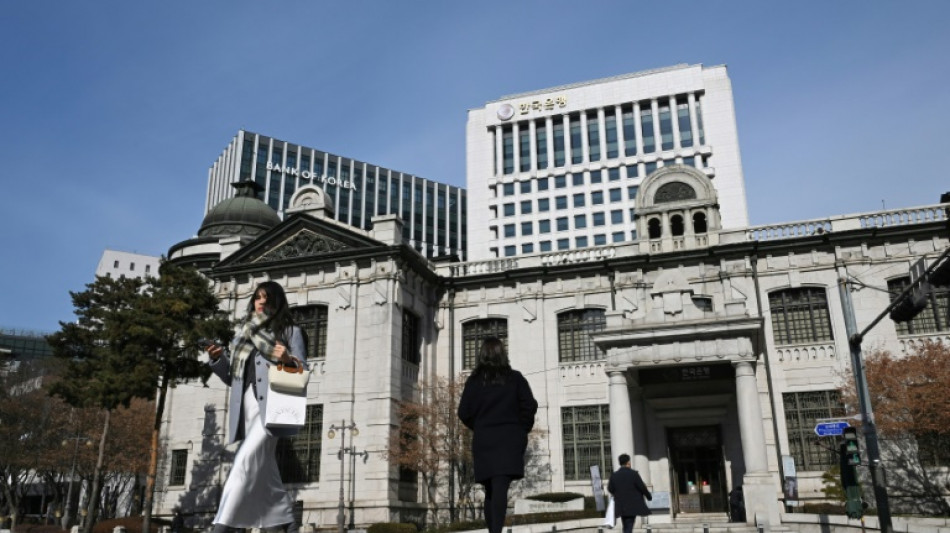
S. Korea's central bank cuts rate, growth outlook over tariff fears / Photo: Jung Yeon-je - AFP
 Surge in Early Social Security Claims Linked to Agency Turmoil

 Panthers Seek NFC South Lead Against Ravens as Baltimore Ends Skid

 GIRLBAND! Headline Show at Rough Trade Marks National Breakthrough

 Samsung Galaxy Buds Active Leak Reveals ANC, Ear-Hook Design and One UI 9.5 Integration

 Egypt and Syria Sign Agreement to Restore Direct Flights After 14-Year Hiatus

 Van Gogh’s ‘Châtaigniers en Fleurs’ Sets $285m Record at Sotheby’s

 Anthropic Sets Record $81.3 Billion IPO Valuing AI Firm at $1.5 Trillion

 eThekwini Faces R6.5bn Flood Claim from Toyota’s Insurer
South Korea's central bank on Tuesday slashed interest rates and its annual growth forecast as it looks to bolster the economy in the face of US tariffs and the fallout from President Yoon Suk Yeol's brief declaration of martial law last year.
The South Korean economy — Asia's fourth largest — grew less than expected in the final three months of 2024 as Yoon's martial law move hit consumer confidence and domestic demand.
Fears are also growing over US President Donald Trump's hardball trade policies that have seen him impose a broad range of levies on some of his country's biggest economic partners since taking office in January.
An official at the Bank of Korea told AFP it expected gross domestic product to expand 1.5 percent in 2025, down from its initial estimate of 1.9 percent in November.
The benchmark interest rate would also be lowered by a quarter of a percentage point, the official said.
In a statement released after the meeting, the central bank said it projected a "slower recovery in domestic demand and export growth than initially expected".
It blamed "the effects of weakening economic sentiment and the US tariff policy".
"There is a high level of uncertainty regarding the future growth path, including major countries' trade policies, (and) the direction of the US Federal Reserve's monetary policy," it added.
Trump warned last week that he would impose tariffs "in the neighbourhood of 25 percent" on auto imports and a similar amount or higher on semiconductors and pharmaceuticals.
South Korea is home to the world's key chipmakers, Samsung and SK hynix, and was the fourth-largest exporter of steel to the United States last year.
- 'Weak' data -
South Korea's trade ministry last week said it had asked Washington to exclude it from planned US tariffs on steel and aluminium.
The country's steel industry was already facing intense pressure in recent years as it grapples with oversupply — particularly from China — and a decrease in global demand.
The US tariffs are likely to intensify those challenges.
Analysts warn that should cheap Chinese steel barred from the US market begin to flood regions like Southeast Asia and Europe, South Korean steel producers will face deepening price competition.
Seoul's central bank on Tuesday also said employment had continued to slow.
"The data for early 2025 have been weak amid signs the political crisis is weighing on the economy," Gareth Leather, senior Asia economist at Capital Economics, said.
But he said even if the ongoing crisis is resolved soon, South Korea's growth is likely to struggle due to a "downturn in the property sector and tight fiscal policy weigh on demand".
A.Malone--AMWN

