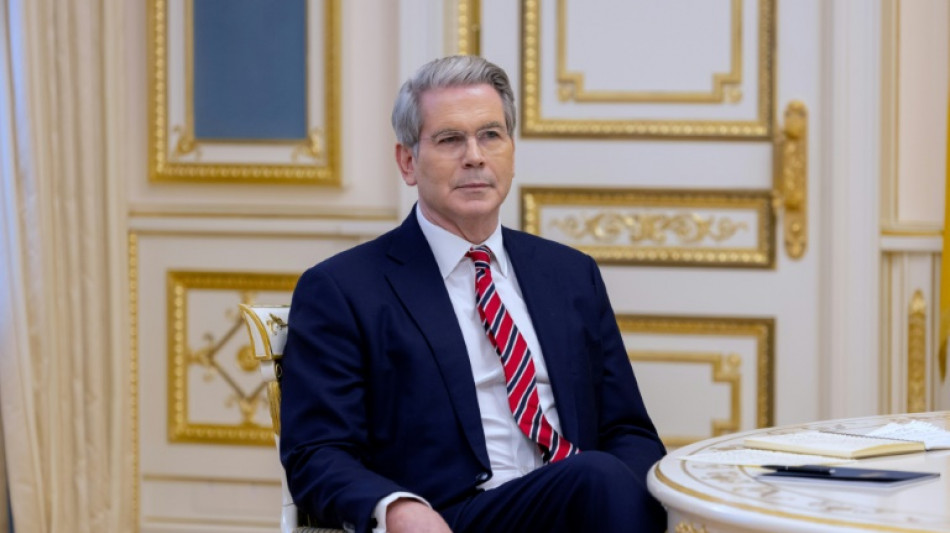
Bessent says tariffs key to Trump plan, can help fund investment / Photo: Tetiana DZHAFAROVA - AFP/File
 Surge in Early Social Security Claims Linked to Agency Turmoil

 Panthers Seek NFC South Lead Against Ravens as Baltimore Ends Skid

 GIRLBAND! Headline Show at Rough Trade Marks National Breakthrough

 Samsung Galaxy Buds Active Leak Reveals ANC, Ear-Hook Design and One UI 9.5 Integration

 Egypt and Syria Sign Agreement to Restore Direct Flights After 14-Year Hiatus

 Van Gogh’s ‘Châtaigniers en Fleurs’ Sets $285m Record at Sotheby’s

 Anthropic Sets Record $81.3 Billion IPO Valuing AI Firm at $1.5 Trillion

 eThekwini Faces R6.5bn Flood Claim from Toyota’s Insurer
US Treasury Secretary Scott Bessent said Tuesday that tariffs are a crucial part of President Donald Trump's economic strategy, asserting that they can be a source of government revenue to help fund investment.
Bessent's remarks came shortly after he met with Australian Treasurer Jim Chalmers, whose country is pushing for an exemption from Trump's steep levies on steel and aluminum imports.
Since taking office in January, Trump has unveiled tariff plans threatening to hit allies and adversaries alike, including 25 percent levies on steel and aluminum imports to take place next month.
In a wide-ranging speech at the Australian Embassy, Bessent said tariffs are an essential component of Trump's broader economic strategy.
They are able to boost US industrial capacity, help improve national security, and can be "an important source of government revenue, which can help fund investments," he added.
Tariffs can also be "used as a tool to correct and manage the internal imbalances in other economies" by adjusting how much American consumers take in of their excess supply, Bessent said.
On China, Bessent said the world's second largest economy needed more consumption.
While Beijing has been ramping up its industrial capacity, he said, this could cause problems for other industrial economies.
"We have to push back and tell them that they cannot export their deflation to the rest of the world," he said.
"China really needs more consumption" and fewer exports, he added.
Domestically, Bessent said the Trump administration's goal is to "reprivatize the economy," noting that much of the job growth in the past four years has been concentrated in the public and government-adjacent sector.
He reiterated a need to end "government waste" and defended the Department of Government Efficiency (DOGE), saying this was not a "department of government elimination."
Bessent said government cuts would be accompanied by deregulation, adding that smaller financial institutions have been increasingly bogged down by reporting requirements.
The Treasury Department will "streamline best practice regulations," working towards a level playing field, Bessent said.
T.Ward--AMWN

