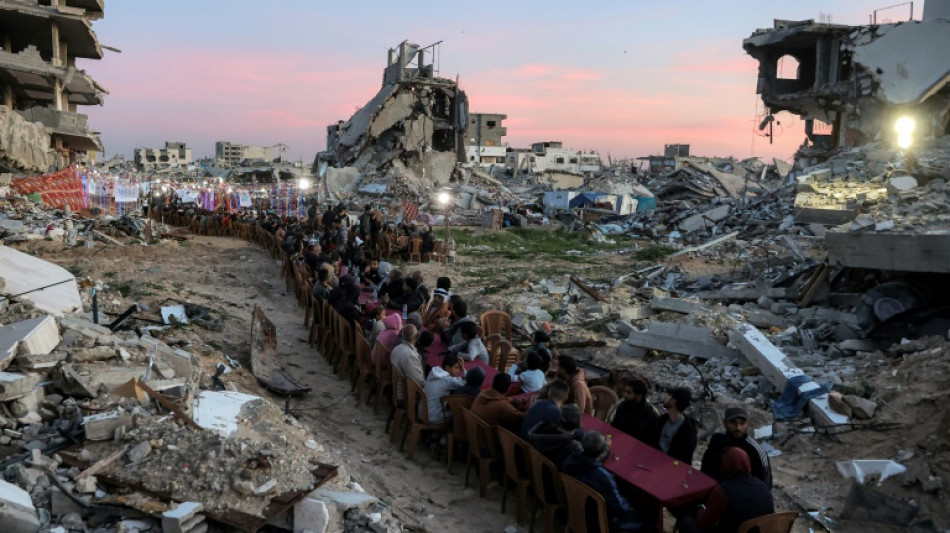
UN urges Israel to restore Gaza aid as Hamas sees 'coup' against truce / Photo: Omar AL-QATTAA - AFP
 Surge in Early Social Security Claims Linked to Agency Turmoil

 Panthers Seek NFC South Lead Against Ravens as Baltimore Ends Skid

 GIRLBAND! Headline Show at Rough Trade Marks National Breakthrough

 Samsung Galaxy Buds Active Leak Reveals ANC, Ear-Hook Design and One UI 9.5 Integration

 Egypt and Syria Sign Agreement to Restore Direct Flights After 14-Year Hiatus

 Van Gogh’s ‘Châtaigniers en Fleurs’ Sets $285m Record at Sotheby’s

 Anthropic Sets Record $81.3 Billion IPO Valuing AI Firm at $1.5 Trillion

 eThekwini Faces R6.5bn Flood Claim from Toyota’s Insurer
The United Nations on Sunday called on Israel to immediately allow aid into Gaza, hours after it suspended humanitarian deliveries into the war-battered territory as talks on a truce extension appeared to hit an impasse.
With uncertainty looming over the truce, both Israel and Palestinian sources reported Israeli military strikes in the Gaza Strip which the health ministry in the Hamas-run territory said killed at least four people.
The 42-day first phase of the ceasefire drew to a close, and early on Sunday Israel announced a truce extension until mid-April that it said US Middle East envoy Steve Witkoff had proposed.
Hamas has repeatedly rejected an extension, instead favouring a transition to the truce deal's second phase that could bring a permanent end to the war.
The Palestinian group, whose October 7, 2023 attack on Israel triggered the fighting, said the "decision to suspend humanitarian aid is cheap blackmail, a war crime and a blatant coup against the (ceasefire) agreement".
In a statement posted online, UN chief Antonio Guterres called for "humanitarian aid to flow back into Gaza immediately", urging "all parties to make every effort to prevent a return to hostilities" and militants to release "all hostages".
The head of the United Nations humanitarian agency OCHA, Thomas Fletcher, said in a post on X that "Israel's decision to halt aid into Gaza is alarming" and may be in violation of international law.
Following the announcement of the aid suspension, AFP images showed trucks loaded with goods lined up on the Egyptian side of the Rafah crossing.
"Since the morning we haven't seen any trucks entering," said Umm Mohammad Abu Laia, a resident of Rafah on Gaza's southern border.
She warned of a "crisis" as the prices of basic commodities surged "as soon as the merchants heard about the closing of the crossing".
The first phase of the truce, which took effect on January 19, saw an increase of aid into Gaza, where the war destroyed or damaged most buildings, displaced almost the entire population and triggered widespread hunger, according to the UN.
Israeli Foreign Minister Gideon Saar, asked by reporters about the risk of starvation, dismissed such warnings as "a lie".
- A 'forever' truce -
Israeli Prime Minister Benjamin Netanyahu's office said he had "decided that, from this morning, all entry of goods and supplies into the Gaza Strip will be suspended".
It said there would be "consequences" for Hamas if it did not accept the temporary truce extension, which would cover the Muslim holy month of Ramadan and the Jewish holiday of Passover.
On a sandy street in Gaza City, Mays Abu Amer, 21, expressed hope the ceasefire can continue "forever".
"We have so much destruction, we need a lot of time for reconstruction," she said.
Mediator Egypt and the International Committee of the Red Cross have appealed for the truce to be maintained.
Militant group Islamic Jihad, a Hamas ally, accused Israel of "sabotaging" the ceasefire.
According to Israel, the truce extension would see half of the hostages still in Gaza freed on the day the deal came into effect, with the rest to be released at the end if an agreement was reached on a permanent ceasefire.
Of the 251 captives taken during Hamas's October 2023 attack, 58 remain in Gaza including 34 the Israeli military has confirmed are dead.
- 'Return all of them' -
In Israel, mourners who turned out to farewell Shlomo Mansour, 85, whose body militants had held in Gaza and returned to Israel on Thursday, said more should be done to get the remaining captives home.
"Return all of them immediately," said Vardit Roiter.
Under the first phase of the truce, Gaza militants handed over 25 living hostages and eight bodies, including Mansour's, in exchange for the release of about 1,800 Palestinian prisoners.
Neria, a 27-year-old teacher who only gave his first name, told AFP it was a "smart move" that could "push forward new things, the release of more hostages and the end of the war".
In southern Gaza on Sunday, the civil defence agency reported shelling and gunfire "from Israeli tanks", which the army said it was "unaware of".
The Palestine Red Crescent said Israeli drone strikes killed one person in the same area and another in a nearby town.
The military said it had conducted an air strike in northern Gaza targeting suspects it said had "planted an explosive device" near its troops.
Including the deaths on Sunday, Gaza's health ministry has recorded 116 people killed by Israel's military since the ceasefire took effect on January 19, substantially reducing violence.
The 2023 attack that sparked the war resulted in the deaths of more than 1,200 people in Israel, mostly civilians, while Israel's retaliation in Gaza has killed more than 48,300 people, also mostly civilians, data from both sides show.
G.Stevens--AMWN

