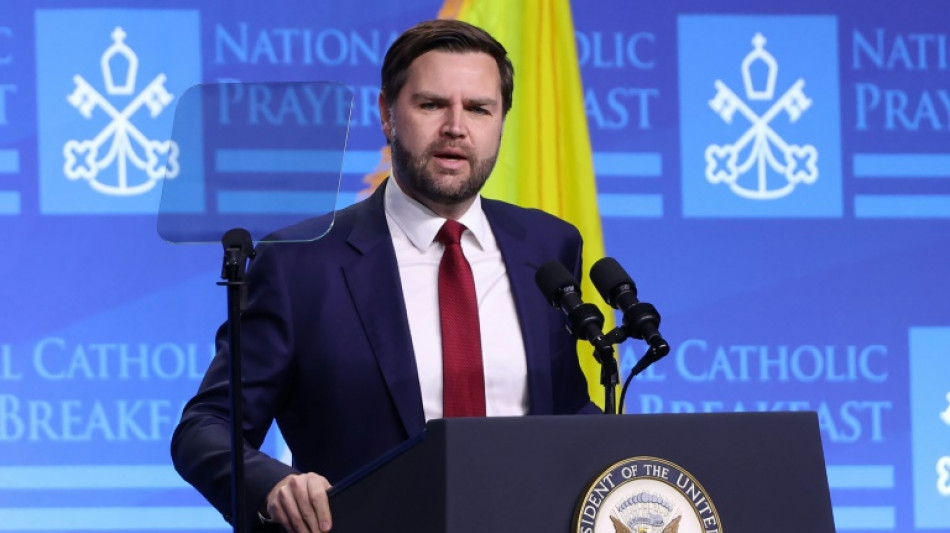
Vance denies having criticized French, British armies / Photo: Ting Shen - AFP
 Surge in Early Social Security Claims Linked to Agency Turmoil

 Panthers Seek NFC South Lead Against Ravens as Baltimore Ends Skid

 GIRLBAND! Headline Show at Rough Trade Marks National Breakthrough

 Samsung Galaxy Buds Active Leak Reveals ANC, Ear-Hook Design and One UI 9.5 Integration

 Egypt and Syria Sign Agreement to Restore Direct Flights After 14-Year Hiatus

 Van Gogh’s ‘Châtaigniers en Fleurs’ Sets $285m Record at Sotheby’s

 Anthropic Sets Record $81.3 Billion IPO Valuing AI Firm at $1.5 Trillion

 eThekwini Faces R6.5bn Flood Claim from Toyota’s Insurer
US Vice President JD Vance insisted Tuesday he was not targeting France and Britain with remarks he made dismissing the military abilities of countries supporting a possible European peacekeeping force in Ukraine.
Britain and France have said they would be willing to deploy ground troops in support of any peace deal -- a proposal Vance responded to Monday in a Fox News interview by mocking the prospect of sending "20,000 troops from some random country that has not fought a war in 30 or 40 years."
After his remarks drew an angry response from politicians in London and Paris, Vance posted on X that he had never mentioned France or Britain in his remarks, and added that both countries had "fought bravely alongside the US over the last 20 years, and beyond."
However, he went on to question the underlying idea of an Anglo-French "coalition of the willing" to police any ceasefire in Ukraine.
"There are many countries who are volunteering (privately or publicly) support who have neither the battlefield experience nor the military equipment to do anything meaningful," he said.
Vance has positioned himself as President Donald Trump's foreign policy attack dog in recent days, particularly when it comes to Europe.
He stunned European leaders at the Munich Security Conference last month when he made a speech seen as a combative broadside against the continent and Germany in particular, accusing them of limiting free speech and excluding parties voicing strong concerns on immigration.
And last Friday the vice president was the first to raise his voice against Ukraine's President Volodymyr Zelensky during a meeting with Trump in the Oval Office that left allies reeling.
The visit was supposed to see the United States and Ukraine sign an agreement on investment in Ukrainian minerals that would have been a first step on the path to a ceasefire deal with Russia, which invaded Ukraine in 2022.
Instead Trump kicked Zelensky out of the White House without any deal and late Monday cut off US military aid to Ukraine.
Trump, who has been accused of sidelining both Kyiv and European allies as he moves to negotiate directly with Russia's President Vladimir Putin, has so far refused to involve the United States in the peacekeeping operation suggested by France and the United Kingdom.
X.Karnes--AMWN

