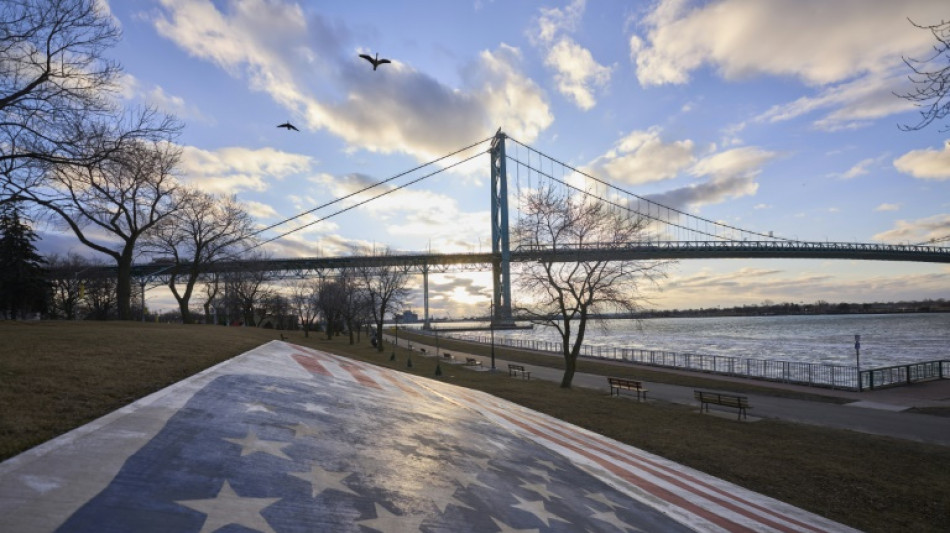
Trade war brings fear, uncertainty to Canadian border city / Photo: Geoff Robins - AFP
 Surge in Early Social Security Claims Linked to Agency Turmoil

 Panthers Seek NFC South Lead Against Ravens as Baltimore Ends Skid

 GIRLBAND! Headline Show at Rough Trade Marks National Breakthrough

 Samsung Galaxy Buds Active Leak Reveals ANC, Ear-Hook Design and One UI 9.5 Integration

 Egypt and Syria Sign Agreement to Restore Direct Flights After 14-Year Hiatus

 Van Gogh’s ‘Châtaigniers en Fleurs’ Sets $285m Record at Sotheby’s

 Anthropic Sets Record $81.3 Billion IPO Valuing AI Firm at $1.5 Trillion

 eThekwini Faces R6.5bn Flood Claim from Toyota’s Insurer
In the Canadian city of Windsor, which survives on the cross-border auto industry, the start of a trade war with the United States has opened a period of fear and uncertainty.
Windsor is separated from Detroit, Michigan by a river, and American automakers based in the US city have been an essential employer on the Canadian side for decades.
"The value of what we have around us is based on the automotive industry. So if it were to collapse, that will collapse with it," Robert Pikata, a 60-year-old who works for Windsor's municipal government, told AFP.
Like many Windsor residents, Pikata has been following the news closely in recent weeks.
Many had hoped that President Donald Trump would ultimately back away from tariffs that Ford's CEO Jim Farley warned would "blow a hole" in the auto industry.
But Trump made good on his threat on Tuesday, imposing a 25 percent tariff on Canadian goods.
Canada immediately retaliated, triggering a trade war between historically close allies and threatening future commerce across a border that sees billions of dollars in daily trade.
Addressing Canadians on Tuesday, Prime Minister Justin Trudeau warned of "tough" days ahead.
Pikata said economic conflict with the United States will see living standards in Windsor fall.
He told AFP he was "disappointed and scared at the same time because of the unknown."
"How is it going to affect me personally and how is it going to affect my family?"
Jessica Dame, a 33-year-old healthcare worker, said businesses across Windsor rely on the US.
"You're literally breaking relationships," she said, addressing Trump. "I think we're gonna see a huge decline in local economies."
- 'Shocked, not surprised' -
Trump's justifications for launching a trade war with Canada have shifted.
His administration has said the levies are designed to force Canada to act on the flow of undocumented migrants and the drug fentanyl across the border.
Trudeau has maintained that Canada is not a significant contributor to either problem in the United States, and on Tuesday called Trump's fentanyl justification "completely false."
Trump has also mused about tariffs as a corrective to the US trade deficit with Canada and falsely claimed that Canada prevents American banks from operating in the country.
The president said this week that auto companies that want to avoid the consequences of tariffs should open plants in the United States.
"Every time I hear (Trump) say something, I always find it's like 50-50 about whether it's actually true or not," university student Zach Puget told AFP in Windsor.
Voicing concern that the trade war would force grocery prices higher, Puget said he was "shocked, but not surprised" that the measures had come into force.
In his address to Canadians, Trudeau offered a stark warning about Trump's motivation.
He said the US president, who has spoken often of making Canada the 51st American state, "wants to see a collapse of the Canadian economy because that would make it easier to annex us."
"That is never going to happen," Trudeau asserted. "We will never be the 51st state."
P.Mathewson--AMWN

